Tampilkan postingan dengan label social commentary. Tampilkan semua postingan

Jumat, 18 Juli 2014

Making Faces When Pedaling Places

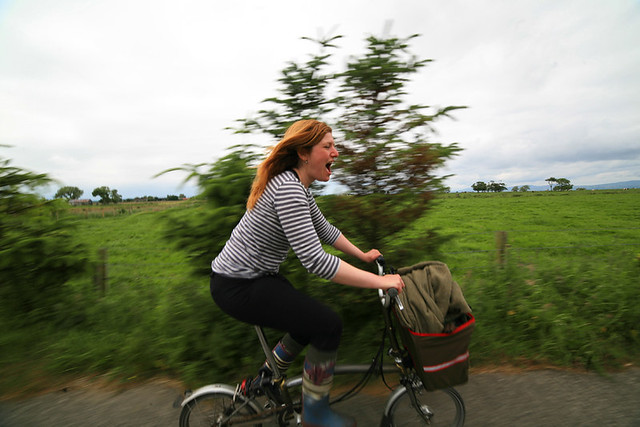
Brompton Blur
Last week some bicycle bloggers and forumites were passing around a link to a funny post on Vox.com. Entitled The 19th-century health scare that told women to worry about "bicycle face," it brings to light an article circa 1897 written by a medical doctor that warns ladies who pedal against producing a "wearied and exhausted" facial expression. So unattractive! 

Of course the title and content of the article immediately made me think of the popular online comic Bikeyface, whose author sees the matter differently. To her, a "bikeyface" is an expression of unbridled joy, rather than a pained grimace.

But despite their polarised definitions, both parties do agree on the underlying notion: that there is such a thing as a facial expression specific to bicycling. As someone whose former career included research in nonverbal behaviour, I find the idea irresistible. Could there really be a set of facial expressions specific to bicycling? 

It's a cool idea, though anecdotal evidence gleaned from my own experience gives me pause. 

Thinking back to the days before I began to ride a bike myself, my impressions of transportation cyclists fluctuated depending on what country I was in. I remember observing cyclists in English cities and finding their demeanor alarmingly aggressive. And I remember thinking that people on bikes on the East Coast of the US looked huffy-puffy and stern - as if what they were doing was both very difficult and very important. On the other hand, watching cyclists in Austria, Holland, Belgium and France, I  do not recall finding their facial expressions remarkable in any way. Some people looked happy, some looked sad, some annoyed, bored or lost in their thoughts - but none of these states seemed to have anything to do with them being on a bicycle. Cycling in its own right was matter of fact, causing neither bliss nor wearied exertion. 

Interestingly, I first noticed the "bikeyface" - in the joy/bliss sense of the word - in myself, catching my grinning reflection in a storefront as I cycled shakily past. And with the rise of the city/transport/ cute bike movement, I did begin to spot other cyclists in the Boston area with this stamp of bliss on their physiognomies. Increasingly, that, as well as the continental European indifference, are if not replacing then at least generously supplementing the super-serious look that first dominated in those parts. 

What this extremely unscientific sampler of impressions tells me, is that the faces we make while pedaling may depend less on cycling in itself than on our attitudes toward it - which can vary tremendously. Today, cycling can be perceived as a risky athletic activity, a fashion statement, a political act, a way to relax and have fun, an independent means of travel, or as any combination thereof. Unsurprisingly, the facial expressions these attitudes yield will differ. And in cultures where transportation cycling is so normalised and easy as to be unremarkable, we are as unlikely to see the bicycle face against which Victorian doctors admonished as we are to see the bikeyface which pedaling enthusiasts promise.

By now, cycling really should be normalised for me. After all, I do it in some form or other nearly every single day. But even when riding my bike in entirely mundane circumstances, on occasion I still catch myself grinning. What can I say? I love it.

Stranger though is the habit I apparently have of smiling even when I am not having fun on the bike. Several friends have now pointed this out to me, but it seems that when I am having a particularly difficult time on a roadbike I tend to smile in leu of displaying the "pain face." This gives the impression that I am far hardier than I actually am and that I am enjoying myself, creating genuine puzzlement among my companions when I later tell them I was struggling or suffering. "But you seemed so happy! - see?" And sure enough, a snapshot will be produced showing my red face distorted by a mad grin. As I never remember doing this, all I can say for myself is that smiling must be a coping mechanism - à la the facial feedback theory: Research has shown that if our muscles contort in a way consistent with a specific emotion, we can genuinely feel some dose of that emotion regardless of whether it is situationally appropriate. So the smile must be my way of saying "I will not surrender to the pain face! If I smile, then I won't be miserable…" 

Thankfully most of my time on a bike gives me no cause to employ this technique and my grins on two wheels are, for the most part, quite genuine. Is there such a thing as a bikeyface? Perhaps not once we control for other factors. Nonetheless in me it is alive and well. When I catch myself doing it, it feels silly and embarrassing - though I am hardly complaining that cycling makes me happy!

Senin, 12 Agustus 2013

What About the Movies?

At the Cinema
"Okay. But what about the movies?"

"What about them?.." 

It is one of those circuitous conversations about whether bikes stand a chance in mainstream culture. The kind of conversation that inevitably raises the point that American cities are not Amsterdam. Or Copenhagen. Before moving on to differences in fuel prices, weather conditions, standards in hygiene and typical commuting distances. Quick to tire of this topic, I sip my wine - inserting the occasional comment on autopilot. But now this movie thing is a new twist and I perk up.

"Can you imagine bikes instead of cars in movies? I mean, that would be ridiculous!"

We run through the gamut of pop culture classics that would not be the same carless. James Bond. Ferris Bueller's Day Off. Back to the Future. Pulp Fiction. The list goes on. Re-imagining some of these with bikes replacing cars proves a great source of entertainment. National Lampoon's Vacation with the dead grandma strapped onto a longtail cargo bike. Law and Order SVU, with Olivia and Stabler as bike cops (okay so that's a TV show, but still).

But it's not just about specific movies. It's entire scenarios, concepts. The summer road trip. The iconic car chase. The drive-in and the drive-through. The dead body in the trunk. Romantic joyrides in convertibles. Disastrous family vacations. High school students cruising aimlessly as they come of age in towns where no one understands them. Tragic couples, well-dressed and adulterous, exchanging looks of yearning in the dim light of the dashboard. Secret agents and mobsters getting in and out of each other's sedans in abandoned lots under rusty bridges. The entire kitsch horror genre that relies on teenagers smooching in the back seat, oblivious to the crouching axe murderers ready to prey upon them. And of course there is that scene, where the sleek black Porsche (or maybe it's a BMW) pulls up and, as the driver comes around to get the door, the camera zooms in on a pair of women's legs stepping out - just the legs, in stiletto heels and perhaps black fishnet stockings - a moment in which we, the viewers, know that the creature who emerges will be beautiful and mysterious and utterly unattainable - destined to become the main character's love interest.

Do you mean to take this - all this - away from us and replace it with bikes? that sporty, politically-correct contraption devoid of sex, drama and suspense? That is the panicked subtext of all this movie talk.It is almost as if we're discussing the possibility of some big, bad Bike Lobby censor editing out cars from all our favourite films and TV shows. 

I never know what to say to those who view bike culture as threatening to car culture, and this is no exception. Look, I don't want my Ferris Bueller and Pulp Fiction ruined with bikes either. Jokes aside, it's absurd to imagine bikes in existing films where the cultural context for them is all wrong. Just like it's absurd to imagine films with period-inappropriate clothing, dwellings or slang. But if bikes become more normalised in society over time, things will change - not forcefully, but organically. Bike-centered cultural scripts will emerge and take root, upon which scenarios of future films could be based - complete with naturally-occuring sex, drama and suspense. It does not seem like such a difficult concept to me.  

And the thing is, Vincent's suit in Pulp Fiction aside, it's not all black and white. Don't you remember, when they were talking in the car, how he'd just gotten back from Amsterdam? If you think about it, he probably rode a bike there. In that suit and everything. Briefcase full of drug money dangling off the handlebars of a borrowed opafiets, a miniskirted lady-friend perched on the rear rack... Okay, so it's not in the movie. It was 1994 after all; they didn't want to shock the American public with bikes. But it's implied, okay? Subtly implied. It sets the groundwork.

And with that image, everyone seems appeased. Maybe the movies are safe after all. 

Selasa, 12 Maret 2013

On Passive Transportation

Sometimes I think about the phrase "Active Transportation," as used by cycling and walking advocates. I think about it especially when I find myself on a long distance bus, train or airplane trip, or as a passenger in a car: sitting still, sometimes for hours, as I am propelled through space with no input from my own body or mind. It is at times like these that the notion of active transportation is at its most appealing, because I am experiencing its opposite so keenly. This unnatural stillness as trees and houses flicker in the corner of my eye, this uncomfortable awareness of being carted, transported, delivered is what Passive Transportation feels like to me.

There is a great deal of focus today on encouraging physical activity. Walk more, be more physically active, be healthier. Getting around on foot and by bike are seen as crucial to a more physically active lifestyle. And public transit is included in what active transportation encompasses, because it is typically used in conjunction with walking or cycling. Walk a few blocks to catch the bus or subway, then walk some more to the office. And because there's no car parked at work, walk to and from lunch as well. An increase in physical activity, however small, is the goal.

Comparatively under-addressed are the psychological aspects of active and passive transportation. And here things get a little tricky, because in a lot of people's minds the car wins. When drivers explain why they want to drive and why they enjoy driving, much of it has to do with feelings of independence and control. The association starts early, as suburban American teenagers see their driver's license and their first car as tickets to freedom. The connection only strengthens in adulthood. Driving allows us to actively control our routes, our destinations, our schedule, our speed. Psychologically, this is active transportation.

Except for those instances when it's not - instances that in some parts of the world are becoming ever more frequent, possibly even the norm, and starting to redefine the driving experience. Those who find driving appealing tend to picture the ideal: driving a car along efficient highways or through scenic country roads, arriving at their destination to park directly in front of the entrance. But as many of us know, and quality of life studies are starting to note, this is far from reality today. Traffic controls car travel. In areas where it is heavy, it can slow cars to a crawl, overriding the driver's control over their speed, route selection, and schedule. The difficulties of finding parking, and obligations having to do with city ordinances, create additional restrictions. In an idealised version of the driving experience the driver may be an active agent, but in the real world they are increasingly not only passive but trapped.

Freedom of mobility is important to human beings. There is dignity in being independent, in being in control of one's movements and one's time. We place value in this, and with dignity and independence comes prestige. Modes of transportation perceived as more dignified will carry more prestige than modes that are not, and how the concept of active transportation is framed will play a role in this. Passive transportation users will be receptive to alternatives seen to offer more freedom and control, not just more physical activity.