Tampilkan postingan dengan label clothing. Tampilkan semua postingan

Selasa, 19 Agustus 2014

Dry Cleaning Your Wool… with Fresh Air

Airing Out Wool
One of the much-touted attractions of wool clothing - and the basis on which it is recommended to cyclists - is its supposed odor resistant properties. In fact, it is not uncommon for proponents of the stuff to brag about how infrequently they wash their clothing (once a month! once a year! never!!!) As a wool enthusiast myself I am often asked about my take on this claim. Can wool clothing really be worn endlessly without washing? or - as one friend recently put it - "are woolsters just grungy?..." 

Well, speaking from personal experience I would put it this way: Wool retains odors to a lesser extent than cotton, and to a much lesser extent than synthetics. This is not to say that it does not pick up odors at all; only that it picks them up at a slower rate, and perhaps emanates them more subtly. Still, eventually there will come a time when you will have to clean your wool garment. But cleaning need not mean washing. And one thing I've discovered over the years, is that "dry cleaning" wool with fresh air can be amazingly effective. 

The practice of airing out clothing is of course nothing new. Compulsive laundering after brief periods of wear is a relatively recent trend, and it was once common practice to hang clothes in the window or even on the backs of chairs overnight to keep them fresher, longer. 

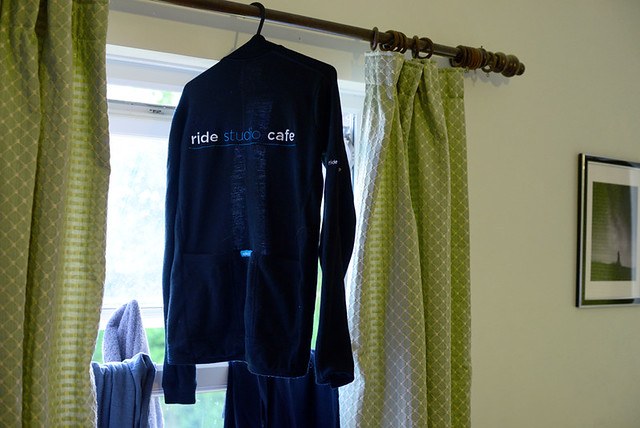
But with wool, this method is disproportionally effective. Just as wool is reluctant to retain odors, it's also eager to shed them if given a chance. The back yard clothesline does the trick best, especially on a breezy day. After I hang my wool clothes on the clothesline for half a day, they don't just smell fresh-er; they smell no less clean than had I actually washed them, then hung them out in the garden. They smell like the sun and the wind, that "fresh laundry" scent that detergent manufacturers try so desperately to bottle, but that can't quite compete with the real thing. And if you don't have a yard with a clothesline? Opening the window and hanging the garment off the curtain rod (or a hook) can work too. 

But why bother with this at all, you might ask, when you can just toss the clothes in the washing machine? Well, environmental and financial issues aside, there is incentive to wash wool as infrequently as possible. Wool tends to be more delicate than synthetics and cottons, as well as more prone to losing its shape. And while this is not necessarily true for all wool clothing (anything made of the "indie" fabric from Ibex I've found to be especially resilient), it has been true for enough of it, so that I avoid washing unless I have to.

While it may seem suspiciously simple, I have found that airing out wool works wonders to remove not only body odors, but also ambient smells picked from the environment, including strong food and cigarette smoke odors. Of course, airing out won't get rid of stains. So with a stain, I'll treat then handwash just the area around it - then air-dry. 

The only time I really wash my wool clothing fully and properly, is after I wear it doing something active on a hot day. When fabric becomes salt-encrusted from sweat, there is really no way to deal with it but wash the entire thing. Otherwise, the airing out method keeps my wool's contact with the washing machine at a minimum. Am I grungy or is wool just that cool? Try it out and decide for yourself!

Rabu, 04 Juni 2014

Long-Term Review: Vulpine Women's Rain Trousers and Jacket

Vulpine Women's Rainwear
When we think of rain gear for cycling, we tend to imagine technical, slippery garments designed for the very specific purpose of keeping dry in wet conditions. These garments do the job. And we can't wait to peel them off once the rain ends. But what of those of us who live and ride in climes where rain never really "ends" as such? where precipitation is the norm, and not a special occasion? Are we to resign ourselves to permanent clamminess under plasticky shells? Are we to shiver under the oppressive weight of soggy tweeds? 

"Heavens forbid," says British apparel manufacturer Vulpine. "We've made some Epic Cotton (™!) rainwear for this very predicament. And it even looks stylish off the bike." 

"Oh Vulpine. You with your quirky social media presence and your heady claims. I'll believe it when I try it for myself." 

And that is how a parcel landed on my doorstep last Autumn containing items from the new Vulpine women's range (read about the men's in this earlier post as well as here): a pair of women's Cotton Rain Trousers and an Original Rain Jacket. Admittedly I took my sweet time testing these garments. Autumn turned to Winter and Winter to Spring, and before I knew it summer was around the corner. Of course, this being Northern Ireland, it has rained continually. 

Vulpine Women's Rainwear
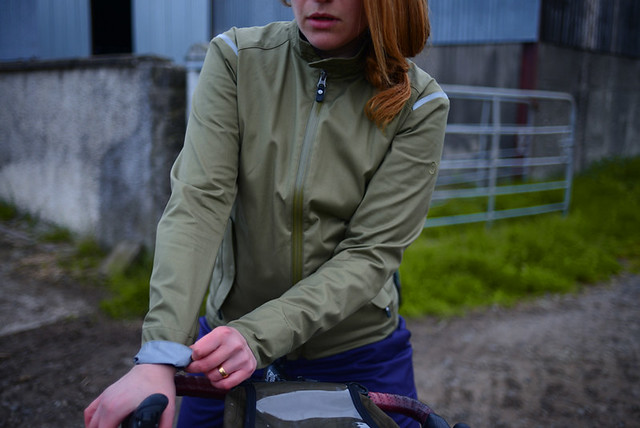
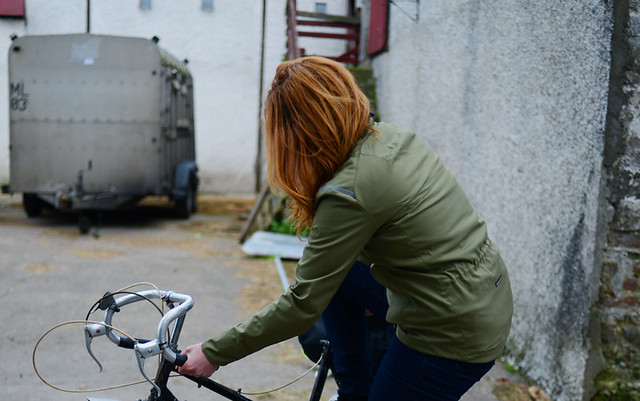
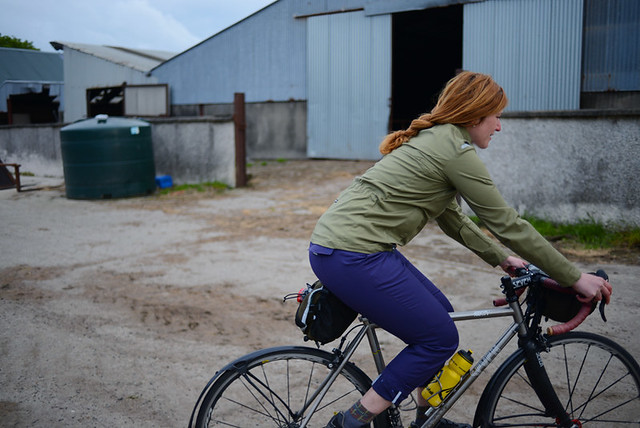
After months of wear, I remain unsure of how to describe the Vulpine Rain Jacket. It is flattering and comfortable, it's kept me dry in the rain, and has all sorts of cycling-specific features that I'll list in a bit. But beyond that there is just something about it - can jackets have auras? - that makes for an overall effect beyond the sum of its parts. On the bike or off, I don't mind saying this jacket feels fricking lovely.

Vulpine Women's Rainwear
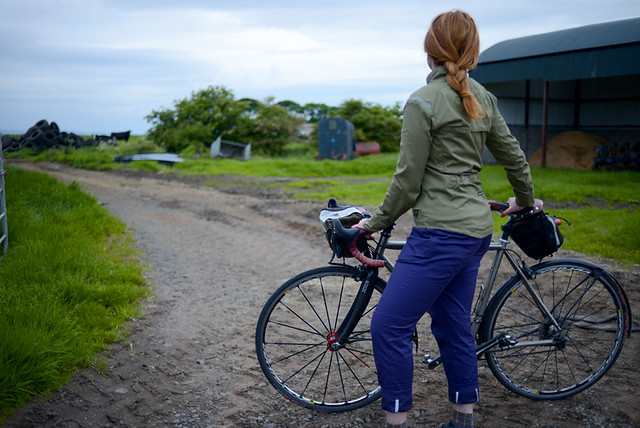
The cotton fabric has a soft texture to it that is pleasant to the touch. The "Epic" treatment (read about it here) really does make it water-repellant and resistant (as defined by keeping me dry for up to 4 hours in a downpour; haven't tried longer). Available in the military green shown here (which is more like a soft sage) or indigo, this jacket is designed for both dry and wet weather, and rated for temperatures 8-18°C. The fit feels true to size, I am a UK size 10 (US size 4) and the Small fits me well.

Vulpine Women's Rainwear
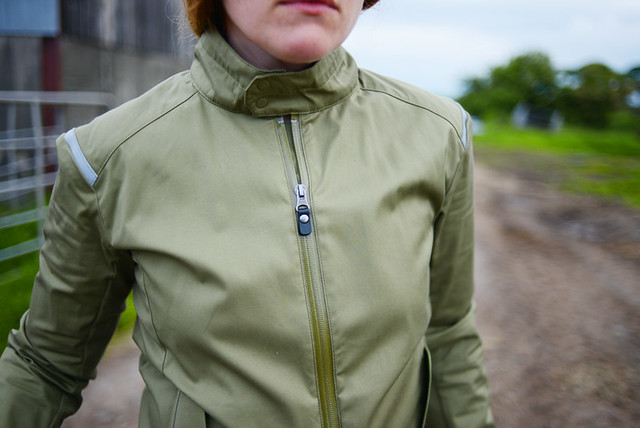
The tailoring I would describe as military meets biker, relying on a combination of darting and drawcords to give the jacket structure.

Vulpine Women's Rainwear
At the same time there is a drapeyness that softens the look, the flowy quality of the fabric an interesting contrast to the square shoulders and crisp standup collar.

Vulpine Women's Rainwear
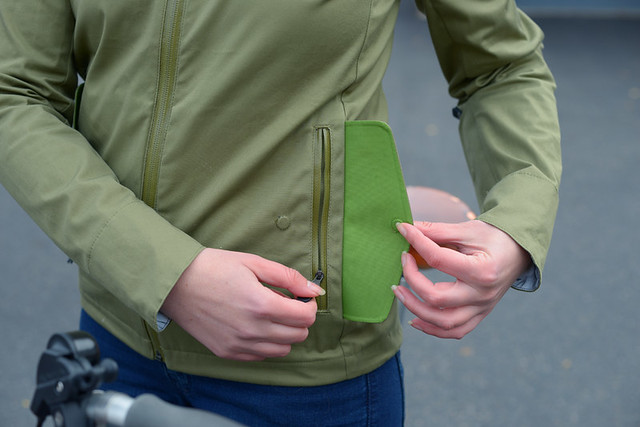
Large zipper pockets with magnet-closure flaps have somehow been achieved without adding bulk to the waistline. A slew of additional interior and sleeve-side pockets offer more storage opportunities, again without compromising the flattering silhouette.

Vulpine Women's Rainwear
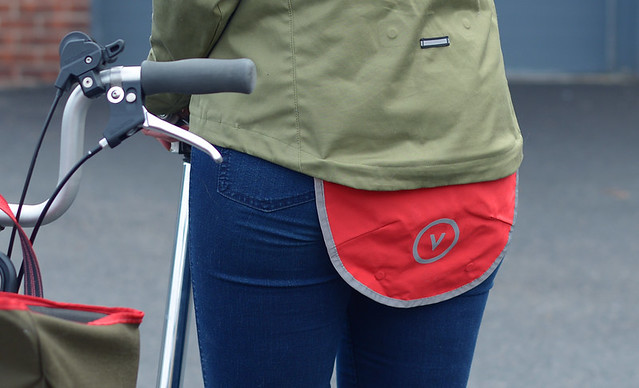
A removable hi-viz "splash guard" flap with reflective detailing can be released or stowed away (I never use it, but for those who like this sort of thing - it is indeed highly visible: "Like a baboon's bottom!" according to the delighted remark of a cycling companion).

Vulpine Women's Rainwear
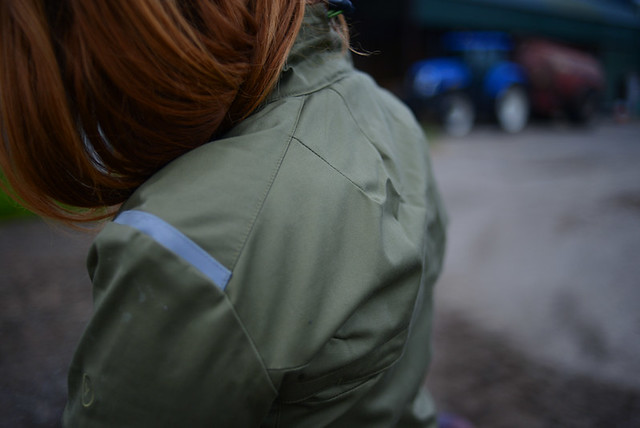
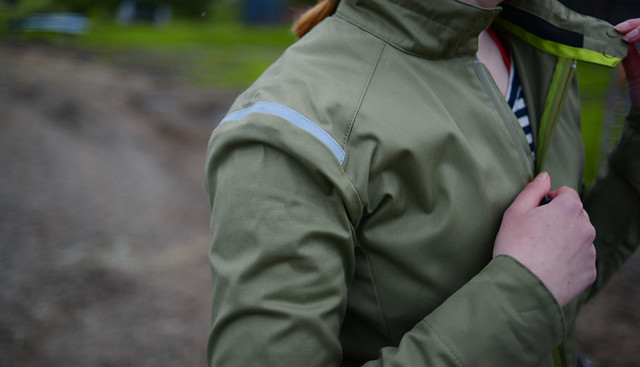
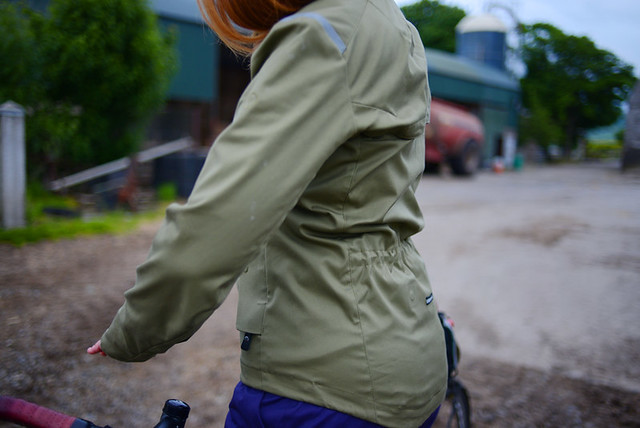
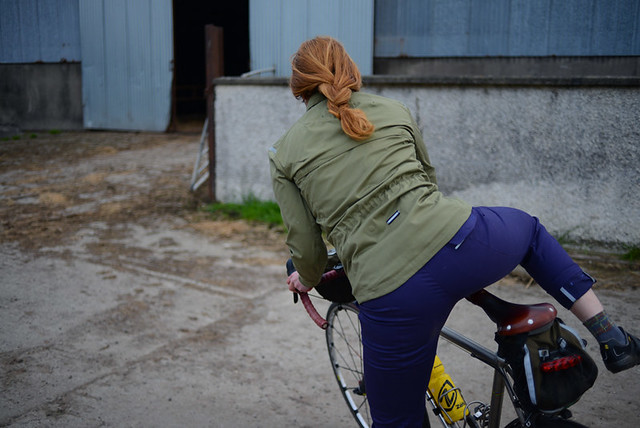
A subtly placed vent over the shoulder blades provides ventilation. And extra length in the rear and in the sleeves provides good coverage even in a drop bar position, without looking out of place off the bike. Neither do the subtle reflective bits at the shoulders and sleeve cuffs look overly cycling-specific.

Vulpine Women's Rainwear
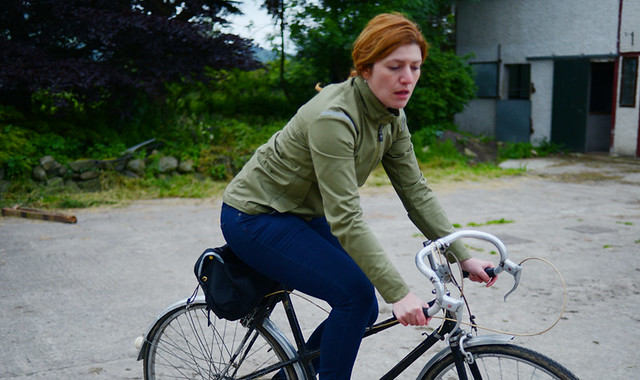
On the bike, the best thing about the jacket is that it does not pull or constrain in any way - the cut allows for excellent freedom of movement while appearing sleek and tailored. In cool weather the jacket regulates temperature adequately even on spirited rides, though I would not wear it in temps above 75°F.

Over the months I've tested it, I have found the Vulpine Women's Original Rain Jacket surprisingly versatile. I have worn it on commutes, on long photo expeditions and on road rides, as well as off the bike altogether. I have worn it with cycling clothes, with casual clothes, even with dresses and high heels. In cool temperatures, I find the weight and breathability to be well suited for both casual and sporty cycling, regardless of whether it's raining or not. The one major drawback as far as versatility, is that the jacket is too bulky to stow away in a jersey pocket or even in a small handlebar/saddle bag, which limits its usefulness in a roadcycling context.

Vulpine Women's Rainwear
While the Vulpine Original Rain Jacket has many useful features to recommend it, in truth my fondness for it has just as much to do with its overall je ne sais quoi. It is one of the more interesting articles of clothing I have worn in some time. It looks lovely, feels lovely, and has become a wardrobe staple.

Vulpine Women's Rainwear
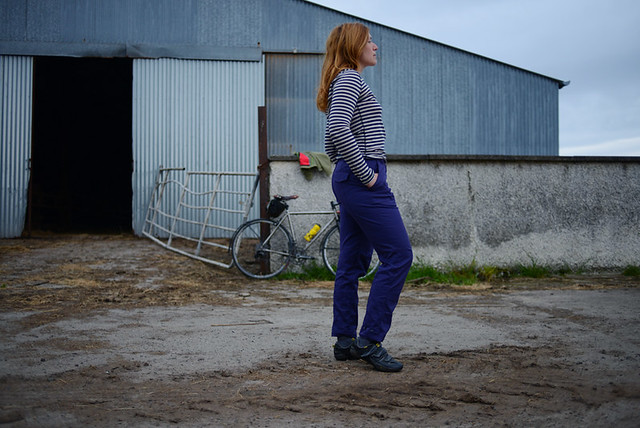
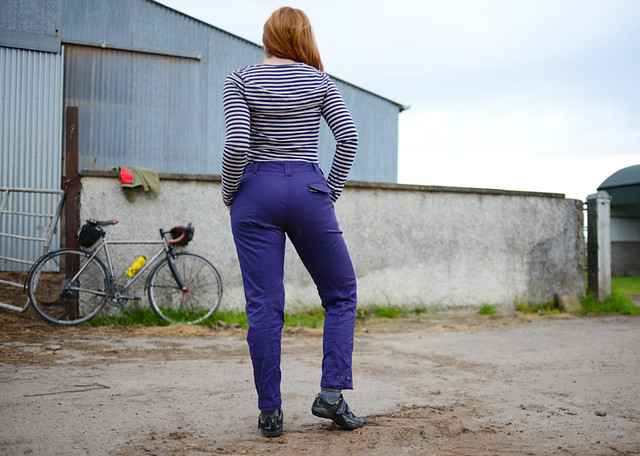
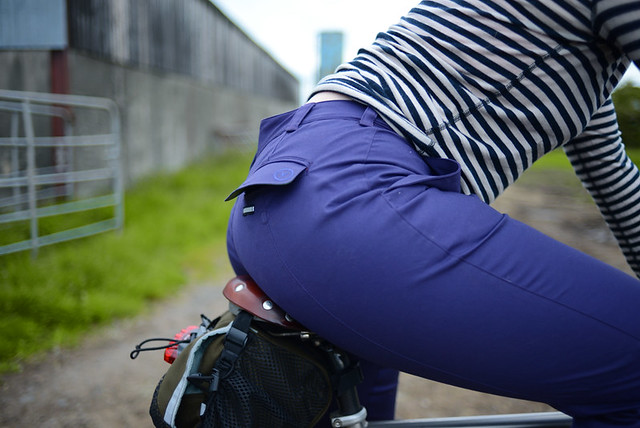
Alas, I cannot say the same for the Rain Trousers (available in the indigo shown here and in sahara - a light khaki). Ever on the lookout for a good pair of cycling-friendly trousers, I wanted to like these things, but they are just not for me. The fabric seems to be the same as that of the jacket, but somehow feels stiffer in use. As far as fit, perhaps the problem is my large behind, which makes these trousers sit all wrong - unflatteringly baggy around the abdomen and hips, but tight across the butt.

Vulpine Women's Rainwear
The high-waisted tapered leg design doesn't do me any favours either, giving my figure a dated, lumpy look. I can picture these trousers looking good on girls with willowy, boyish figures, creating curves where they do not already exist. But big-bottomed girls, beware!...

Vulpine Women's Rainwear
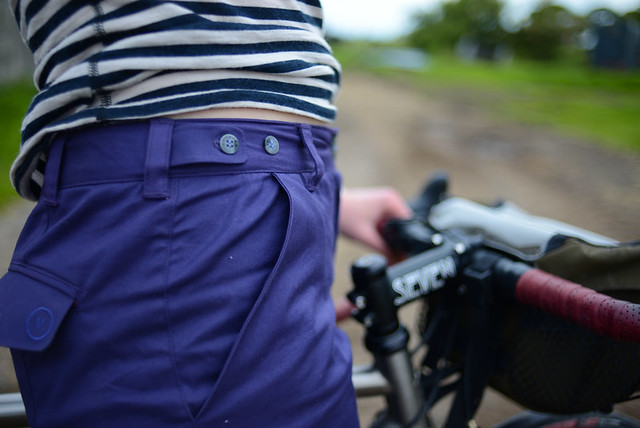
In theory, the adjustable waist and ankles of the Rain Trousers are useful features. However, for me they only exaggerate the unflattering fit mentioned earlier.

Vulpine Women's Rainwear
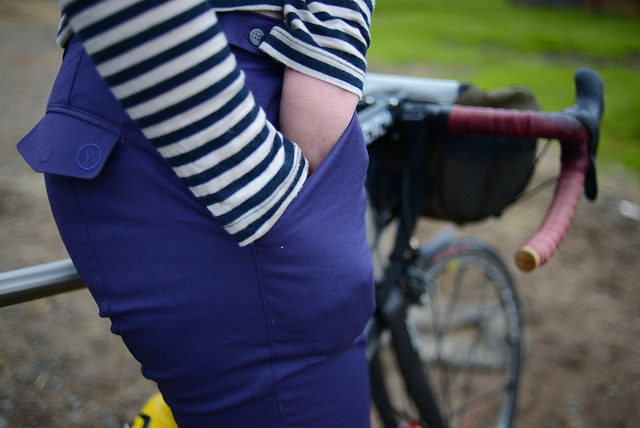
Ditto with the enormous front pockets, which tend to bunch up inside the front of the trouser legs.

Vulpine Women's Rainwear
The front pockets and the waistband at the rear flare out uncomfortably when I am on the bike, and while they don't constrain leg movements I can at times feel a pulling sensation suggesting an awkward fit. 

Vulpine Women's Rainwear
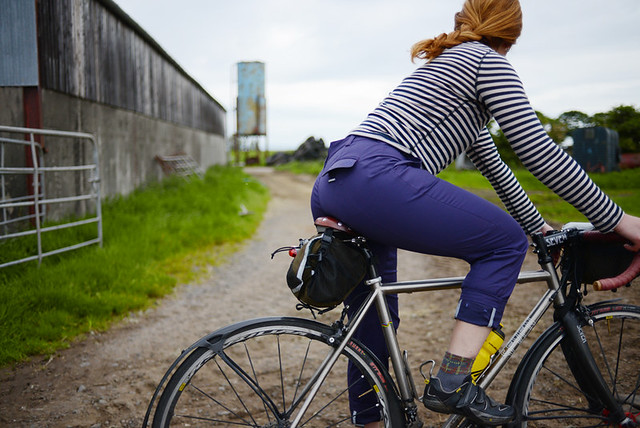
But fit issues aside, there are other aspects of these trousers I am less than enthusiastic about. Firstly, while they are just as water-resistant as the Rain Jacket, they somehow don't feel quite as effective at temperature regulation, despite their 4-20°C rating. Perhaps it's the lack of vents or the fact that, unlike the jacket, they sit directly against the skin. But my legs get hot and clammy when cycling vigorously, even in cool weather. The fabric feels a bit too stiff for pedaling comfort as well. Maybe others will have a different reaction, but I cannot imagine wearing these trousers for anything but casual commuter spins.

Vulpine Women's Rainwear
To balance out the critical comments with some positive ones, the Vulpine Rain Trousers did get something important right that other manufacturers can't seem to manage: They feature a nice roomy gusset at the crotch and no seams that dig into sensitive areas on the saddle regardless of position on the bike. The reflective bits at the cuffs are also nice, and I daresay these trousers look a bit more flattering as capris with the cuffs turned up. 

Vulpine Women's Rainwear
As far as durability, I cannot fault either the jacket or trousers after several months of use. Aside from their impressive water-resistant properties, both garments have proven to be stain-resistant and even scuff-resistant. The jacket in particular I've been wearing quite a lot, and it hardly shows signs of use. 

Vulpine designs their clothing to transcend the on/off the bike distinction, as well as to bridge the gap between sport and transport. These in of themselves are tricky endeavours. Add water-resistant properties and women-specific fit to the mix, and they're really asking for trouble! In light of this, to come up with a garment as cool and versatile as the Women's Original Rain Jacket is commendable. And I hope my blunt feedback about the Rain Trousers will not discourage Vulpine from continuing to offer their brave and unique designs. 

Complete picture set of the jacket and trousers here

Jumat, 02 Mei 2014

What Makes a Thing Lucky?

A Touch of Houndstooth
The cyclists I know who take part in any sort of events, will often have objects which they deem lucky and therefore must have with them when attempting a ride of importance. Usually, though not always, this item will be a pice of clothing - which means it gets worn a lot, and as a result might be faded, discoloured in the wash, threadbare, torn and patched up repeatedly, or perhaps too small or too big for the rider, having been acquired at a time when their body was differently proportioned. No matter.  In preparation for the event, this lucky thing will be sought out with manic determination. And it will be worn regardless of condition, replacing the rider's anxiety with a sense of familiarity and calm. It is, after all, lucky.

Ah but what makes it so? Is it having worn the thing during multiple race victories or completions of tough events? Is it having received it as a gift from someone special, or on a special occasion? Was this item worn by another rider, whose skill or strength might rub off on us, if only a tiny bit, if we wear it too? Does this thing happen to be our favourite colour, or stamped with our lucky number, or manufactured on the date of our birthday? Does it contain some secret message of significance that makes sense only to us, and sin this secret way signifies luck? Any of these things it could very well be.

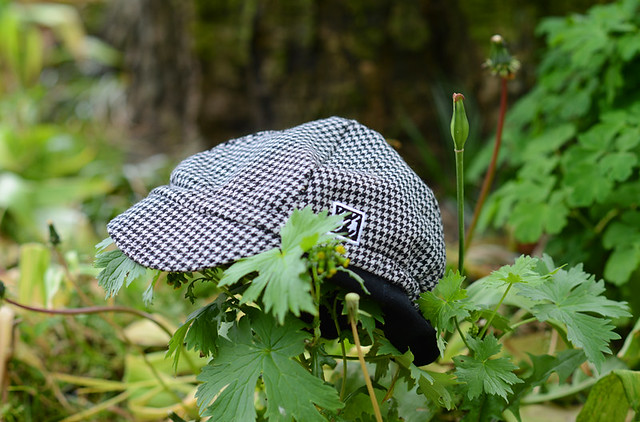
It was only recently that I realised that I too have a lucky cycling item. I knew it when I began to search for it in preparation for an upcoming brevet, and, even though it was by no means the only item of its kind that was suited for the task I wanted it for, I began to get flustered when I did not immediately find it. It is a woolen cap with earflaps, in a houndstooth pattern. It is half a size too big for me and, by the end of a long ride sits lopsided under my helmet. Its 3-panel design does not flatter my face. It has not been washed in 2 years and smells like the soured strawberry Yahoo I spilled on it in a previous encounter. And it just so happens that I've worn it on my longest, coldest, dampest, dirtiest, hilliest, most uncomfortable rides - which, in the end, also left me with the loveliest memories. I did not win anything during these events. I did not do particularly well time-wise. I don't know what exactly makes this silly hat lucky. All I know is, when I finally found it, ran my fingers over its wooly texture, caught a whiff of its absurd but familiar scent and tucked it into my pocket, I let out a sigh of relief and relaxed.  Finally, I was ready to go. 

Senin, 07 April 2014

Cycling Bibs for Women: 4 Basic Styles

Lately I've been getting lots of questions about women's bib shorts. Are they more comfortable than regular cycling shorts and worth switching to? Having made the switch to bibs a year ago, for me the answer was Yes. As soon as I tried bib shorts it was love at first ride. Instead of an elastic cutting across my belly fat and chafing my skin on long rides, bibs offered a wonderful feel of support and compression. True, the under-the-jersey straps make peeing a more elaborate process for women. But that is a price I am willing to pay for the extra comfort I get out of them on the bike.

So the next question is, which style to chose? There seem to be so many. The funny thing about that is that until recently there were almost none. Cycling shorts and tights would be offered in a bib style for men, but not women. Then a couple of years ago this suddenly started to change, with manufacturers scrambling to come up with women-specific designs and each seeming to arrive at something different. But why the need of a women's specific style in the first place? Let's start by examining the traditional design.

The Classic Bib Design

Unlike elastic-waisted shorts, cycling bibs stay up via suspender-style straps. These straps can be either solid of mesh, narrow or wide, and they can vary in their degree of stretch. The classic cycling bib design (ie most men's bibs) routes the straps straight up and over the shoulders, as shown on the left. For women this can be problematic, as it means the straps are placed directly over the breasts. Depending on the size, shape and orientation of the breasts and nipples, this can result in uncomfortable digging into sensitive tissue - in particular with straps that are on the narrower side and made of a dense, not super-stretchy fabric. Because there is so much variety in this part of a woman's anatomy, it is difficult to come up with bib dimensions that will solve this problem - which is why most manufacturers avoided the issue altogether and stuck with ordinary shorts for their women's lines. Still there there are manufacturers who produce women's bibs in the classic design - for instance, Road Holland. I own a pair of these and find them comfortable enough. The straps are very wide and made of a lightweight, stretchy mesh; worn over a sports bra I can hardly feel them. But again, reactions to this style will differ depending on the specifics of the design and on your anatomy. In particular, women with large breasts and large, sensitive nipples may find the routing of the straps uncomfortable.


The Open Bib Design

Some manufacturers have tried to address the problem of bib strap routing by making them "open" - that is, routed around rather than directly over the breasts. Here the straps sit at the far sides of the torso, close to the armpits, resembling the back of an athletic swimsuit. Personally, I find this style the most comfortable out of the ones available. The bib straps on my Giordana shorts keep clear of my boobs and stay in place remarkably well; I cannot feel them at all when on the bike. However, I know that some women dislike having the straps so close to the armpits and experience chafing at the inner arms. This does not happen to me at all. But whether this style works for you will depend on your anatomy and skin sensitivity.

The Y-Front Bib Design

An alternative style of routing bib straps to avoid the breasts is the Y-front. Here the straps meet at the collarbone and connect to form a single panel that sits between the breasts, then gradually expands at the abdomen to merge with the lower part of the shorts. Assos, with their coy models, is particularly well known for this style and I have a pair of their shorts for review. The Y-strap bib routing is clever and feels comfortable enough to me - with the caveat that the size has to be spot on, or else the strap will either choke or feel too loose. Some versions of this style also feature a clasp - presumably for easier removal of the straps in order to pee. Personally I do not like having a clasp at my sternum and would prefer the version without it. All in all, the y-front style is a little too fussy for me - but preferences will differ.  Those with unusually long or short torsos might have trouble finding a good fit.

The Full-Coverage Bib Design

Yet another way to avoid dealing with boobage issues is with a full coverage style of bibs. Similar to a bathing costume circa the 1920s, this design is basically a combination of shorts and a tank-top. Typically a zipper will run down the middle. Rapha makes their women's bibs in this style and I own a pair of the 3/4 knicker version. In some ways I like this design, in particular I enjoy the extra compression that comes with the full coverage. However there are times when I just don't want all that extra fabric around my torso - when I'd like to wear bibs and not a full body suit. Aside from this, women with large breasts and narrow hips or vise-versa might find it tricky to get a good fit, as the top and bottom proportions are either/or.

There are other women's cycling bib designs out there, but I find that most are variations on these four. Every season it seems there are more and more manufacturers offering various versions of women's cycling bibs. If you are looking to compare styles and prices, Team Estrogen looks like a good starting point. If you have your own favourite style, brand or model, please share what works for you - as well as what doesn't. Women in all shapes and sizes can and do wear bib shorts. But they are not for everyone; in the end it is all about what suits you personally.

Senin, 13 Januari 2014

Cycling in Wellies

Cycling Wellies
Sure I harbored memories of their stiffness and lack of breathability from having donned them in the countryside years ago. But my resistance to Wellies went beyond that, most likely a result of their absurd, meteoritic rise to popularity in recent years. Step out into the urban streets of Cambridge, Massachusetts on a mildly drizzly day, and you'll encounter a rubber boot infestation out of all proportion to the amount of rain or the surface conditions at hand. Like flocks of exotically brightly-footed birds, crowds of young women in colourful Hunters and copies thereof stylishly stomp their way across shallow sidewalk puddles and the damp grasses of Harvard Yard. What's turned this awkward, uncomfortable form of footwear into a fashion accessory was beyond me. But for whatever reason Wellies seemed to have replaced UGGs and Crocks as the new Ugly It-Shoe, and I wasn't about to buy into the trend. Even when I found myself in circumstances where I actually needed the vile rubbery things for the original purpose they were designed for, I resisted - donning my normal, perfectly good waterproof boots instead.

Muddy Yard
But I did not resist for long. I live next to a farm now, and spend quite a bit of time there. The yard looks like this …on a dry-ish day.

Then there are the vast fields I cross to take photos along the water's edge. And while that green stuff may look like grass, the soil it grows on is soft and soggy. Seeing farm animals grazing with the fur on their legs wet and matted from sinking into the grass, it was clear that my normal, perfectly good waterproof boots would get destroyed after a couple of such forays. Not to speak of my interest in photographing abandoned peat bogs.

Anyway, Wellington boots. Nowadays you can buy all sorts of fancy versions, including those with a warm lining already built in. But considering the purposes I needed them for, I decided to go for the plain unlined type, meant to be worn with several pairs of socks. The rationale here is that should you step into deep water that goes over the edge of the boot, you just change your socks and can keep wearing the boots after wiping down the interior. With lined boots you would have to wait for the lining to dry if the interior gets wet.

Armed with the knowledge that I wanted plain rubber farmer's boots, I went to the local shops that sell such things. Sadly, it turned out my size 4UK feet are freakishly small by local farming standards. And so I walked out with a pair of teenage girls' boots in bright sky blue with green and lilac striped trim. So much for plain, but my other choices involved butterflies or pandas.

But of course looks aren't everything. So let's talk about what's important for us cyclists: power transfer. How are Wellies to cycle in? Well, kind of bad. The soles are quite flexible - somewhat more so than running shoes, but less so than foam flip-flops. Nothing about these boots said "I want to ride a bike in these!" the first time I wore them. But despite this, they are strangely addictive. The comfort of even the cheap ones I bought are a huge improvement upon the painfully uncomfortable, clammy Wellies I recall from childhood. The uppers are flexible and don't dig into my calves, the toes don't pinch even after an hour's hike through the peat bogs, and somehow my feet do not overheat despite their lack of breathability. In fact, worn over two or three pairs of wool socks, nothing keeps out the winter damp better. 

Little by little I started to wear the Wellies not just on the farm or when walking across soggy fields, but out and about - including around town and on the bike. The flexible soles felt strange when pedaling at first, but I got used to it and have cycled in them for up to 14 miles so far with no adverse effects. An additional advantage, is that the Wellies' wide adjustable uppers fit easily over even the baggiest of trousers, keeping them safely tucked away from the bicycle's drivetrain. Of course they can be easily worn with a skirt as well. And when I come home covered knee-deep in mud - which seems to be the norm these days - I simply rinse the boots off and in seconds they are ready to wear again - the ultimate in low maintenance. 

And so, my winter footwear wardrobe these days consists more or less of these. I've held myself back from going dancing in either of them so far, but I wouldn't rule it out. 

Minggu, 24 November 2013

Pretty-Bright! Three Reflective Vests for Plain Clothed Cycling

all  images G. McLaughlin
I've never been an enthusiast of hi-viz gear for transportation cycling. When riding through well-lit, densely populated areas, personally I do not feel the need for it. But as my commutes began to take me through more remote places, the idea of wearing a little reflective something became more appealing. While there's no shortage of hi-viz cycling clothing out there, some bicycle commuters feel that much of it is unattractive and ill-fitting. To address this, a number of companies now aim to make reflective gear that's as effective as it is fashionable. I have tried products from three of them over the past months: the Lightning Vest by Dargelos, the Vesp by Vespertine, and the Capelet by Day Glow Doris. All of these are handmade by small, independent manufacturers and aimed mainly at women. Here are my thoughts on their utility and looks.

Dargelos Lightning Vest: Daylight
The Dargelos Lightning Vest fascinated me from the moment I saw it, because it is such an ingeniously simple concept. This garment is basically a hand-knotted net of 3M reflective ribbon, providing all-over reflection for your entire torso, while also being extremely lightweight and compact. And because the netting is spaced fairly wide, pockets remain accessible. Available in two sizes, the Lightning Vest is drapy in cut and roomy enough to fit over a jacket or coat. Prior to trying it, I wondered whether this might make it prone to snagging on parts of the bike, but I have not experienced that so far - the netting stays close to the body. 

Dargelos Lightning Vest: Daylight
One thing I do find a little awkward about the Lightning Vest in use, is figuring out the head and arm openings. It's not complicated, but it does take some care - particularly to not get my hair caught in the netting.

Dargelos Lightning Vest: Daylight
Judging the Lightning Vest as an article of wearable, fashionable clothing, I have to say that I like it. The silver netting is light and ethereal-looking, and the cut is unexpectedly flattering. It certainly is unusual, but to my eye it looks nice.

Dargelos Lightning Vest: Flash
And as far as reflective properties, my favourite aspect of this garment is the amount of coverage it provides. 

Dargelos Lightning Vest: Flash
With my entire torso covered in reflective netting, I am equally visible from the front, rear and sides. Made in NYC, USA, the Dargelos Lightning Vest is priced at $138. 

Day Glow Doris Capelet: Daylight
The 50's Capelet by Day Glow Doris is a vintage "Dior-inspired" vest that comes in hi-viz colours (yellow, green, pink and red) with reflective trim and buttons. The rounded collar, 3/4 bell sleeves, floral ribbon trim and retro cut give it a soft, feminine look that makes for an interesting contrast with the neon and hi-viz colour scheme. 

Day Glow Doris Capelet: Daylight
Roomy in cut and easy to put on, the capelet closes via a hidden velcro strip in the front (the reflective buttons are decorative), which also makes it possible to adjust fit. Though designed to be worn over a jacket, this capelet is available in one size only (S/M). Made of a lightweight polyester fabric, it is bulkier than the other vests featured here, but can still can be scrunched up to fit into a (deep) pocket.

Day Glow Doris Capelet: Daylight
As far as its fashion appeal, the Day Glow Doris Capelet is clearly targeted at those who go for the funky retro look. I am not sure the '50s styling is my cup of tea exactly, but I can appreciate the design and do find the cut flattering. And as far as neon goes, I also like the particular shade of red/orange the manufacturer chose: It is not a typical "construction zone orange," but more like the colour of a wild poppy rendered in neon. 

Dayglo Doris Capelet: Flash
In the dark, the Day Glow Doris reflective features are limited to the reflective ribbon at the collar, sleeves, buttons and waist. In the front there are quite a few reflective bits. 

Dayglo Doris capelet: Flash
However, in the rear and from the sides the reflective areas can be less visible. For instance, if I wear my hair loose it will cover the collar, and if my arms are too far forward the strips along the sleeves will disappear. To be sure, this capelet is highly visible - but the reflective features are limited to the edges, rather than being its centerpiece. Made in the UK, the Day Glow Doris Capelet is priced at £49 (or $80 USD at current conversion rates).

Vespertine Vesp: Daylight
The Vespertine Vesp is a mini-vest with a deep v-neck cut and a ribbon-tie front, that is a lighter-weight, more versatile alternative to the manufacturer's line of reflective dresses and jackets. 

Vespertine Vesp: Daylight
Available in sizes XS-XL, the Vesp is shown here is the silver lamé fabric, and is also made in several neon colours (yellow, green, orange and pink). It is adjustable to fit over a jacket (go up a size for thick overcoats). 

Vespertine Vesp: Daylight
While the Vesp does not exactly look like everyday wear to my eye, the delicate tailoring and the use of diagonal lines make it surprisingly flattering and as unobtrusive as a silver lamé article of clothing can be. It also impressed me by being much lighter and more collapsible than it looks - I can easily scrunch it up to fit into the tiniest of pockets.

Vespertine Vesp: Flash
In the dark, the Vesp's arrangement of reflective 3M ribbon make a sort of butterfly shape in the front,

Vespertine Vesp: Flash
And a large, prominent "X" in the rear that covers much of the torso, supplemented by another thin reflective strip at the waist-line hem. The edges of the X extend to the sides, where the reflective ribbon is also quite prominent. Made in NYC, USA, the Vespertine Vesp is priced at $68 for the neon versions and $84 for the silver lamé.

Overall I find all three of the vests described here easy to wear, reasonably attractive, and effective in their high visibility features. For riding in the daytime in overcast conditions, the Day Glow Doris provides the best visibility with its swathes of neon fabric. For riding at night, the prominent X of the Vespertine Vesp seems to be the most eye-catching from the back, while the all-over netting of the Dargelos Lightning Vest provides the most thorough reflective coverage. 

For women seeking fashionable hi-viz wear, either of these products could fit the bill. And if you like the concept but find the price too high - why not whip out the needle and thread, and get creative with the 3M ribbon? Although what I'd like to do is find some 3M yarn and do some hi-viz knitting... 

Senin, 09 September 2013

Monday Mailbox: Cycling, Clothing and Skin Sensitivity

Moore's of Coleraine
When discussing athletic cycling clothing, or even dressing for the bike in the context of utility cycling, I will occasionally mention being sensitive to certain fabrics. Because of this I get lots of questions from readers who are in the same predicament. There are those who find themselves unable to wear cycling apparel typically available in bike shops. There are also those who find that the fabric in their ordinary, everyday clothing - which was fine for driving and walking in - begins to cause problems once they start getting around by bike. Having had both experiences, here is my perspective after some years of cycling. 

Firstly we all mean something different by "sensitive." Here is what I mean by it: When I wear certain items of clothing, my skin gets easily and dramatically irritated - to the point of rashes, abrasions or even lesions forming in the course of a single bike ride - in areas where the fabric contacts my skin. This does not appear to be a chafing issue, but more like a chemical burn or allergy type of reaction. 

After nearly 5 years, I still cannot pinpoint precisely what causes it in my case. In the beginning, I believed it was "artificial fabrics" on the whole, so I tried to avoid them and wore only natural fabrics (wool, silk, etc.). But over time I learned that it is not a clearcut artificial vs natural fabrics issue. For example, I now know that I can usually wear lycra and spandex directly against my skin without any problems. My earlier assumption that I could not wear lycra was based on the fact that much of the cycling clothing casually referred to as "lycra" is in fact either partly or entirely polyester. It was the polyester I was sensitive to. This theory held true for a while, as I'd try different articles of polyester clothing and inevitably develop rashes. Even those wool/poly blends I usually cannot wear directly against my skin. Then again, one time I wore a jersey that was 100% polyester to which I had no sensitivity, even after a 60 mile ride in the summer heat and humidity. 

Point being, these things can be tricky to figure out, so don't jump to conclusions. If you are sensitive to an article of clothing, it could be the fabric, but it could also be the dye, or some surface treatment used on the fibers, or some other factor entirely, or a combination of everything - including how these things interact with your unique body chemistry, and in particular, sweat (the latter would also explain why you might be entirely fine with certain fabrics when sitting around at the office or walking to and from the car, but not once you start pedaling and working up a bit of a sweat).  

So, what do you do if you have skin sensitivity to cycling clothing? My first suggestion would be to eliminate chafing as the culprit. If your clothing is either too loose or too tight, this could cause abrasions from chafing that might be mistaken for skin sensitivity - I have seen it lots of times with local cyclists. 

Once you are certain chafing is not the issue, pay attention to the clothing labels and see whether an obvious pattern emerges. Experimenting with fabrics is expensive, but many shops' return policies now are amenable to exchanges after items have been worn. And to determine whether it is the dye or surface treatment you are sensitive to, try washing the garment before wearing it again and see what happens. I recently tried some cycling-specific trousers that gave me a rash when I first wore them, but no longer caused that reaction after I put them through the wash a couple of times based on a friend's suggestion. And finally, for what it's worth, I think avoiding artificial fabrics remains a valid tactic. 

Some of us can wear anything on the bike and don't see what the problem is. Others are frustrated by wasting money on clothing that irritates. Hopefully over time we figure out what works for us and what doesn't. In the meantime, there is always the second hand market - and trading clothing with friends!

Jumat, 23 Agustus 2013

To Match, or Not to Match

Blurry Grass Walk
"So are you, like, allergic to matching kit?"
"Hm?"
"Well it's just that I know you own shorts and jerseys from the same manufacturers. But you never wear them together."

Caught off guard by being thus scrutinised, I quickly take stock of what I've got on. Between the shorts, jersey, jacket and various warmers I count 5 different brands. Okay, the man's got a point. But hey, at least it's all vaguely the same colour. And what does it matter anyway?

I confess that my choice of what cycling clothes to don on a road ride is largely determined by what's clean. I ride a lot and don't have time to constantly be doing laundry. And since shorts and jerseys have different "can keep wearing it without washing" cycles, it just so happens that the clean jersey/short combo appropriate for that day's weather often won't match.

But while I don't intentionally go for the mismatched look, upon giving it some thought I realise that I am comfortable with it. More comfortable than with the slicker, more polished matching look. Because on the bike I am neither slick nor polished, it seems somehow appropriate - even "correct," if you will - that my style of dress reflect that. 

One day early this summer I was out riding and passed a couple of cyclists on a gentle descent. They were skinny boys on nice bikes, who must have been lost in conversation and taking it easy. On the next uphill they caught up to me and we got to chatting. One of them looked over my shorts and jersey. Trying to make out the writing (it was my club's name - Ride Studio Cafe), he said with a straight face: "So who is that you ride for?" For, not with. I thought he was mocking me and turned beet red (Come on, how the hell could I ride "for" anyone, spinning uphill at 10mph?). I am still not sure whether he was joking or not, but in a roundabout way that illustrates why I shy away from wearing the matchy stuff - especially with my club's name on it. 

There is all this talk among roadies about "looking pro." It is said ironically, but nonetheless meant seriously. It covers lots of things, including clothing - which, according to the rules, ought to match. In that vein, I guess I am quite happy to leave looking pro to the pros - while myself mismatching my cycling clothes with abandon. 

Selasa, 23 April 2013

Showers Pass Women's Portland Jacket

Showers Pass Women's Portland Jacket
When offered to review some products from the rain gear company Showers Pass, I immediately chose the Portland Jacket. Endowed with the technical features Showers Pass rain gear is known for, the Portland has the look of everyday apparel, while steering clear of extra frills and over-the-top urban stylishness. The combination could be just the thing for many bicycle commuters - particularly those whose definition of commuting involves spirited riding and roadbike positioning. Available in men's and women's versions, this review is of the latter.

Showers Pass Women's Portland Jacket
The Showers Pass Portland is made of a proprietary synthetic 3-layer softshell material with a waterproof breathable membrane and box fleece lining. It is made in Vietnam. The fabric is waterproof, but the seams are not sealed. 

The hem of the jacket hits around the widest part of the hips. The sleeves extend a couple of inches past the wrists. The stand-up collar zips up to the chin. The fit is quite slender, almost like "racing fit." If you want a relaxed fit for layering, I would suggest going up a size. The model pictured is a US Women's Size 4 and she is wearing the Portland in a Medium (over a t-shirt and a sweater). Branding on this jacket is minimal. 

Showers Pass Women's Portland Jacket
The light gray exterior features a subtle glen plaid pattern, with reflective piping along the seam at the shoulder blades in the back and above the chest in the front. The silver Showers Pass logos on the back of the collar and on the chest pocket in front are also reflective.

Showers Pass Women's Portland Jacket
The black fleecy interior has a soft, waffled texture to it that is pleasant to the touch. 

Showers Pass Women's Portland Jacket
The drop-down hem in the rear extends coverage and adds a wide reflective strip.

Showers Pass Women's Portland Jacket
A feature specific to the women's version of the Portland is the side zippers. The jacket can be unzipped to varying degrees on the sides to flare out at the hips. This is a clever and flattering solution to the problem of accommodating variety in waist to hip ratios among women. The wearer can unzip the sides a little, a lot, or not at all, depending on body shape, positioning on the bike, and the look they are going for.

Showers Pass Women's Portland Jacket
In front, there are two side pockets, tilted for ergonomic comfort, and a hidden chest pocket (with "audio port"). There are hidden armpit zippers for temperature regulation, which is also helped by the two-way zip feature of the main zipper in the front.

Showers Pass Women's Portland Jacket
The small interior pocket will fit a wallet or phone.

Showers Pass Women's Portland Jacket
Zippers at the wrists accommodate for variations in rider arm lengths, ensuring that the sleeve does not constrict the hand. 

Showers Pass Women's Portland Jacket
Prior to passing on the Portland to the model, I did a few commutes in it myself. Personally, I found the jacket not ideal on an upright bike, since it provides no leg coverage (as a trench-style raincoat would). But on a roadbike it made a lot more sense. I will sometimes commute on this bike when I want to combine roadcycling with photography work, and a jacket like the Portland is a good way to still "look normal" while dressing comfortably for a leaned over position and spirited riding. The fit and all the zip features accommodate road positioning excellently. Having worn the jacket in the rain for a prolonged period, it was indeed waterproof - though missing a hood. Possibly it is assumed that a helmet will be worn, with its own rain cover contraption. The internal soft fleeciness makes the jacket quite cozy to wear on those raw chilly drizzly days. Unlike many other rain jackets, the Portland breathes well and is fine to wear when it's not raining. I would basically call it an all purpose Spring/Fall jacket. Possibly it is also suitable for cold summer evenings in the North, but not so much for a New England winter. Having worn it once on a 35° F day with "only" two layers underneath, I felt underdressed for the cold. Worth noting is that this is not a pocket stow-away jacket; its folded-up size will require a bicycle bag or rack-strap system.

The model pictured is a cyclist who usually commutes to work on a roadbike in street clothing (typically stretchy jeans and sweaters). Like me, she finds the Showers Pass Portland jacket waterproof and breathable. And she agrees that the fit is ideal for road positioning. Even with her aggressive posture, the front of the jacket does not feel like a weight pulling down. Neither does it fold to dig into her middle section uncomfortably, or pull at the shoulders. The stretch of the fabric and strategic zippers make for a comfortable and flattering fit. The look of the jacket suits her casual personal style. 

The Showers Pass Portland is an attractive, functional and practical bicycle commuter jacket for cool and rainy conditions, priced at $200. It will likely be most appreciated by those who prefer a leaned-over posture on the bike and feel constrained by longer, trench-style designs. Personally, I would prefer this jacket with a hood and wonder whether a detachable one could be included in a future iteration.