Tampilkan postingan dengan label wool. Tampilkan semua postingan

Selasa, 19 Agustus 2014

Dry Cleaning Your Wool… with Fresh Air

Airing Out Wool
One of the much-touted attractions of wool clothing - and the basis on which it is recommended to cyclists - is its supposed odor resistant properties. In fact, it is not uncommon for proponents of the stuff to brag about how infrequently they wash their clothing (once a month! once a year! never!!!) As a wool enthusiast myself I am often asked about my take on this claim. Can wool clothing really be worn endlessly without washing? or - as one friend recently put it - "are woolsters just grungy?..." 

Well, speaking from personal experience I would put it this way: Wool retains odors to a lesser extent than cotton, and to a much lesser extent than synthetics. This is not to say that it does not pick up odors at all; only that it picks them up at a slower rate, and perhaps emanates them more subtly. Still, eventually there will come a time when you will have to clean your wool garment. But cleaning need not mean washing. And one thing I've discovered over the years, is that "dry cleaning" wool with fresh air can be amazingly effective. 

The practice of airing out clothing is of course nothing new. Compulsive laundering after brief periods of wear is a relatively recent trend, and it was once common practice to hang clothes in the window or even on the backs of chairs overnight to keep them fresher, longer. 

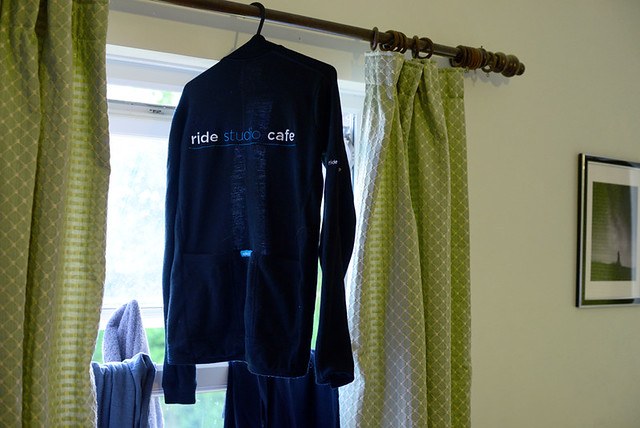
But with wool, this method is disproportionally effective. Just as wool is reluctant to retain odors, it's also eager to shed them if given a chance. The back yard clothesline does the trick best, especially on a breezy day. After I hang my wool clothes on the clothesline for half a day, they don't just smell fresh-er; they smell no less clean than had I actually washed them, then hung them out in the garden. They smell like the sun and the wind, that "fresh laundry" scent that detergent manufacturers try so desperately to bottle, but that can't quite compete with the real thing. And if you don't have a yard with a clothesline? Opening the window and hanging the garment off the curtain rod (or a hook) can work too. 

But why bother with this at all, you might ask, when you can just toss the clothes in the washing machine? Well, environmental and financial issues aside, there is incentive to wash wool as infrequently as possible. Wool tends to be more delicate than synthetics and cottons, as well as more prone to losing its shape. And while this is not necessarily true for all wool clothing (anything made of the "indie" fabric from Ibex I've found to be especially resilient), it has been true for enough of it, so that I avoid washing unless I have to.

While it may seem suspiciously simple, I have found that airing out wool works wonders to remove not only body odors, but also ambient smells picked from the environment, including strong food and cigarette smoke odors. Of course, airing out won't get rid of stains. So with a stain, I'll treat then handwash just the area around it - then air-dry. 

The only time I really wash my wool clothing fully and properly, is after I wear it doing something active on a hot day. When fabric becomes salt-encrusted from sweat, there is really no way to deal with it but wash the entire thing. Otherwise, the airing out method keeps my wool's contact with the washing machine at a minimum. Am I grungy or is wool just that cool? Try it out and decide for yourself!

Jumat, 02 Mei 2014

What Makes a Thing Lucky?

A Touch of Houndstooth
The cyclists I know who take part in any sort of events, will often have objects which they deem lucky and therefore must have with them when attempting a ride of importance. Usually, though not always, this item will be a pice of clothing - which means it gets worn a lot, and as a result might be faded, discoloured in the wash, threadbare, torn and patched up repeatedly, or perhaps too small or too big for the rider, having been acquired at a time when their body was differently proportioned. No matter.  In preparation for the event, this lucky thing will be sought out with manic determination. And it will be worn regardless of condition, replacing the rider's anxiety with a sense of familiarity and calm. It is, after all, lucky.

Ah but what makes it so? Is it having worn the thing during multiple race victories or completions of tough events? Is it having received it as a gift from someone special, or on a special occasion? Was this item worn by another rider, whose skill or strength might rub off on us, if only a tiny bit, if we wear it too? Does this thing happen to be our favourite colour, or stamped with our lucky number, or manufactured on the date of our birthday? Does it contain some secret message of significance that makes sense only to us, and sin this secret way signifies luck? Any of these things it could very well be.

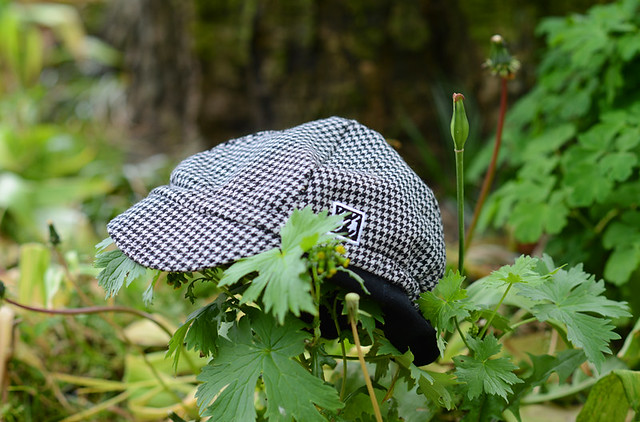
It was only recently that I realised that I too have a lucky cycling item. I knew it when I began to search for it in preparation for an upcoming brevet, and, even though it was by no means the only item of its kind that was suited for the task I wanted it for, I began to get flustered when I did not immediately find it. It is a woolen cap with earflaps, in a houndstooth pattern. It is half a size too big for me and, by the end of a long ride sits lopsided under my helmet. Its 3-panel design does not flatter my face. It has not been washed in 2 years and smells like the soured strawberry Yahoo I spilled on it in a previous encounter. And it just so happens that I've worn it on my longest, coldest, dampest, dirtiest, hilliest, most uncomfortable rides - which, in the end, also left me with the loveliest memories. I did not win anything during these events. I did not do particularly well time-wise. I don't know what exactly makes this silly hat lucky. All I know is, when I finally found it, ran my fingers over its wooly texture, caught a whiff of its absurd but familiar scent and tucked it into my pocket, I let out a sigh of relief and relaxed.  Finally, I was ready to go. 

Senin, 09 September 2013

Monday Mailbox: Cycling, Clothing and Skin Sensitivity

Moore's of Coleraine
When discussing athletic cycling clothing, or even dressing for the bike in the context of utility cycling, I will occasionally mention being sensitive to certain fabrics. Because of this I get lots of questions from readers who are in the same predicament. There are those who find themselves unable to wear cycling apparel typically available in bike shops. There are also those who find that the fabric in their ordinary, everyday clothing - which was fine for driving and walking in - begins to cause problems once they start getting around by bike. Having had both experiences, here is my perspective after some years of cycling. 

Firstly we all mean something different by "sensitive." Here is what I mean by it: When I wear certain items of clothing, my skin gets easily and dramatically irritated - to the point of rashes, abrasions or even lesions forming in the course of a single bike ride - in areas where the fabric contacts my skin. This does not appear to be a chafing issue, but more like a chemical burn or allergy type of reaction. 

After nearly 5 years, I still cannot pinpoint precisely what causes it in my case. In the beginning, I believed it was "artificial fabrics" on the whole, so I tried to avoid them and wore only natural fabrics (wool, silk, etc.). But over time I learned that it is not a clearcut artificial vs natural fabrics issue. For example, I now know that I can usually wear lycra and spandex directly against my skin without any problems. My earlier assumption that I could not wear lycra was based on the fact that much of the cycling clothing casually referred to as "lycra" is in fact either partly or entirely polyester. It was the polyester I was sensitive to. This theory held true for a while, as I'd try different articles of polyester clothing and inevitably develop rashes. Even those wool/poly blends I usually cannot wear directly against my skin. Then again, one time I wore a jersey that was 100% polyester to which I had no sensitivity, even after a 60 mile ride in the summer heat and humidity. 

Point being, these things can be tricky to figure out, so don't jump to conclusions. If you are sensitive to an article of clothing, it could be the fabric, but it could also be the dye, or some surface treatment used on the fibers, or some other factor entirely, or a combination of everything - including how these things interact with your unique body chemistry, and in particular, sweat (the latter would also explain why you might be entirely fine with certain fabrics when sitting around at the office or walking to and from the car, but not once you start pedaling and working up a bit of a sweat).  

So, what do you do if you have skin sensitivity to cycling clothing? My first suggestion would be to eliminate chafing as the culprit. If your clothing is either too loose or too tight, this could cause abrasions from chafing that might be mistaken for skin sensitivity - I have seen it lots of times with local cyclists. 

Once you are certain chafing is not the issue, pay attention to the clothing labels and see whether an obvious pattern emerges. Experimenting with fabrics is expensive, but many shops' return policies now are amenable to exchanges after items have been worn. And to determine whether it is the dye or surface treatment you are sensitive to, try washing the garment before wearing it again and see what happens. I recently tried some cycling-specific trousers that gave me a rash when I first wore them, but no longer caused that reaction after I put them through the wash a couple of times based on a friend's suggestion. And finally, for what it's worth, I think avoiding artificial fabrics remains a valid tactic. 

Some of us can wear anything on the bike and don't see what the problem is. Others are frustrated by wasting money on clothing that irritates. Hopefully over time we figure out what works for us and what doesn't. In the meantime, there is always the second hand market - and trading clothing with friends!