Tampilkan postingan dengan label step-through. Tampilkan semua postingan

Rabu, 25 Juni 2014

Black and White

Two Very Different Takes on Step-Throughs!
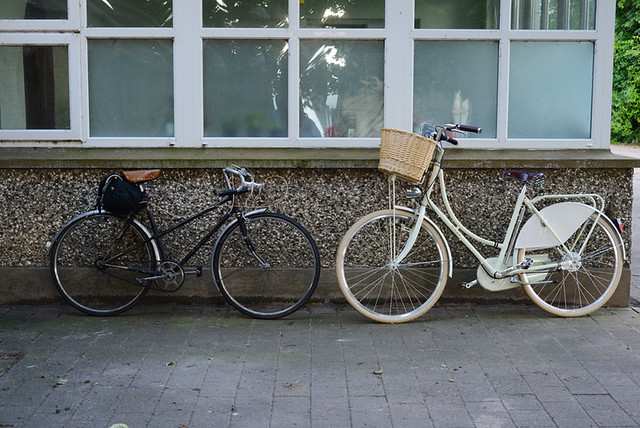
42 centimeters, or nearly 17 inches! Any guesses what that figure refers to? Go on, think about it before I tell you. Anyone? 

Over the past few weeks I've had under my guardianship two step-through bicycles that could not be more different from one another: a vintage Claud Butler Lady Lightweight that belongs to a friend, and a modern Mosi Carolina that was sent to me for review by the manufacturer. The former was essentially designed as a time trial bike (according to 1930s notions of what that entails) with all-arounder capability; the latter as a Dutch-style urban commuter. Switching back and forth between these machines has been an interesting experience - especially considering that 42cm is the difference in their handlebar heights! In fact I don't think I've ever ridden a bicycle that's quite as upright as the Mosi or quite as low-leaning as the Claud Butler. And to think that both of them can be described as step-throughs or "lady's bikes" - evoking a similar image while in reality being so different.

And yet, despite these differences what I found most striking about the two bikes was an attribute they had in common, aside from the low step-over: Both felt absolutely amazing to ride. Amazing in an entirely different way form one another, but amazing nonetheless, with each machine's handling feeling "just right" in the context of what that bike was meant to be. This is something not many people think about unless they are involved with product design or product reviews. But it is a core criterion based on which a product can be judged as successful. 

Recently, I was talking to a Belgian acquaintance who owns a shop selling European utility bikes, and who is also a former amateur road and track racer. In his opinion, if a Dutch-style bike feels "too upright" (and size/weight/fit are eliminated as the culprit), it is because there is a flaw in that model's design. A well-designed bicycle of its kind should feel as if it's supposed to be that upright, evoking an "Ooh, this is very different but very nice" type of reaction from even the roadiest of roadies, as opposed to a request to slam the stem. Similarly, a well designed utility bike of this type should not feel slow-rolling in action; subjectively it should feel as if its speed is just right for how fast you want to go while riding in that position. And he applies the same principle to what they refer to in continental Europe as "sports bikes" - that is, road-racing or touring bikes with drop bars. In theory, even to a rider new to the sporty side of cycling, a well designed roadbike should feel intuitive and safe after a minimal initiation period. If it doesn't, something is off. 

For the most part, I think I agree with this way of putting things. Though my own cycling experience so far is limited to just over 5 years, I've crammed a lot of pedaling time and a great number of bikes into those years. I have ridden bikes that did not feel "just right" to start with and so I'd try to wrangle them into being just right with mixed (usually not entirely successful!) results. I have also been lucky enough to ride bikes that have felt exactly right from the get-go. And the thing is, once you've had that experience you know it's possible. You know that not all bikes of the same category, even if they look similar and are similarly priced, are in fact the same in how well they perform the function they were designed to perform. Whether it is a city bike or a racing bike, or something in another category entirely, when a bike feels just right we tend to know it. Sometimes it really is black and white.

Jumat, 28 Maret 2014

The Call of the Robin's Egg Blue

Raleigh Sports in Robin's Egg Blue
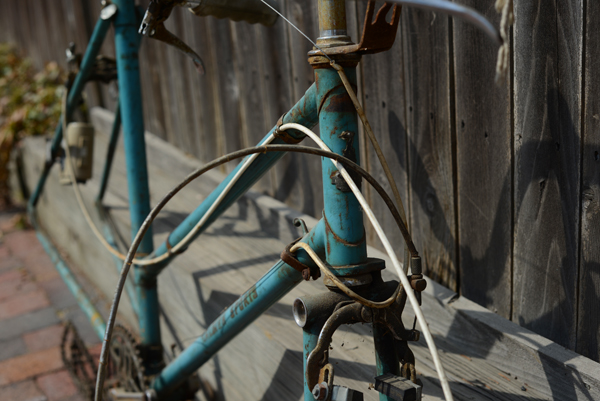
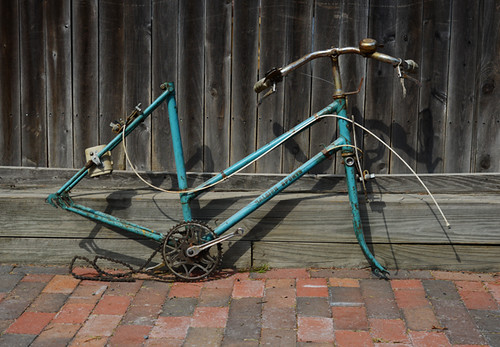
When I first saw the turquoise hued frame, I assumed it was an aftermarket repaint - not an unusual state of affairs around these parts. But drawing nearer, it became obvious by the amount of wear and tear that its colour was original. An early '60s Raleigh Lady Sports, in robin's egg blue. An iconic colour in the bicycle industry, to be sure. Just not iconic to the English 3-speeds of that era - a breed better known for its sombrer palette of oxide greens, matte blacks and root-beery coppers.

Raleigh Sports in Robin's Egg Blue
At some point all bicycle lovers experience that feeling of "Man, I am way too into this." For me this happens about once a week. And yet, it never gets old. "I've never seen one in this colour," I whisper, my heartbeat quickening. 

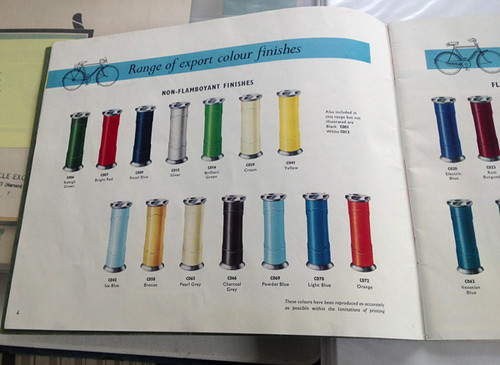
Raleigh Finish Selection for Export, 1960s
In response a 1962 Export catalogue is swiftly produced, its pages flung open to a rainbow-like spread of finishes. A dazzling range of powders and pearls, the likes of which most have never seen on an old 3-speed.

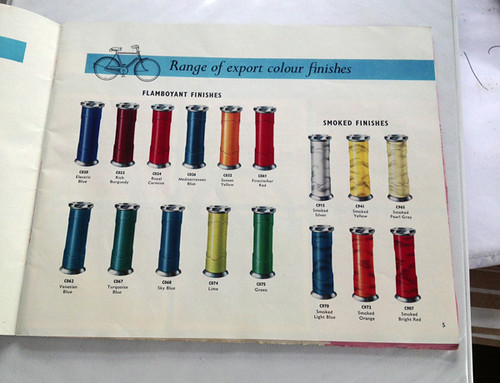
Raleigh Finish Selection for Export, 1960s
Let alone the "flamboyant" and the "smoked" finishes.

So, if all of these colours were offered, why did so few Sports models survive in anything but the usual shades we're familiar with? No one can say for sure. But most likely the dealers were risk-averse, and stuck with the original green/black/copper palette they already knew would sell well. If a more unusual colour ended up in circulation, it was likely because a customer special-ordered it.

Raleigh Sports in Robin's Egg Blue
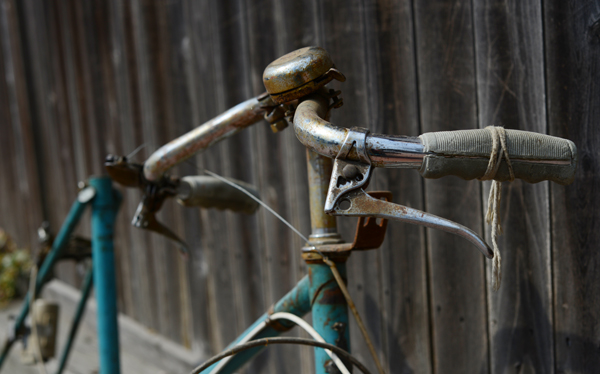
Such was the case with the frame I was now admiring. The original owner special-ordered the finish, and requested for the handlebars to be flipped when building up the bike. For the decades it was in use, she rode the bicycle with its original parts (notice the elegant grip repair method) and thoroughly enjoyed it.

Raleigh Sports in Robin's Egg Blue
It is amazing the way colour can change a bicycle's personality. Looking through my photos of the frame, a friend immediately commented that in robin's egg blue the Lady Sports looked "lighter and faster" than its traditionally-hued sisters (having lifted it, I assure you "lighter" is not the case). Another said "I thought this was a Betty Foy at first!" 

No doubt the robin's egg blue played some role in the wild popularity of Rivendell's mixte through its 2009-2012 production. And the 2011 Surly Cross Check (I am told people are still phoning bike shops on a hunt for that year's model, just because of the colour). Possibly it is the most common colour I've noticed for frame repaints for road and city bikes alike. There is just something about it, and the associations it evokes (blue skies? seaside holidays? Easter candy? vintage Vespas?), that strikes a cord. Seeing it so unexpectedly combined with a '60s Raleigh Lady's Sports was a nice treat, for which I thank, once again, Nick of the Three Speed Hub

Rabu, 19 Maret 2014

It's a Beater

In cyclist jargon, to refer to a bike as a "beater" is to describe a machine that is so weathered, so cheap, so ugly - or, ideally, so all three of these things - that you do not care about wrecking it. Sure you might have your nice bike. But it's the beater you leave out in the rain for days, ride on heavily salted roads,  lock up outside bars in dodgy neighbourhoods, and generally subject to all manner of abuse. Because who cares - it's a beater. On this concept a Canadian company has based an entire line of city bicycles, named …drumroll… Beater Bikes. For $350 a pop you get a single speed roadster, either diamond frame or step-through, equipped with a surprising amount of commuter accessories.

But what sort of creature is this Beater, with its hammer-head tulip headbadge and krylonesque paint job? The Bicycle Belle in Boston carried them briefly, which gave me a chance to try one. And you know what? By golly, I liked it. The Beater is not without faults, but as far as "budget bikes" go, it seems hard to beat (heh) and has now replaced the KHS Green as my favourite bike of that category.

As far as the basics, the welded frames and forks (described as simply "steel") come in one size only (53cm for the diamond frame and 45cm for the step-through) and one colour - matte racing green. The loop design of the step-through is attractive, in a subdued industrial sort of way, with nice even curvature, clean welds and a unicrown fork that blends in well with the frame. Aesthetically, the bike looks simultaneously classic and modern, with a subtle dystopian undercurrent to it. The all-black components (rims, crankset, stem, seat post, handlebars) complement the matte green frame finish and, combined with the iconography of the headbadge, give off a futuristic and vaguely sinister vibe. Not in a bad way. It's an interesting juxtaposition, with the bike being so vintagey in concept. Loop frames can come across as too cutesy, but the Beater does not suffer from that. The complete bike weighs under 30lb, which is pretty good for an all-equipped city commuter of this style. In addition to the single speed, a 3-speed version is available for an extra $100.

On the step-through model, the headtube is extended past the seat tube considerably, and the stem is extra long to allow for a super-upright posture. For someone of my height (just under 5'7") or taller it is also possible to adjust the fit so that handlebars and saddle are level, for a sportier position.

I like the proportions of this bicycle. It is compact compared to a genuine Dutch bike, but the "cockpit" does not feel cramped. And as far as the Beater's ride, I thought it a very normal-feeling, unremarkable (in a good way), stable bike that beginners would feel comfortable on, but experienced cyclists would not find limiting - as long as they don't expect performance beyond the city-bike category. The ride quality is not as plush as that of some others I've ridden, but it's not harsh and is better than I would expect at this price point. The bottom bracket is not too high, so it is possible to put a toe down at a stop while remaining in the saddle and still get decent leg extension when pedaling. And for me there is no toe overlap despite the 700C wheels with 38mm tires and fenders.

In addition to the fenders and chainguard, which are colour-matched to the frame,

the Beater comes equipped with a rear rack,

a double-kickstand,

battery operated LED headlight and tail light, a bell, padded vinyl saddle, rubber grips, platform pedals and even a front wheel stabiliser.

What it doesn't come with is a front brake. And therein lies the Beater's tragic flaw: It is coaster brake only. Now, I like coaster brakes as much as the next contrarian, euro-born, skirt-wearing, baguette-toting transport cyclist, and am prepared to debate their merits in my sleep. But even I would not make a bike that's meant to be ridden in North American cities coaster-brake only. I mean, come on, Beater - a pile of accessories but no front brake?.. Anyway. The proprietress of the Bicycle Belle was of the same opinion, which is why she retrofitted her entire stock of Beaters with front calipers before allowing them out the door. The good news is that this can be done aftermarket. The less good news is that it increases the bicycle's cost, thereby diminishing the wow factor of what would otherwise be a perfectly decent and ridable, fully commuter-ready $350 bike.

So, if I might be so bold as to make a suggestion to Beater: Why not nix the front wheel stabiliser (the cheap ones are no-good anyway) and replace the double kickstand with a plain old single one, then use the savings to fit the bikes with front brakes? (And to be honest, if catering to the North American market, a bike with front and rear hand-activated brakes in lieu of coaster would sell better still - but I am not versed on the cost difference that sort of change would entail.)

All things considered, I enjoyed riding the Beater. For the price point, I am impressed with both its design and with the accessories package it comes with. How well will a bike like this hold up in use is a question only an owner can answer - and if you are one of them please feel free to share your experience. Based on my limited impressions, I would recommend the Beater to readers searching for an off-the-shelf city bike for under $500 ...if it weren't for the manufacturer's choice of brake system.

Kamis, 13 Maret 2014

Double the Fork Blades, Double the Fun? Trying a Humber Ladies Sports

In the cavernous depths of Boston's Three Speed Hub, the humble black step-through looked like a garden variety vintage 3-speed. Smallish and plain of ornament it seemed downright unremarkable next to its freakishly collectable turn of the 20th century neighbours. But as I made my way past it, from the corner of my eye I glimpsed a little something that made me examine it closer - ultimately dragging it out into daylight. And there, by the creaking garden gate and under threat of rain, I stood and marveled at that deliciously bizarre feature that distinguished Humber bicycles from other English 3-speeds of its era.

Behold: The Duplex Forks!

That's right. In leu of standard fork blades, Humber devised a fork with skinny twin blades on each side.

Brazed into a twin-plate fork crown at the top with a cm gap between them, they swoop down,

growing closer together toward the dropout socket. Exciting isn't it? Okay, so maybe I need to get out more …but still! I mean come on, they are twin fork blades!

Founded in 1868 in Beeston, England, Humber Cycles were a brand that has always struck me as largely fictional. By the 1900s - when they began manufacturing bicycles as we know them today - original owner Thomas Humber had already sold the company and it was headed, as far as I can tell, by a marketing entity.

This could explain why, at a time when other bicycle manufacturers were making efforts to become more accessible to the general population, Humber boldly branded itself as "The Aristocrat of All Bicycles" (inscribed on the seat tube decal) - boasting a superior build quality and a plusher ride feel than its competitors. Naturally, these alleged advantages were reflected in the price. "Not cheap, but good," the adverts assured.

Having seen lots of Humber ephemera before ever glimpsing an actual bike, I've wondered whether perceptions of these bicycles at the time reflected the marketing message. After all, by 1932 Humber was sold to Raleigh, essentially becoming just another of its sub-brands. But when I asked this question in Northern Ireland, those who remembered the days when Humbers were sold in shops new, said that indeed they were considered high-end bikes and valued as such. And although owned by Raleigh since the '30s, Humbers were always made according to their own design - including the unique Duplex Fork.

Another distinguishing feature of the Humber is the Maypole Chainring - a ring design that features 5 dancers in a circle, presumably around a maypole. It is not clear where this design came from. Recently, a Wheel of Life plaque with a more detailed, relief version has been put up on Humber Street in Beeston.

That aside, this specific Humber has a number of neat features. The most striking is the enormous Rollfast cyclometer. Larger than a coffee mug in diameter, it displays moving speed and miles ridden.

Mounted at the stem, a cable extends from the unit to the fork's dropouts

And plugs into a plate of sorts at the axel. As far as I can tell the cyclometer still works. There are 1,396 miles on this bicycle, according to the counter.

The lighting is bottle generator powered Radsonne, headlight and tail light.

The bottle is at the back, clipped on to the left rear stay.

3-speed Sturmey Archer gearing - the gears labeled high (H), neutral (N) and low (L) rather than 1-3.

A Raleigh-branded kickstand.

And a Brooks B72L (ladies?) saddle. Interestingly, this bicycle seems to have come with (stock) upgrades of an aluminum seatpost and rear hub to make it "sportier." However, the wheel rims are steel.

Being a Sports model, this step-through was designed around 26" wheels, with a shorter wheelbase, steeper angles, and a lower bottom bracket than the more stately Roadster models, as well as with a brazed, rather than bolted, seat cluster, and with caliper brakes in leu of rod brakes. Date of manufacture is 1956.

In person this Humber looks very compact - tiny even - but once I got on, it felt like a perfect fit. The cockpit was not cramped at all, there was no toe overlap, and the North Road handlebars were easily set level with the saddle, which is my preference for upright bikes. According to the speedometer I was doing 10-12mph straight out of the gate. Sporty!

But I know that, with bated breath, you are all waiting to hear about the Duplex Forks. Do they indeed deliver a superior ride quality experience worthy of the title "Aristocrat of All Bicycles?"

Well, I will say this much. This is one fine riding bicycle. Finer, for example (as in smoother, cushier, and at the same time more responsive) than a Raleigh Ladies Sports of the same era. It was so nice I did not want to stop riding it, wishing instead to whisper sweet nothings into its ear as we cycled off into the sunset, enormous cyclometer clicking away to the tune of our bliss... But whether it's the weirdo fork construction that's responsible for this or something else entirely, is difficult to tell. While the official line was that the Duplex Forks were a design feature to improve ride feel, in reality the manufacturers of the time often just wanted to find a way to visually differentiate their product. Hetchins had their vibrant stays. Bates had their diadrant forks. Baines had their flying gate frame. And so the duplex forks were Humber's distinguishing feature. Whether ultimately useful or decorative, they are a part of bicycle manufacturing history. And getting to look at, touch and ride one of these fairly rare machines was an exciting experience - for which I thank Nick at the Three Speed Hub heartily.

Sabtu, 16 November 2013

A Go on the Bobbin Bramble

Bobbin Bramble Gold Green
Two years ago, I wrote about the Bobbin Birdie when they were first introduced in the US. These brightly coloured, reasonably priced classic loop frame bikes have since become quite popular. The London-based Bobbin now brings another model to the North American market - the step-through Bramble. As they put it, the Bramble is inspired by "the Coventry-made Triumphs beloved by Land Girls and English district nurses in the interwar years up until the 1950s." No doubt fans of Call the Midwife will rejoice.

Bobbin Bramble Gold Green
The Bramble differs from the Birdie in several ways. Its step-through frame features straight parallel tubes.

Bobbin Bramble Gold Green
Its construction is lugless, except for the fork crown. The frame is a mix of hi-ten and cro-moly steel, made in Taiwan. The complete bike weighs around 12kg and is available in 17”,19” and  21” frame sizes.

Bobbin Bramble Gold Green
Instead of the Birdie's internally geared hub, the Bramble features 6-speed derailleur gearing.

Bobbin Bramble Gold Green
And hand-activated caliper brakes, front in rear, rather than a coaster brake. 

Bobbin Bramble Gold Green
And handlebars that are less swept back, for a slightly sportier position. These aspects of the bike make the Bobbin Bramble more suitable for longer and hillier rides than the Birdie, while its commuter-oriented features make it just as transportation-ready.

Bobbin Bramble Gold Green
 Included with the bike are an integrated colour-matched rear rack,

Bobbin Bramble Gold Green
colour-matched fenders, kickstand, bell,

Bobbin Bramble Gold Green
and a chainguard providing plenty of coverage.

Bobbin Bramble Gold Green
The synthetic sprung padded saddle is wide, for an upright sitting position, its caramel-brown colour matching the grips.

Bobbin Bramble Gold Green
The 26" wheels with 1 3/8" city tires are the same as the Birdie's, and do well on battered surfaces.

Bobbin Bramble Gold Green
They also allow for plenty of toe clearance when turning.

Bobbin Bramble Gold Green
But the most noticeable thing about this Bramble is the colour. Bobbin calls this shade "golden-green," and it is the most successful recreation of that magical vintage English 3-speed shade of green I have yet come across. This nuanced green gives off a warm deep glow in the sunlight, with hints of yellow, orange and even crimson detectable in its flame-like shimmer. Needless to say, I am crazy about this colour - but for those less enamoured, the Bramble is also available in plum.

Bobbin Bramble Gold Green
I test rode the Bobbin Bramble at the Bicycle Belle in Boston, along a typical local commuter's route. Much like the Birdie, this is a straightforward, no fuss, "hop on and go" type of bike that did not call attention to itself as I cycled around the neighbourhood. The sitting position can range from bolt-upright to jauntily leaned-forward, and my own preference is for the bars and saddle to be level. However, most of those who buy these bikes seem to prefer the bars set higher, and the handling remains stable with this arrangement.

For whatever reason, I found the ride quality of the Bramble a little cushier than that of the Birdie. On the other hand, I found the handlebars uncomfortable: There is something about this particular bend that twists my wrists at an awkward angle. This could be a matter of personal taste of course. 

The Bramble does not come equipped with lighting, so adding it will be an extra expense. However, everything else needed for a comfortable commute is there. Priced at around $530 in the USA, the Bramble is another welcome option from Bobbin - this time for hillier, longer commutes. And the stunning colour does not hurt either. 

See complete specs and picture set, and many thanks to the Bicycle Belle for the test ride.