Tampilkan postingan dengan label hills. Tampilkan semua postingan

Kamis, 15 Mei 2014

Ode to the Pseudo-Wall, Its Joys and Hidden Dangers

As cyclists grow familiar with hills, in their countless iterations and guises, a reliable favourite is what I shall call here the Pseudo-Wall.

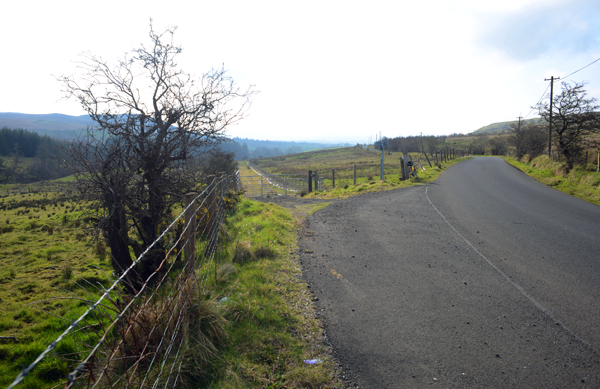
Recall those times you've cycled, at a good clip, on the rolling terrain of a vast open road as yet unknown to you - perhaps as part of a brevet, sportive or other organised ride - when suddenly, in the distance, you see this very road you are on turn vertical. From your vantage point it looks not so much like an incline or even a steep hill, as literally a wall - stone gray and perpendicular to the ground beneath you, pointing heavenward and of an impossible height.

The first time you encounter such a sight, it fills you with dread and panic. Perhaps a strange taste builds up in your mouth. For surely what looms ahead is unscalable. Oddly, the other riders beside you are not screaming, writhing, or turning back in terror. Perhaps they are made of stronger stuff than you.  Or else they hide their true emotions, just as you attempt to do.

Contemplating this, you advance toward the fearsome giant and stoically brace for impact - for the burning pain in your legs, for spinning wildly or standing on the pedals and stomping, for the possibility even of having to unclip and walk. But as your approach continues, something rather odd happens: The point of impact never comes. It is as if the transition toward the wall's gruesome incline blurs and softens as you draw nearer. And just as you start to wonder When will I finally reach this knee-breaking monster?! you glance over your shoulder and see you are already half way up it. In no particular order, you cycle through feelings of joy, surprise, suspicion, relief and anti-climax. And by the time you are done with those, you've reached the very peak. Did you even climb a hill at all? The dizzying view behind you says yes indeed. But your body does not feel anywhere near the anticipated effects.

Such is the wondrous phenomenon that is the pseudo-wall. Some call it a false climb, for it is a climb that looks far worse than it feels. Possibly the effect is a visual illusion, having to do with perspective and limitations of the human eye. Like when we see a huge setting sun and excitedly snap a picture, only to capture a tiny spec. It can also be that we underestimate our momentum on approach, which proves sufficient to carry us over the steep parts. But no matter what we call it and how we explain it, what a rush it is to know, when we see the thing ahead and recognise it for what it is, that we can conquer it with relative ease despite its menacing facade. Once familiar with the pseudo-wall, we storm it with fearless confidence. And it is then the new riders who steal glances at us and wonder how we can be so calm when heading toward that thing.

In that implicit, visceral way that bypasses rules and checklists, we learn to recognise the pseudo-wall, to tell it apart from hills that will truly feel brutal. We get quite good at this over time. But on occasion, mistakes are made. Unlucky is the cyclist who encounters the False Pseudo-Wall. Doomed is the cyclist who attacks it blithely, only to feel their speed and energy drain so quickly it leaves them breathless even before the pain hits, even before the cold panic of having misjudged their gearing sets in. Having witnessed cyclists fall prey (literally falling over, having failed to downshift in time!) to the false pseudo-wall, I will never underestimate its sinister ways. With respect I eye every new looming hill, for their power to surprise is awesome.

Jumat, 11 April 2014

Toward a Topographical Fatalism

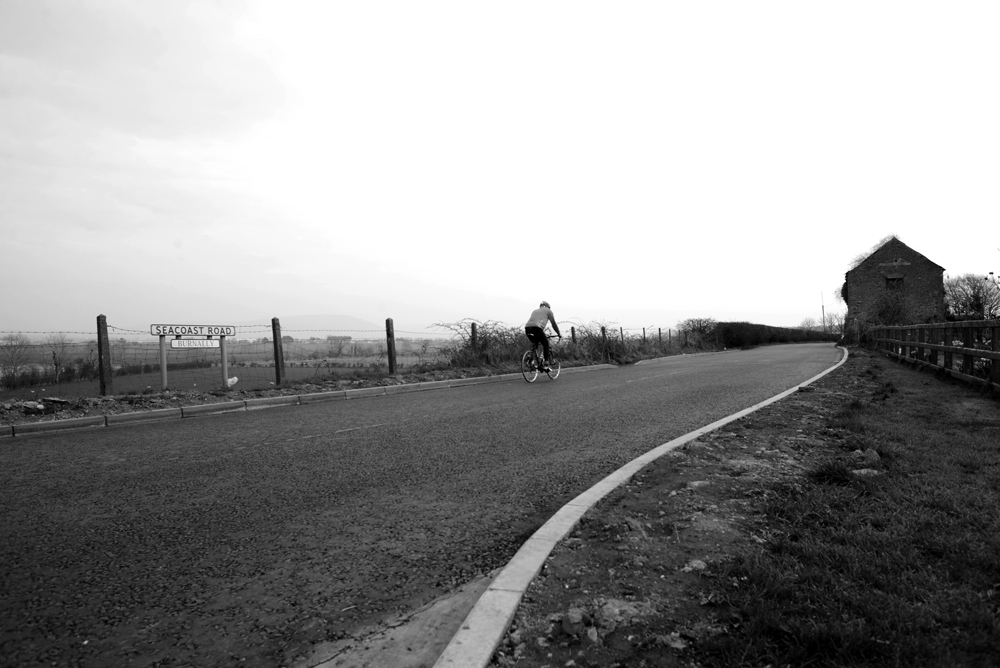
Seacoast Road Cyclist
Without a doubt living in Northern Ireland has changed me as a cyclist. I have noticed. My friends have noticed. But the exact nature of this change is tricky to articulate. It isn't merely a matter of having gotten "better," as defined by improvement in speed and technique. Sure there is that too. After all, how can one not improve with pavement the texture of hard-packed gravel? With a mountain straight out the front door? With winds attacking from every direction? With former racers for cycling buddies? 

But the more fundamental change is in a shift in perspective. I have given in to the landscape. I have stopped approaching difficult topography as a problem - or even thinking of it in terms of difficulty in the first place. The landscape is there, its qualities outside my control. I cannot change it. I can only experience it, appreciate it, remember it. And that is best done if I do not struggle against it, but instead take it as it comes. Rather than suffering through a climb and wishing for it to end, I try to harmonise with it and - believe it or not - enjoy the moment  …or minute, or hour, as the case may be. When approached this way, the reward becomes not the view on top, and not even the sense of accomplishment upon reaching it, but the climb in itself.

Of course it's easy for me to adapt that attitude now that I have a featherweight bike with ultra-low gearing. But it isn't just that either. One day last Autumn I was out with local cyclist and coach Colin Loughery. We were talking about gearing, pedaling technique and strength training. "You want to try something?" he asked. I replied that I did, whereupon he instructed me to accelerate and get into my tallest gear as we rolled down a long flat stretch giving way to a slight incline. "When this flat bit ends," he said, "there will be a drag [hill]. See if you can stay in your tallest gear all the way to the top."

My mood instantly darkened. I didn't look forward to embarrassing myself in front of Colin. But I knew the incline we were about to go up, and there was just no way I could do it in 50/11. Feeling the momentum begin to wear off as I started the climb, my mind raced, grasping for strategies that would at least save me from toppling over. Maybe if I stood right away and pushed with all my might...

But before my butt had a chance to leave the saddle, came Colin's friendly command. "Don't stand! Stay seated and don't change gears. Just pedal." The words coming out of his mouth were so fantastical, that upon hearing them something in me snapped and allowed me to suspend disbelief. Okay, I would pedal. And in this insane gear, while remaining seated, I would crest this hill without breaking my knees or toppling over. 

And then I did exactly that. The strength for it came from somewhere deep within my abdomen rather than from my legs or lungs. It was as if some extra cluster of muscles appeared to accommodate this impossible thing I was trying to do. I could feel it for days afterward. 

"Good. But you stopped pedaling in circles." Colin had said to me at the top. As if, such a normal and casual thing it was to cycle up a hill in 50/11, that we could talk pedaling technique. Circles were the last thing on my mind then ...a pity, as later I discovered that making sure to continue pedaling circles and resisting the urge to stomp makes even grinding feel nicer, more meditative. 

The seeds had already been sewn. But it was on this ride that a philosophy of topographical fatalism took root. Just go with it. Suspend disbelief. The road awaits, and with it the wonderful unknown. 

Rabu, 02 April 2014

Of Miles and Mountain Vistas: A Spring Initiation Ride

View from Burnfoot
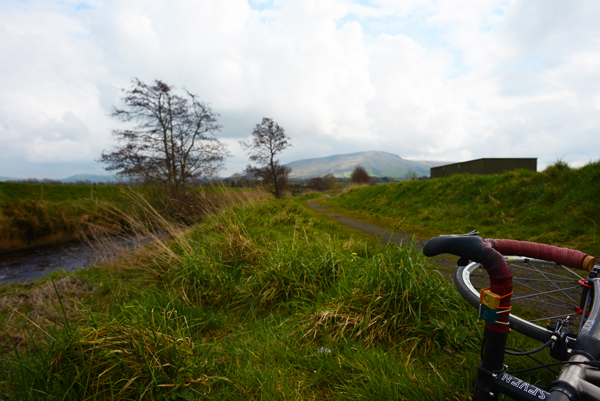
Having told myself I would not stop until at least ten miles in, it worried me that I was already tired so early into the ride. But when I rolled into the center of Burnfoot - with its view of the Pointy Mountain and its titillating village shop selling 60p sausage rolls - I saw it was mile 15 already. Somehow the time, or the distance, or both, flew faster than I realised. So far so good for the first big ride of the season. With my piping hot sausage roll and electrolyte-laced water, I sat by the stream and took in the landscape that spread out in front of me. It looked far. And it was where I was headed. 

I've tried not to whine about it too much. But, as far as road cycling goes, winter in Northern Ireland was disappointing. Because it rarely snows here, I hoped to ride year-round without breaking stride. But the powerful winds put a damper on that. From mid December through a good part of March, I was lucky to get out once-twice a week, and even then for 20 or so flat miles at a time. I had not done any significant hills or milage since before the winter holidays. When finally the weather turned enough for proper cycling to commence, the expression "Two steps forward, one step back" came to mind. I panted up climbs and panicked down descents that I had come to think of as easy by last summer's end. Good thing I did not start with the intermediate ones!

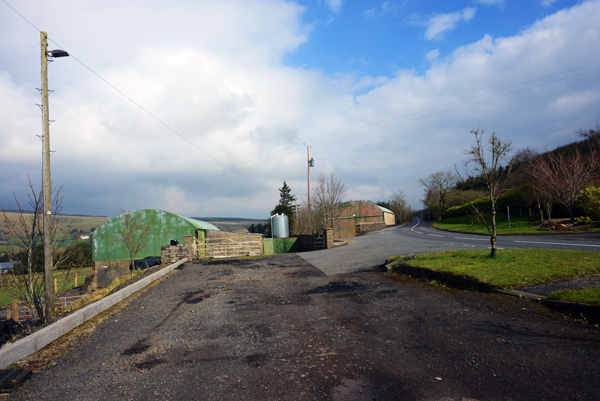
Farm Road to Garvagh
Last spring I worried about working up to longer rides and even put together a training schedule. This year I did nothing of the sort. The feeling of readiness happened organically. One day I just knew: Tomorrow. I sat down and planned the route, a meandering 60-odd miles along the shoulders of a couple of local mountains, through the villages of Drumsurn and Garvagh. The route would begin with some flat miles, followed by a warm-up climb, then two long climbs and descents, before turning flat again for the final stretch home. I designed it mostly along back roads and to maximise mountain views. The climbs were a side-effect of that, rather than the objective. Still, I saw this ride as a sort of jump-start to the season, as a shot of adrenaline, as something to shock my system and jog my body's memory, to establish a reacquaintance with the miles and the climbing. As part of this spring initiation rite, I accepted that, along with the beautiful views, some degree of pain and misery awaited me. 15 miles in and already tired, I braced myself for what was to come. "This will be difficult. But get it over with, and future rides will be more enjoyable."

Legavallon Pot
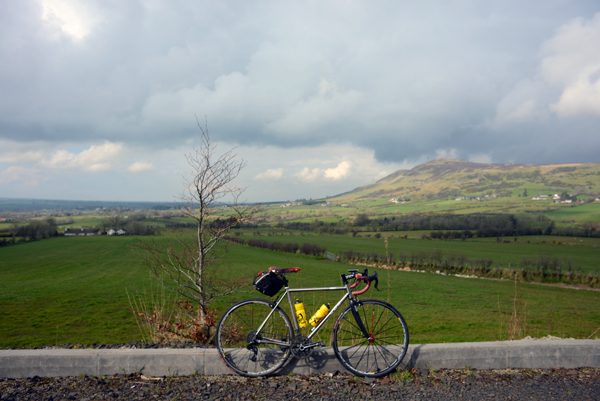
But as flat roads gave way to rolling hills, which gave way to the first real climb, I began to feel better, not worse. Somewhere from deep within, an energy emerged, as if out of winter hibernation. The energy did not come in bursts, but seeped out in measured doses, at once calming me and waking me up. The eight mile climb along Legavallon Road wasn't difficult. It just Was. It didn't hurt or feel miserable. It was merely slower than a non-climb. And this slowness was a welcome one, affording plenty of opportunity to study the valley that spread out to my left more dramatically with each foot of elevation gain.

They call this part of the country the Legavallon Pot. Cycling up a mountain ridge in Drumsurn rewards with a dizzying view of a round gap, green with pastures and milky with low cloud, like an enormous bowl of matcha. Interestingly, the official observation point does not show off this feature of the landscape particularly well. But the stretch of the road that does is awkward to stop at. The best way to observe it is from the bike itself, rolling through the view.

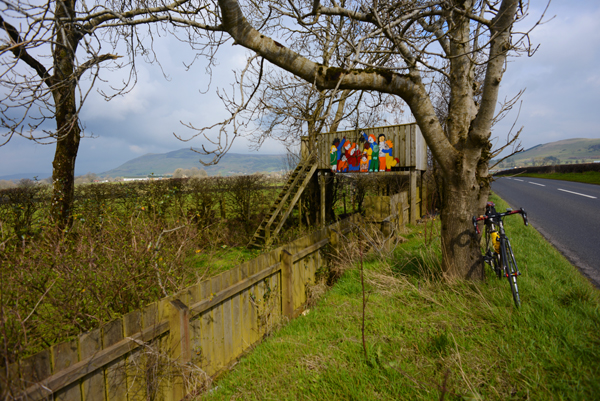
Tree House Mural in Drumsurn
In addition to the natural landscape, the country roads that criss-cross these hills are full of fascinating oddities. My favourites are the mysterious murals in the middle of nowhere. 

Here a boy dangles a giant spider over a group of other children and one green alien, who respond with an impressively realistic variety of emotions. Some look amused by his antics. Others are terrified. Others still appear aloof, or saddened by being on the sidelines of the game rather than at its center. I thought it a nuanced portrayal of child group dynamics. The tree house and mural were not near any sort of residence or child care center, as far as I could tell.

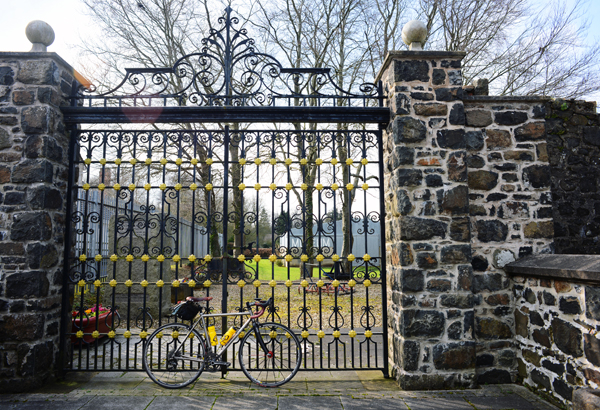
Garvagh Museum Gate
The village of Garvagh is an old one and deserves a post dedicated to it exclusively. While tiny, it boasts a surprising number of attractions - including a forest, a museum, its very own pyramid, and a history of vampirism. But on this occasion, I was more interested in its eating establishments. I stopped at a fish and chips shop and ate a late lunch as school children in their uniforms descended from buses, staring at my bike and attire with undisguised curiosity. Allowing for the school run traffic to die down, I set off for home. 

Descent to Limavady
The second big climb was on the return leg and steeper than the one before …which, when I noticed this fact, made me think of Pamela Blalock and her signature rides. She is known for, shall we say, throwing in some wake-me-up hills at the end of a long ride. And while at first I dreaded this, eventually I not only got used to it but began to look forward to it, feeling disappointed if a ride did not feature a good so-called Pamela Climb at the end. 

With a mental salute to my friend, I cycled up the mountainside appreciatively. My legs, however, were now growing heavy and I could sense the wilting point on the horizon. It also grew unseasonably warm, and soon I was sweating under my jacket. But seven miles later the descent came, and with it the cooling rush of breeze against my face and chest. The mountain views ahead grew dense and layered, like overlapping bits of construction paper in subtle shades of slate blue and lilac. Of course during the beautiful parts I was going too fast to want to stop for pictures. But seeing this landscape I made a mental note to return here via a more direct route soon, specifically to photograph it.

The descent went on and on. And to think that I had almost forgotten over the winter that dream-like sensation of falling. Now it came back to me in full emotional force. Miles and miles of plunging down a mountainside. On descents like this, the bike becomes something other than a bike. A flying carpet?

A day and a short recovery ride later, I still feel buoyed by the sensation of that last descent, by the rush of following the curves of the road while staring ahead at those layered hazy mountain ridges. That sort of descent really does feel like a dream. Or like a long swoon. The 60 miles and the climbing and the feel of being out of shape are not what I remember after this ride. Perhaps that is why I want to keep going further.