Tampilkan postingan dengan label technique. Tampilkan semua postingan

Kamis, 22 Mei 2014

The One Who Taught Us


It's always interesting, when reading books that have nothing to do with cycling what so ever, to come across such passages, casually thrown in. The world of bicycles permeates the text suddenly and then, just as abruptly, it is abandoned. It was, after all, only a snippet. A literary device. Usually a means of conjuring up a childhood memory, replete with symbolism.

Oddly enough I've stumbled upon these types of narratives in several completely different books I've recently read. Each time the passage had to do with learning how to ride a bike - or, more precisely, with the person who taught the author how to do so.

This makes me wonder whether most people - whether they go on to be cyclists in their adult lives or not - have such a memory, and similarly to these authors, feel the incident to be somehow pivotal to their life story. Is it an important memory, the kind of which we have a very vivid sensory recollection? Does it serve to illustrate either the character of the teacher, or the relationship between them and the fledgling cyclist? Furthermore, are there specific persons who tend to play this role in our lives? When I surveyed my friends, grandfathers and uncles made repeat appearances.

Reading and listening to the stories of others, I realise I may be an anomaly. No one taught me how to ride a bicycle. I figured it out myself, on a borrowed bike, alone, in a city park. New York City in springtime. Saturday afternoon. Cherry blossoms. Orthodox Jews strolling. Children's squeals in Spanish from the swings and monkey bars. And me, apart from it all, a clumsy curious child with messy hair, wearing something stripey, made of a terrycloth fabric. I do have a vivid memory of it, and in particular, of the moment I went from pushing off and coasting for several seconds at a time, to knowing, with a breathtaking certainty, that I could keep the bike in motion indefinitely and, aglow with this knowledge, planting my feet on the pedals. This moment went hand in hand with the awareness that no one was there to witness it, to congratulate or encourage, like I'd seen the minders of other children do. But it wasn't a sad feeling. To know that this unbelievable thing I'd just done was my secret only added a layer of depth to the magic.

In retrospect it would have been nice to share a special bond with a family member or older friend through the act of being taught how to cycle. But being my own teacher, however clumsily and haphazardly, makes for a nice memory as well.

PS: text excerpt from Birchwood by John Banville.

Jumat, 11 April 2014

Toward a Topographical Fatalism

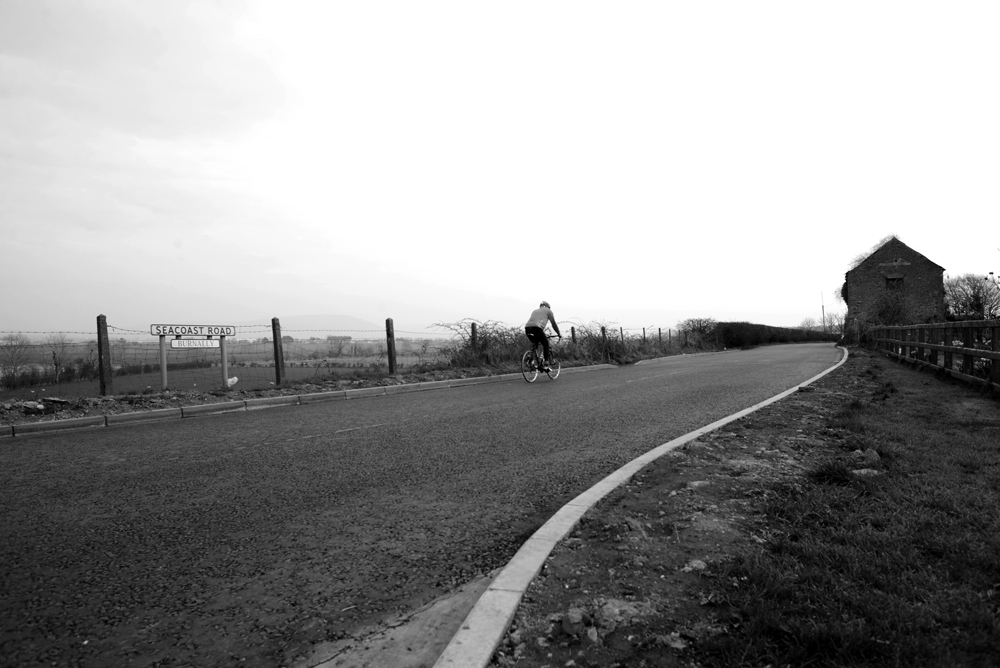
Seacoast Road Cyclist
Without a doubt living in Northern Ireland has changed me as a cyclist. I have noticed. My friends have noticed. But the exact nature of this change is tricky to articulate. It isn't merely a matter of having gotten "better," as defined by improvement in speed and technique. Sure there is that too. After all, how can one not improve with pavement the texture of hard-packed gravel? With a mountain straight out the front door? With winds attacking from every direction? With former racers for cycling buddies? 

But the more fundamental change is in a shift in perspective. I have given in to the landscape. I have stopped approaching difficult topography as a problem - or even thinking of it in terms of difficulty in the first place. The landscape is there, its qualities outside my control. I cannot change it. I can only experience it, appreciate it, remember it. And that is best done if I do not struggle against it, but instead take it as it comes. Rather than suffering through a climb and wishing for it to end, I try to harmonise with it and - believe it or not - enjoy the moment  …or minute, or hour, as the case may be. When approached this way, the reward becomes not the view on top, and not even the sense of accomplishment upon reaching it, but the climb in itself.

Of course it's easy for me to adapt that attitude now that I have a featherweight bike with ultra-low gearing. But it isn't just that either. One day last Autumn I was out with local cyclist and coach Colin Loughery. We were talking about gearing, pedaling technique and strength training. "You want to try something?" he asked. I replied that I did, whereupon he instructed me to accelerate and get into my tallest gear as we rolled down a long flat stretch giving way to a slight incline. "When this flat bit ends," he said, "there will be a drag [hill]. See if you can stay in your tallest gear all the way to the top."

My mood instantly darkened. I didn't look forward to embarrassing myself in front of Colin. But I knew the incline we were about to go up, and there was just no way I could do it in 50/11. Feeling the momentum begin to wear off as I started the climb, my mind raced, grasping for strategies that would at least save me from toppling over. Maybe if I stood right away and pushed with all my might...

But before my butt had a chance to leave the saddle, came Colin's friendly command. "Don't stand! Stay seated and don't change gears. Just pedal." The words coming out of his mouth were so fantastical, that upon hearing them something in me snapped and allowed me to suspend disbelief. Okay, I would pedal. And in this insane gear, while remaining seated, I would crest this hill without breaking my knees or toppling over. 

And then I did exactly that. The strength for it came from somewhere deep within my abdomen rather than from my legs or lungs. It was as if some extra cluster of muscles appeared to accommodate this impossible thing I was trying to do. I could feel it for days afterward. 

"Good. But you stopped pedaling in circles." Colin had said to me at the top. As if, such a normal and casual thing it was to cycle up a hill in 50/11, that we could talk pedaling technique. Circles were the last thing on my mind then ...a pity, as later I discovered that making sure to continue pedaling circles and resisting the urge to stomp makes even grinding feel nicer, more meditative. 

The seeds had already been sewn. But it was on this ride that a philosophy of topographical fatalism took root. Just go with it. Suspend disbelief. The road awaits, and with it the wonderful unknown. 

Kamis, 20 Maret 2014

The Body Remembers

I never thought that I would become one of those cyclists with permanent tan lines. But many months since my last ride in shorts the persistent duotone of my legs says otherwise. It is strange to see myself discoloured in this way, to be sporting this roadie badge of honour that I never strove for and do not especially "deserve." Are these legs even really mine?

In fairness, the bulk of the damage was done in the course of a single ride, early last summer: that 300K brevet, when, uncharacteristically, I rode all day in 90°F+ heat and humidity without issue only to, equally uncharacteristically, give up just 30 miles from the finish after night had fallen. This failure hit me with unexpected intensity. After some time I wanted badly to put it behind me, to stop dwelling on the hows and the whys and the what-ifs. But how could I forget an event that left me physically branded? The marks were so prominent, the contrast between the pale and the darkened flesh so dramatic. To make matters worse, everyone around me noticed. "So many miles so early in the summer!" But of course they did not know the real story the tan lines told. All those hours in that insane sun… and all for nothing.

When they don't make me think of the failed brevet, my etched legs make me think of photography. There is considerable overlap between cyclists and photographers, and among these are many film enthusiasts. When you ask those who prefer film over digital to explain why, many will tell you film has a special look that digital simply can't replicate, that film stirs emotions in a way that digital cannot. I do not believe this to be so, and the more I use both mediums the more certain I am there is no such thing as "the look of film" per se. Once you fully and properly control for format, type of lens used, type of film used, aperture and exposure settings, and the myriad of other factors involved, I believe that you can create a digital and a digitised (i.e. viewable on your computer) film image so that the two are indistinguishable to the human eye and emotional palette.

This is not a popular opinion and many film lovers will disagree. But that is beside the point. Because my point is that despite holding this view, I nonetheless prefer film photography over digital. When I want to capture something truly special or meaningful - be it a place, person or event - I shoot it on film. For me it is not about the look, or the quality, or the negative vs megapixel size. It is about capturing a moment and fixing it in physicality; it is about transforming fleeting light into a solid tangible object. The sensual palpability of the silver gelatin process is especially appealing. The baths, the resins, the salts and metals, the "cooking." The photographic process is essentially a printmaking process, and it is the alchemy of it that attracts me. Is this any more valid than the "special look of film" narrative? Maybe not. It's only my way of conceptualising it.

When seen from this perspective, my legs, in a sense, have become photographic objects. Exposure to light produced an etched, physical record of an otherwise fleeting event. Large format. Pigment on flesh. If analogue photography is what I'm after, this is it, in its most basic form.

After a long winter, I am slowly getting back into the swing of roadcycling. The tan lines are covered by long fleecy tights and, considering where I live now, might be for some time. But as I ride, I notice something else that has imprinted on my body. While my fitness level has degraded and my muscle tone's diminished, the technique I have internalised over last summer and all the summers before that have not. On climbs I rise out of the saddle so effortlessly, and on corners I lean so intuitively, that I can hardly believe it was ever otherwise. And then there is that feeling of oneness with the bike that carries with it an animalistically alert-yet-calm sort of confidence that I can hardly put into words. These states of being are etched so deeply, they are of archival quality. The body is analogue and it remembers.

Rabu, 05 Maret 2014

Easy Breezy Squeezy

Lately I've been getting a kick out of cycling through tight spaces. You know, like claustrophobically narrow alleys. Skinny gaps between poles. Openings in fences. Interruptions in rows of dense prickly hedges. Doing this opens up a whole new world of shortcut possibilities. And delivers a physical rush from zipping through a gap that, while wide enough to fit me and my bike, is just wide enough and leaves no room for error. Anyone else enjoy this, or am I just being weird?

But it's about more than the fun factor. For me there is great satisfaction in being able to make that "will I fit through this?" judgment correctly, quickly and with reasonable confidence - something that would have been out of the question a couple of years ago.

I've always had problems with proprioception (awareness of the body in space), and in turn, with spatial rotation. I'm the sort of person who routinely bumps into furniture. Who tries to kick a ball and misses. Who ducks for a tree branch that hangs nowhere near low enough to hit my head. Driving a car was always stressful because of this; the detached, abstracted feel of being inside a vehicle distorted my sense of movement in space even further.

There is a unique physicality to being on a bike, that communicates balance, motion and speed in a way that, however slowly, gets through to me. And it is doing more than teaching me new skills. Essentially it is repairing sensory motor deficiencies that I thought were permanent. It is a gradual process, not a quick fix. But year by year, and sometimes even month by month, the improvements are noticeable. Ironically, I would even feel more confident driving after these years of riding a bike.

There are times I think life is complicated. But then I fly through a gap in a fence without breaking stride and feel so happy, that I remember it is not that complicated after all.

Senin, 06 Januari 2014

The Way We Do the Things We Do

A recent bout of flu has activated a marathon knitting session, with nearly everyone in my immediate radius now supplied with a hat or two as a result of my drowsy, sofa-ridden industriousness. I've also started a sweater, which, thankfully, is complicated enough to keep me occupied for days. When fellow knitters see the things I make, they usually ask about the pattern. And my reply is that I don't use a pattern. I know the basics of knitting and sort of improvise from there. I visualise designs in my head and implement them without even sketching anything out on paper. I gauge sizing by looking at a person and guesstimating. The whole process is so intuitive and unconscious for me, that it is almost automated: From conception to completion, I don't pay much attention to what my hands are doing, until - voila- the thing is magically finished, and with some luck, looks and fits as intended.

This approach to knitting has its benefits. However, it also means that I am terrible at explaining to another person how I made a particular garment. It seems so obvious to me, that I find myself saying things like, "well, just - you know - knit a beret shape!" (they: "but… ??!!")

In the midst of such conversations, I am fully aware how frustrating it must be - particularly for a novice knitter - to talk to someone like me. Because that's how I feel talking to anyone for whom cycling is so intuitive, such second nature, that any attempt to break down technique into a step-by-step process is beyond them. "What do you mean how do you climb standing?" such a person might say, "you stand up on the pedals and do it!" Right. Just like you'd pick up the needles and knit a beret.

It may seem that cycling and knitting have little in common. But in fact every productive and performative activity involves, on some level, mastering a sequence of distinct steps. The earlier in life we learn this activity, the more naturally we take to it, and the more frequently we practice it, the less aware we are of those steps - the more seamless and unconscious the sequence becomes. We go through it automatically, unthinkingly, and in so doing we might even genuinely believe that the act is, or "should be," that way for everyone. But the thing is, it might not be. It really might not.

If I consider the way I do the things I do, I realise that cycling is one of the very few activities I do on a regular basis and enjoy doing, where I give any explicit thought to process. Everything else - be it cooking, photography, painting, knitting or dancing - I do on a more unconscious, automated level. Technique is involved, but I've internalised it to the point where it has become invisible unless I really, really force myself to acknowledge it. Maybe over time, it will be the same with cycling. Or maybe it never will. In the meanwhile, I try to be more mindful of the way I explain my process to others, if they ask me questions about activities that to me seem self-evident.

Kamis, 03 Oktober 2013

Left, Right, Left? On Cornering and Traffic-Handedness

Dowland Road, Limavady
For much of my adult life, I have moved between countries with right-handed and left-hand traffic flow. However, until recently I had only driven and cycled in the former. Only when I stayed in Ireland last spring did I finally experience cycling on the left side of the road. Since then, I have gone back and forth several times, and have noticed something odd in the process: I seem to do better cycling in left-handed traffic - in particular, when it comes to cornering. 

I first noticed it earlier this summer. Cycling on the winding back roads in Northern Ireland's Roe Valley, I was somehow able to make tighter turns and to corner faster than back in New England. When I shared this observation with a riding buddy, he said "Well, sure - you're getting more practice now." But I could not attribute this improvement entirely to practice, because I noticed it immediately upon arrival. And when I went back to Boston later, I noticed a difference in the opposite direction: I was not quite as good at cornering as I had been at the end of my stay in Ireland. How could my ability suddenly diminish like that?

Only after some time did it hit me that the side of the road I was on played a role. In the US, right turns are tighter, since you are cycling on the inside of the turn, and left turns are wider, since you are cycling on the outside. In Ireland it is the opposite. And apparently I find it easier to do a tight left turn than a tight right turn.  It is not a huge difference, but it is there: I can do a sharp left much more intuitively - and therefore faster, smoother, calmer - than a sharp right. 

Noticing this has made me wonder whether others have had similar experiences in directional preference when cornering. Is it related to the cyclist's handedness, I wonder? Me, I started out naturally left-handed, but was re-trained to be right-handed at a young age... which resulted in an ambidextrous hodge-podge where I am right-handed in some tasks, left-handed in others, and indifferent in others still. What role this plays in cycling, I am not entirely sure. But when it comes to cornering, it seems left-handed traffic flow is my friend.

Rabu, 18 September 2013

Driving As a Cyclist

Pickup Truck Reflections
Until last week I had not been behind the wheel of a car since 2007. But I knew this day would come - the day I would want to drive again. 

Over my years as a driver, the cars I've owned have always had automatic transmission - I never learned how to drive manual. When I mention this to an Irish friend, he shakes his head and roars with laughter. "Automatic!" He says it as if the word itself, used in relation to cars, is amusing in its absurdity. "Automatic?! Okay, so you never learned to drive properly in the first place. Well come on - I'll learn ya!"

And just like that, I am in the driver's seat. I feel ready for this, looking forward not only to being behind the wheel after such a long time, but specifically to trying the manual gear-shifting. And the funny thing is - this enthusiasm comes from being a cyclist, not in spite of it. 

The 8 mile stretch of Benone Beach is like an unpaved extension of the road. Cautiously I maneuver the rickety Saab along the sand, my left hand on the gear shift knob, my senses heightened, trying to listen to the engine's sounds and feel the give in the clutch.

Things do not go as badly as I thought they might. I am not stalling out. I press the correct pedals. My hand is getting used to the positions of the gears, so that I can shift without looking. Operating the gear box makes sense, having gotten used to the concept and feel of gears on the bike. When the gear is too high, the car makes a straining noise - not unlike a cyclist grinding along at a painfully low cadence. When the gear is too low, the car feels as if it is spinning out, unable to pick up speed efficiently. It is not a perfect analogy by any means, but it is just enough to make sense. And I can feel that with some practice this will become intuitive.

I think of driving now differently than I did 5 years ago. Cycling is a very physical activity, and it has made me more viscerally aware of the mechanics involved in operating a vehicle. I think of driving as a serious skill, rather than a perfunctory action. When in the passenger's seat I now find myself more aware of the driver's technique and degree of control under different road surface conditions and speeds. Having worked so hard to learn how to handle my bike on winding mountain roads, I appreciate the handling skills involved in operating all vehicles - be they motorcycles, tractors or cars. Some of the people I know here are extremely skilled drivers, and I must admit that riding with them is exciting. I am impressed with the smoothness and precision with which they operate their complicated, heavy 4-wheel motorised vehicles. And if I do drive myself, I aspire to aim for the same degree of proficiency.

Rabu, 14 Agustus 2013

Tracing the Tangles

Mysterious Ways
In theory, cycling on Cape Ann - with its miles of rocky beaches and its quaint villages - should be idyllic. In practice, it is all main roads, devoid of shade and dense with traffic, along a largely hypothetical coastline. The water views are obscured by developments and the sea is strangely scentless much of the time. Add to that the crater-sized potholes, the unyielding drivers, and the mosquitos immune to insect repellant - and frankly I don't find it so idyllic at all.

But stubbornly I persist: the same old 45 rolling miles, from Rockport to Ipswich and back. There is exactly one stretch of backroad along my route, and I anticipate it as one might anticipate a tart fruity filling in an otherwise bland pie.

There is only one stretch of backroad, but this stretch has a little of everything: climbing, quiet, overhanging trees, wooden bridges over saltwater marshes. And the part I look forward to most are the twists. The narrow road loops abruptly to the left, then to the right, then to the left again, then - who knows. It twists haphazardly - not so much a series of hairpins, as a mess of tangles.

As a young girl I once found a stray length of golden chain in my grandmother's garden. It was thin and delicate, the kind of chain meant to be worn with a pendant. But now it was dirty and torn and missing a clasp - not really of use to anyone. I remember standing there and spilling it back and forth from one hand to the other, fascinated by the curves and tangles it made each time it settled on my palm. I would trace the tangles with my eyes and it was an act of meditation.

This memory comes out of nowhere as I now trace the twists of the road on my bike. Or rather, it is the bike that traces them. I merely hang on and take it all in, savoring the experience. The bike leans dramatically left, then right, then left, then ...who knows. And I relax and lose myself in the meditative feel of it, my hands keeping clear of the brakes. I can't tell you how I finally learned to corner. It just happened one day. It emerged from a tangle of experiences, memories, emotions.

Senin, 15 Juli 2013

Last Woman Standing

Pushing my bike uphill, I am high off the ground and high on happiness. 

"Look, look! I can stand out of the saddle!" 

My riding companion's face registers confusion, then bewildered comprehension. 

"Oh my God. You mean all this time you couldn't?!" 
"Nope!" 

Funny that she hadn't noticed - although many people I ride with don't seem to notice my deficiencies in cycling skills; I guess I find ways to disguise them. But privately I remain acutely aware of those deficiencies. And ever since I started riding as an adult, I've been trying to master this particular "skill" - something most riders seem to take for granted as just being part of riding a bike. Standing up when a gear feels too high is simply the natural thing to do for them. Pedal sitting, pedal standing, what's the difference?

For me there was a big difference. Since childhood, I've had problems with balance and proprioception (the awareness of one's body in space), both of which made riding a bike in anything but a rudimentary manner seem unattainable. 4 years ago, I could hardly swing a leg over a top tube without toppling over. But my irrational love of cycling made me persistent. Things are much better now than they used to be, to the point that I can almost pass for "normal" on a roadbike - all the more reason my few remaining difficulties are so frustrating. 

So what was the problem getting out of the saddle?.. The physical memory is disappearing now, but try to imagine this: Whenever I'd try to stand up, I would lose the sense of where I was in relation to both the bike and the ground. Not only did I have no intuitive notion of how to hold my body up when no longer seated, but I'd start to experience general disorientation and mild vertigo. Not surprisingly, these sensations would make me anxious, which in turn made the whole thing worse; a vicious cycle. Verbal instructions from well-meaning riding companions did not help. This was obviously just something I needed to work on myself. And I did keep trying.  

But the first break-through came when I wasn't trying at all. It was a couple of months ago. I was riding an Xtracycle Radish one day, up a gentle hill. Just before I was about to reach the top, I stood up and leaned forward instead of downshifting. My mind was elsewhere and the whole thing was unintentional; it just happened. After I realised what I'd done, I was so happy I almost had to pull over on the side of the road to laugh or cry or something. My mind was blown! I tried it again later, this time intentionally. It was not quite as natural as the first time. I was jerky in my movements and my legs grew tired quickly, but for a few pedal strokes at a time it worked. 

Several days later came the 300K brevet. I was losing time on a long climb, and in a moment of frustration I tried standing up again so that I could push a bigger gear. This did not feel the same as it did on the Xtracycle and I nearly fell off my bike. After that I decided to give my standing attempts a little rest.

And I did, until one day - on my roadbike in Northern Ireland - it "just happened" again on its own. I simply stood up, absent-mindedly on a short hill. This time I decided to harness whatever impulse had enabled me to do this. Continuing to ride on rolling terrain I stood up again and again, rather than switching gears, until I began to trust that I could do it. After a week of this, I was no longer hesitant or nervous to stand up at will. 

A few days ago I pedaled over to County Tyrone to visit a friend. It was a 100 mile day with around 6,000 feet of climbing over the "shoulders" of the Sperrins mountain range. I stood up whenever I wanted, and finally, in the course of this ride, it began to feel as I imagine it's felt to other riders all along - normal. 

One thing I realise now, is that in addition to whatever balance issues were involved, another problem was weak legs. At first my legs would start to quiver after just a short time out of the saddle; I felt like one of those newborn colts learning to walk. On a serious hill, I still get worn out quickly when standing. So even though the balance and proprioception problems are gone, I continue to practice just to develop more leg strength. And finesse. At the moment, my technique is not exactly elegant. I don't throw the bike from side to side needlessly, but my pedal strokes are jerky and awkward compared to how I pedal seated. 

As my last two years of roadcycling have shown, it is possible to do even long distance rides without ever standing out of the saddle. And there are, after all, experienced riders who simply prefer not to stand. I do not know whether I am one of them yet. But once I form a preference, it will be exactly that - a preference, and not a limitation.

Selasa, 02 Juli 2013

Wind Beneath My Wheels

Windy Brompton Blur
Cycling in New England, I've had my share of encounters with strong winds. Or at least, what I considered strong winds. Here in Northern Ireland they are on an entirely different scale. Part of it is the open landscape. Much of the time, you are cycling through glens (undulating grassy hills), without much in the way of trees for cover. Even the mountains tend to be all grass and rock, with only the occasional clump of forest. This quality of the landscape is part of what makes cycling here so special - the open, panoramic views are ever-present, encouraging on climbs and breath-taking on descents. But on windy days there is little in the way of shelter. Cycling in a group, the riders can shelter each other. Cycling alone, you are exposed to it all. 

And the windy days can be unpredictable. I have gone out on a calm morning, only to battle violent gusts mid-ride. I have cycled down a straight road in what alternated between headwinds and tailwinds - confused, erratic currents.

One day last week, a headwind grew so strong and steady that, as I rode down a long steep hill it insistently pushed me back up. I could not have imagined such a slow, strenuous descent: It was as if some invisible giant had casually put his hand up against my handlebars.

But most disconcerting of all are the cross winds. I've had the least experience with these so far, but here they are common. Winds blowing sideways and on the diagonal can be strong enough to push the bike around the road. When the wind is steady, I find ways to either lean or position myself against it to reduce the impact. But when it is gusty, a sudden push against the side of the bike, or worst of all, the handlebars, can rattle my nerves. Faced with this, I try to keep simultaneously loose and hyper-ready to react to the blows with quick tiny counter-movements. And if the gusts get really bad, I wait it out: The weather is changeable; the pattern will morph into something else before long.

But the wind is not all bad. One night, I was cycling home along a 10 mile flat stretch. A tailwind picked up - so strong and so close to the ground, it felt as if the current settled in between my tires and the road, transporting me all the way home on a magic carpet ride. 

Rabu, 17 April 2013

A Year in Cadence

Some time ago I discovered the concept of cadence. Put simply, cadence is the rate at which the cyclist is pedaling, measured in crank revolutions per minute (rpm). People I ride with will sometimes tell me mine is high, which is how I became curious what it is. For a while I had a computer with a cadence sensor and was able to monitor it. When I first got the sensor it was typically in the mid-80s. Eventually it grew into the low 90s. Then last Spring I got my new bike, and it came with a new-fangled fancy computer, but no cadence sensor. I meant to add it, but then forgot. A year went by during which I had no idea what my cadence was. Then last week, again I got a comment from someone riding next to me. It was something like "Jeez you pedal like you're going downhill on a fixed gear! Might as well take off that big ring, eh? Looks hardly used!" (this is true). At the same time, this post appeared on Heidi Swift's site, glamourising riding in the small ring à la Julie Krasniak. So I figured the universe was trying to tell me something.

I asked at my cycling club (which is also a bike shop, which is also a cafe) about installing a monitor. "Oh it's easy!" they said, and swiftly attached an enormous ugly thing to my bike's left chainstay. The sheer size and alienness of it took me aback, since my previous cadence monitor had been just a wisp of a thing. Eying the monstrous appendage apprehensively, I got on my bike and pedaled away.

Getting up to Just Riding Along pace, I glanced at the cadence and saw that the number was 103. I thought no, that's not right. And with all that thinking going on, it did drop a bit - but then promptly rose again. I rode a loop on rolling hills, glancing at the cadence occasionally. Mid 90s - low 100s seems to be a range I am comfortable with, without getting out of breath.

Curious, I decided to check how high I could make that number go up. Seeing 112 was pretty fun, rising toward 120! I kept that up for a bit, until suddenly I was overwhelmingly nauseous. I will have to experiment more carefully...

I'm not sure what to make of my rising cadence numbers over the years. I guess I just plain like to pedal fast and feel little resistance. Alas, I don't seem to ride any faster or more elegantly because of it. But it's fun to see the number go up. And it certainly explains why I like having low gears on my bikes!

Senin, 15 April 2013

Monday Mailbox: How to Unclip in Time If Your Bike Stalls Out Uphill?

Monday Mailbox is a weekly post dedicated to questions received over email. Here is one I've been asked by new riders on a few occasions:
I see that you use clipless pedals, and that you do some rides with steep hills. How do you make sure to unclip in time and keep from falling over if your bike runs out of gears and stalls out on a steep climb? I would like to try clipless pedals, but this part makes me nervous.
I am going to answer this question literally - as in how do I handle this situation. It may not be the most elegant or standard way to do it, but it works for me.

If I'm in my lowest gear already and a hill is so steep that I sense I am coming to a complete stop, I make one last effort to push on the pedals with all my force and heave the bike forward. This buys me the extra bit of momentum I need to unclip and put my foot down calmly.

But in general, with clipless pedals the key is not to panic. Once you get used to the system, unclipping should be instantaneous. So even if your bike comes to a complete stop and starts falling over to one side, there is still time to unclip - as long as you don't panic and "forget" how to do it.

And on a separate note: If you frequently find yourself running out of gears uphill to the point of stalling out and having to walk, consider that your bike may have the wrong gearing for your style of riding or ability. Talk to your local bike shop about lowering your gearing; most likely it will mean swapping out the rear cassette and will not be too expensive. Being able to ride all the way up a hill beats having to stop - whether you ride with clipless pedals or not.