Tampilkan postingan dengan label Ireland. Tampilkan semua postingan

Kamis, 07 Agustus 2014

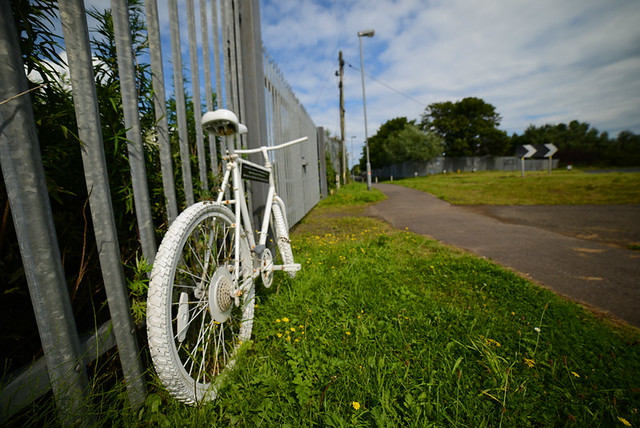
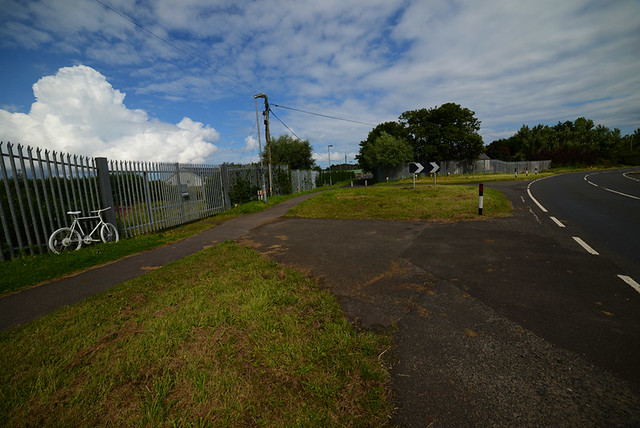
The Ghost Bike of Magilligan

Magilligan Ghost Bike
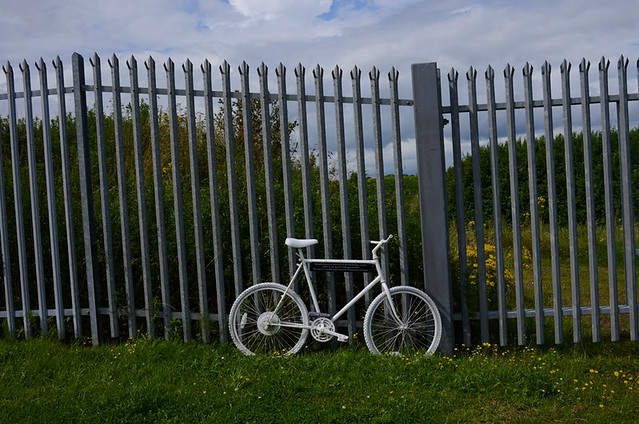
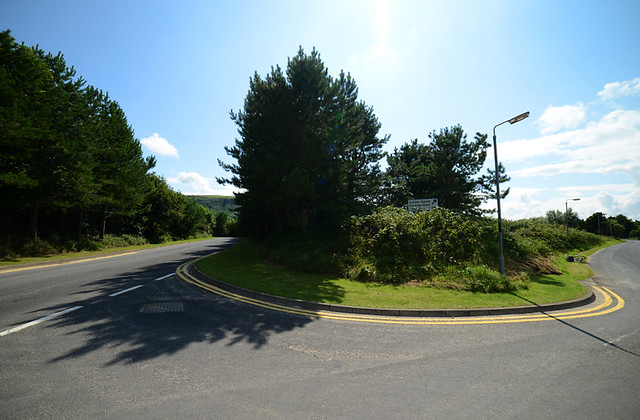
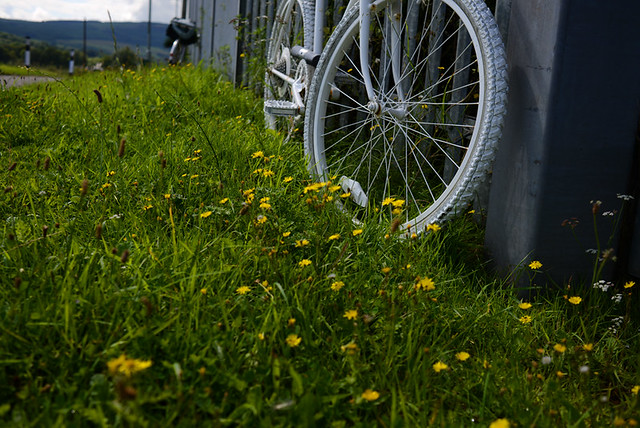
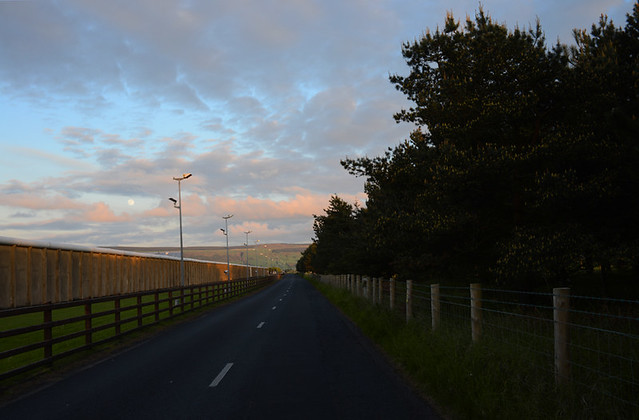
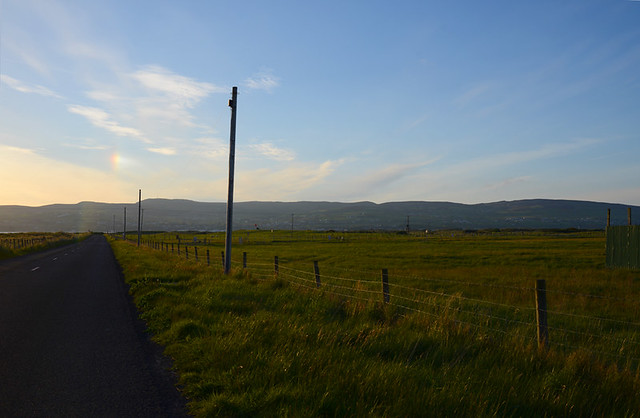
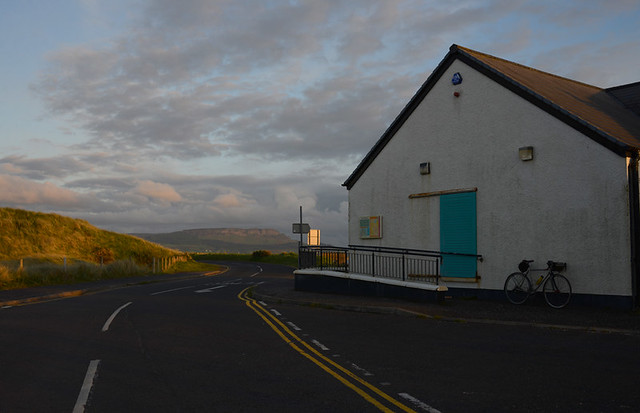
The shortcut to the beach is hidden along the main road, just before the big bend leading into Benone. Sun-drenched and shelterless, this stretch of road is like a child's drawing of a sunny day: blue skies, white clouds, yellow fields; the colours oversaturated; the edges unnaturally crisp. Veering away from all this, the shortcut plunges into leafy shade as it winds through parcels of forest all the way to the strand. The tiny lane is easy to miss if you don't know where to look. But if you do know, it is unmissable: Just watch for the handpainted stark white bicycle, chained to the caravan park fence.

Magilligan Ghost Bike
No matter how often I pass it, the sight of the Ghost Bike rattles me. Perhaps it is the location. I am accustomed to seeing these monuments to fallen cyclists in cities. But this one is jarringly out of place on a rural coastal road. In this unexpected environment, the ghost bike is more noticeable, more striking. Isolated and uncamouflaged by urban clutter, it refuses to blend with its surroundings; it is unignorable.

As the eye wanders from the bike to the sharp bend in the road, the imagination engages, activating a sequence of horrible stills. How did it happen? Who did it happen to? The plaque attached to the top tube names Gareth, aged 16. I know that I can ask around and learn the whole story in great, terrible detail. But I don't. Once I pedal past the bike and turn into the shaded backroad, I try to put it out of my mind. Because when I ride to the beach on a beautiful summer day, I do not want to think about ghost bikes.

Magilligan Ghost Bike
I do not want to wonder, for instance, whether the bike in front of me was the boy's actual bike. The very bike that got hit and… I close my mind's eye before the sequence is finished.

Benone
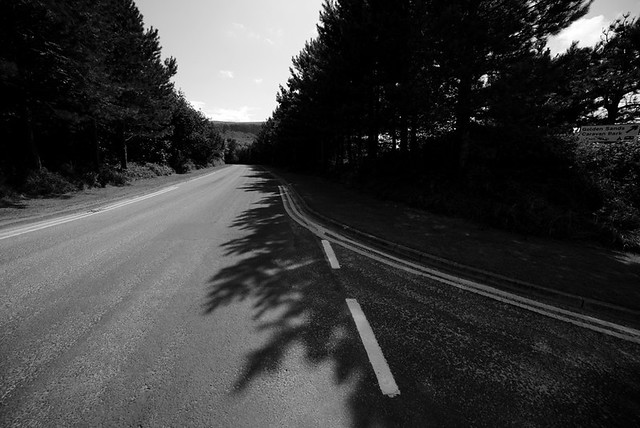
Smelling heavily of pines and, more faintly, of seaweed, the road to the beach disorients with its un-Irish feel. It is more like Maine, or Croatia. The sun filters through dense pine needles and the shapes dance on the rough pavement. The beach is not visible, but its presence is felt beyond the pines, and at any moment you expect to glimpse it around the next bend. It is the kind of road where, even before you've gone where it wants to take you, you are gripped by a pre-emptive nostalgia for the experience you're about to have.

Benone
And when I feel this, I do not want to think about ghost bikes. I do not want to think about death, or injury, when the sun is on my face and the waves of the ocean beckon. The ghost bike intrudes, but I shake it off as I would a fallen leaf tangled in my hair.

Benone
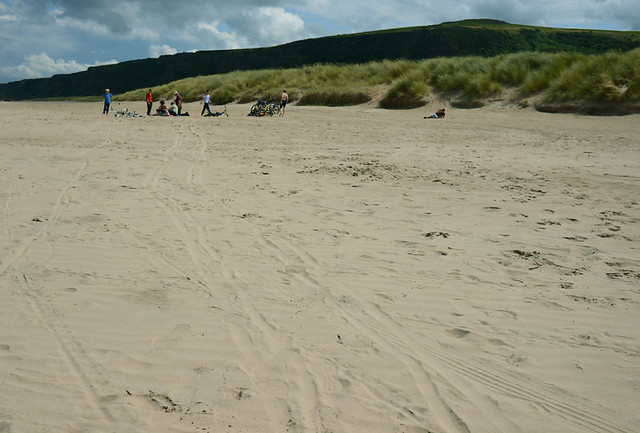
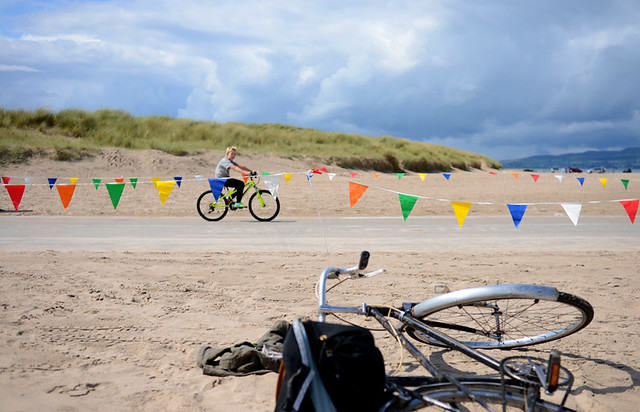
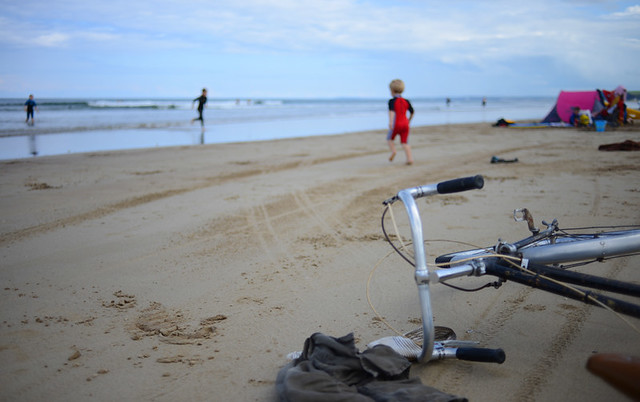
Through the pine needle shadows, past the caravan park and the holiday homes, a steady stream of kids makes its way to the Strand. They throw their bikes down in haste and run to the water.

Benone
Past the too-vibrant bunting that delineates the entrance and exit points, more kids pedal.

Benone
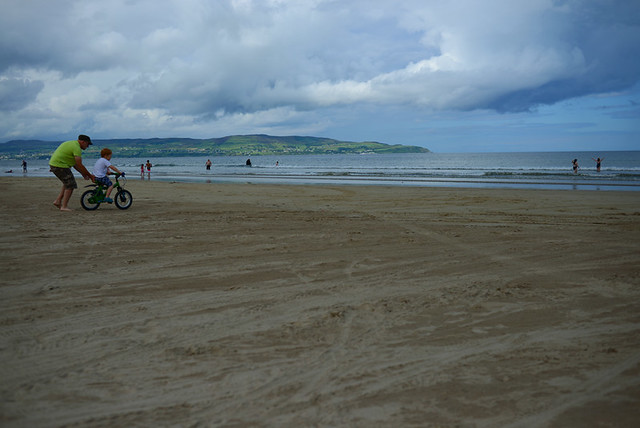
By the water, a father teaches his son to ride a tiny two-wheeler. The boys falters and tumbles into the soft sand, unhurt and undeterred. They laugh and try again. The sun shines.

Benone
I try to relax, to enjoy myself, to swim. But the children on bikes are all around me. As I watch, I catch myself wondering about the parents of the boy for whom the ghost bike was put up. Are they resentful when they watch such scenes? Are they merely sad? Or, are they happy for these other children, feeling the sun and the water on their healthy, intact bodies?

Magilligan Ghost Bike
I try to shake these thoughts off, so at odds they are with this beautiful summer day. But as I pass the ghost bike on my return, I stop and something compels me to sit on the grass beside it. I look again at the bend in the road, and I read the plaque, and I take it all in without trying to push the imagery away, as I run my fingers through the buttercups and the Queen Anne's lace that flourish around the scuffed white tires. The bike will be here every time I ride to the beach. Perhaps I'll grow immune to it over time. Or perhaps not, and every time I see it my mood will darken and these thoughts will haunt me. And maybe that is as it should be. I just hope the motorists driving past feel a least a trace of the same reaction. 

Rabu, 23 Juli 2014

Come On, Pilgrim! ...Or, Why I Could Not Ride My Bike for Days

“Old women climb it in their bare feet.”

I believe that was the phrase that drew me in. First, because of the sheer exuberance of the mental picture it painted. I imagined a tight procession of tiny octogenarian ladies – faces weather-beaten, backs bent under the weight of rucksacks, tanned limbs chalky with mountain dust under long skirts, callused feet leaving a trail of blood up a narrow path that winds, winds its way up the mountain to the tiny chapel in the clouds.

The mention of the old women also serves to make the climb seem accessible. If the frail devout dears do this bare-footed, it cannot possibly be that difficult. What is a pilgrimage anyway? If the Cantenbury Tales are anything to go by, basically a long walk.

Croagh Patrick is known as Ireland's Holy Mountain. In year 411, St. Patrick climbed upon it and fasted there for 40 days. And now we, feeble mortals that we are, can climb it in honor of this to atone for our sins. We can climb it to find inner peace, or for good luck. We can climb it for the views, or for the mere satisfaction of having climbed a thing that can be climbed. So say the descriptions of this County Mayo attraction. And having read them, I wanted to climb it too.

We set out on a day that started off hot. 20 degrees may not seem like a lot to those from warmer parts of the world, but there is something about the climate in Ireland, with its special flavor of dense mid-summer humidity, that makes 20 feel closer to 40, and the term “heat wave” does not feel misapplied when used unironically by locals.

The mountain sits right on the coast, and making our way to it from the nearby town of Westport we marveled at the luxurious bike paths spreading in all directions with fantastical island and mountain views. Today Croagh Patrick, but tomorrow certainly bikes.

Marked with a discrete sign, access to the climb was just steps from the main road, behind a clump of woods. There, at the foot of the mountain, stood a white statue of the namesake saint around which crowds gathered for photos. And just beyond that, a steady stream of people could be seen scrambling up a rockface. Funny, because I did not see a trail. They were sort of half-climbing, half-crawling up jagged slabs of stone alongside a stream. As I followed, it slowly sank in: This was the trail.

The start of the climb was immediately tight and steep. So steep, that after climbing for just a few minutes one could turn around to see sweeping views of Clew Bay and its scattered islands.

The climb was also immediately rocky. At first the rocks weren’t loose, but firmly embedded into the soil. Jutting out from the steep pitch at strange angles, they made for extremely awkward footholds, making the climb like an intense, vertical game of Twister. An additional layer of excitement was added by these rocks’ sleekness. Perhaps that had to do with the stream nearby, or maybe whatever kind of rock this was just inherently slippery. But even in my good hiking boots, stepping on some of these rocks was not unlike stepping on ice - the larger and more stable a rock looked, the more likely this being the case.

After nearly a mile of this, the trail widened and began to resemble an actual trail, while the terrain changed into what in cycling terms is known as loose gravel. In some sections the rocks were small, pebble-like. In others they were more like boulders. But as we climbed the pitch kept growing steeper, the loose stones sliding and rolling downward beneath the soles of our boots as we fought gravity to progress upward. It required a great deal of focus, and it never let up.

For someone moderately fit like myself, the difficulty of the climb was a little embarrassing to acknowledge, especially considering how many other people - (pilgrims!) - were attempting it alongside me without complaint. There were no devout old women in bare feet as had been promised. But there were elderly persons of both genders, as well as children and variously aged adults, dressed in a dazzling variety of footwear and clothing from technical climbing gear to sundresses and sandals. Most moved very slowly, taking plenty of breaks, but with an air of determination about reaching the top. The heat and humidity of the day had risen a few degrees by now, and my clothes - a thin wool top and lightweight leggings - were already drenched in sweat. I had drunk a third of the 1L bottle of water I'd brought with me, and eaten a handful of trail mix.
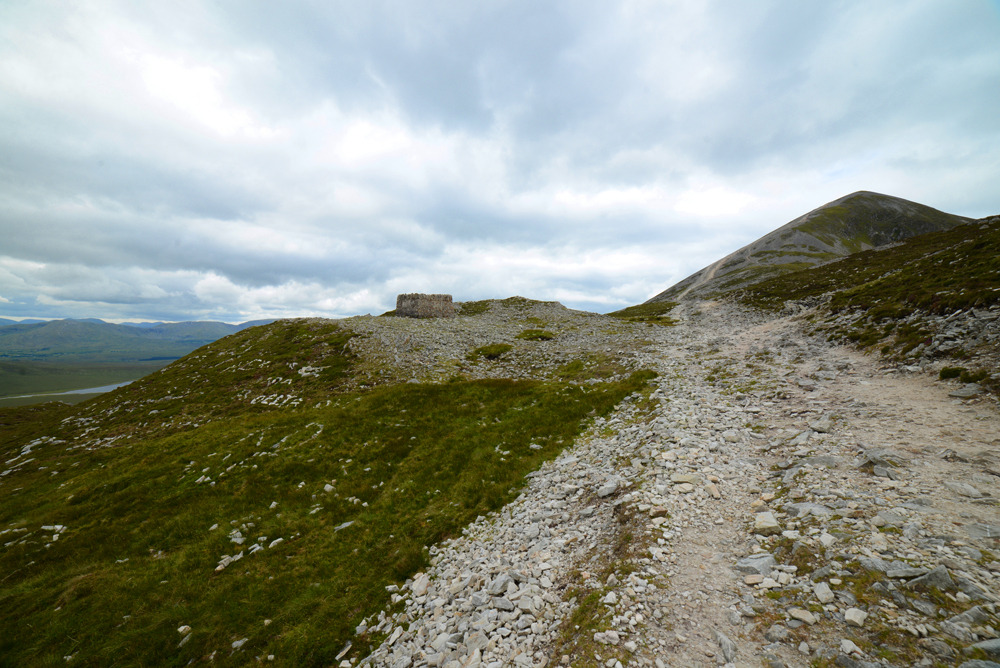
As the climb progressed, it continued to grow steeper, until it reached a plateau. Here the final stretch to the peak loomed in the distance like a mountain in its own right.

At this stage there was only a third of the way left (the climb being 3 miles in each direction), and this fostered a sense of being "almost there." However, the last stretch to the peak was the most difficult. Here again the trail as such disappeared, with climbers struggling to pick the least treacherous line up the now near-vertical rockface. The surface here consisted not of loose rocks in the standard sense of that word, but of loose thin flat slabs of what must have been quartz. These slabs combined the sleek properties of the large sturdy stones in the first part of the climb, with the unstable, crumply properties of the loose gravel in the second part of the climb. This, in addition to the steeper-than-ever pitch, made the final section stunningly difficult and time consuming. As I climbed, gaining height proportionally to distance, not only did the flat jagged slabs of stone give out under my feet, but my boots also slipped on the rock surface itself. Now and again I would lose my footing and fall forward onto my knees, bracing with my hands so as not to slide backwards and down. It was then it occurred to me how difficult it would be to get down this slope on the return trip, with my sense of balance. But for the time being, I suppressed this thought, aiming for the top.

The top came into view with excruciating slowness, but eventually come into view it did. Though I did not know it at the time, I was exceptionally lucky for the day on which I climbed Croagh Patrick to have been crystal-clear, as more commonly the top of the mountain is obscured by cloud. But on this day, the humidity had disappeared by the time we neared the peak and there was a crispness to the atmosphere that made even the most distant feature of the landscape sharply visible.

To one side stretched the mountains of inland Mayo and the neighbouring County Galway. To the other, acres of peat fields spread across the mossy hillside, dotted by sprinklings of young heather.

But the most prized view was that of Clew Bay, showing the mad messy scattering of tiny islands it is famous for, of which there are said to be 365. Here, several sheep - their coats and improbably clean shade of white - patrolled the viewing point, charging pilgrims admission for approach - the currency being banana peals and sandwich crusts.

Since not long after St. Patrick’s time, there has stood on this mountain a chapel of some sort or another. The current one is a white, tidy little structure that is kept functional by a caretaker who climbs to it 4 times a week (albeit along a less steep alternative route to the Pilgrimage trail). On special occasions, Mass is held here, with thousands of people attending - which also means climbing to reach it.

Considering how many people had been climbing the mountain alongside me, there were not a great many at the top - perhaps a dozen, which makes me think that many turn back at some point. Here I also finally saw a barefooted woman. Looking to be at least in her mid-70s, she was sinewy and tanned, dressed in high-tech hiking gear and a bandanna around her forehead, her bare feet sturdy on the slippery rocks. Just as I reached the top, she began to descend, singing songs radiantly.

Alas, my own descent was neither celebratory nor composed. To put it bluntly, I could not get down the steep top part of the mountain. I tried it this way and that, but I only slid and tumbled, losing my footing with nearly every step down the vertical rockface.

Above me and below, the pilgrims who had made it this far and now needed to get down did so the best way they could. Their methods varied wildly, from running with jaw-dropping confidence, to a weepy slip-sliding down on their behinds. The latter was a method I had seriously considered. The tops of my thighs began to burn with the effort of bracing myself against gravity's pull and the rocky downslide. My legs trembled and gave out form underneath me, weakened by effort and anxiety.

At one point, I found myself unable to pick a line through the dangerous slippery rock and, exhausted, I collapsed on my behind and began to sob involuntarily. A woman on her way up seized the opportunity to remind me triumphantly that Jesus was with me. "Be brave my girl, and Christ will save you!" I stopped myself just in time before replying with the first thing that popped into my head. "Does he have a helicopter?"

Anyway. Whether it was due to Christ saving me or not, I got off the mountain intact, and proceeded promptly to the pub with a few of the other pilgrims, where we had a "feed" of local lamb. I could not walk down stairs or properly pedal a bike for the next 3 days, coasting around Westport feebly for the remainder of my holiday while the coastal bicycle trails mocked me with their crisp white markings.

At the pub hung vintage photos of Mass held at Croagh Patrick Chapel at the turn of the 20th century. Men in suits and brimmed hats. Women in long skirts and high heeled boots with elaborate Edwardian hair. Feeling my own still-drenched top, I imagined doing the climb in a long tweed skirt and heels, then pedaling home on a high-geared fixed wheel roadster. People must have been hardier in the day, as well as more religious, to subject themselves to such an adventure. A pilgrim I am not. But there's nothing like ruining your legs for days that makes you pine for cycling, singing a song of thanksgiving once you're fit to pedal again.
Jumat, 04 Juli 2014

Room at the Inn? Accommodation Strategies for Bicycle Touring

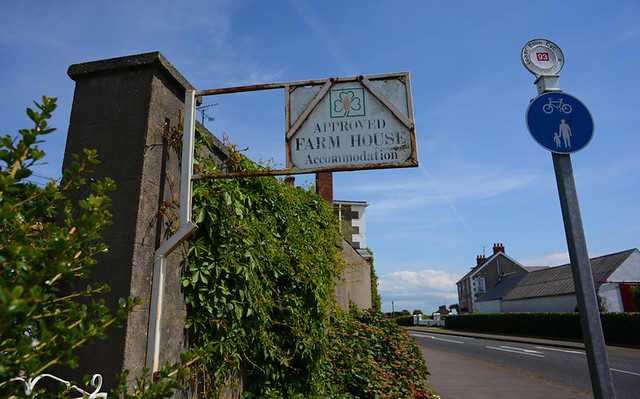
Approved Farm House Accommodation
Some years ago, an Austrian friend of mine planned a lovely bicycle tour around the west of Ireland. She put together a scenic route, booked rooms in B&Bs and hostels, took a week off work, flew overseas with her bike, and… had a miserable time! It rained every day, with visibility so poor she could hardly make out any of the scenery, and winds so strong she struggled to complete her daily milage. After a few days of this and with the forecast promising more of the same, she decided it might be better to stop and hang out locally instead of continuing to tour. So she tried to extend her stay at the B&B she'd last spent the night and cancel her other reservations. Unfortunately the B&B had no room for her to remain there for extra nights, and some of the places she'd booked ahead would not allow last-minute cancellations. She was essentially locked into continuing her tour. And she did, returning home with a pannier full of soggy clothing and pictures of blurry rainscapes. Now whenever someone mentions touring in Ireland, she grimaces and tells this cautionary tale. It was in fact what influenced me to pick a place and use it as base-camp for day trips, instead of touring from point to point, when I first visited in 2012. 

The thing about bicycle touring in Ireland, is that you have to be kind of flexible. There are stretches of beautiful, sunny weather here. And there are stretches of stormy, miserable weather. If you plan too far in advance or too rigidly, you might be committing yourself to a trip consisting entirely of the latter. And while normally I don't mind cycling in the rain one bit, with touring it's more than about being cold and wet. It's about wanting to experience the local scenery by bike. If all you are seeing is mist and sheets of rain, that rather defeats the purpose! 

Luckily for me, I do have some flexibility. What working freelance lacks in income, it makes up for in allowing for a degree of scheduling freedom. And so this summer I'd love to take advantage of this and try a little mini-tour. Nowhere far or exotic, but maybe to this little spot I like in County Sligo, just over 100 miles away. One day last month, when the forecast for the next few days looked good, I thought "Great, this is it!" and began to phone up B&Bs and hostels. But my spirits were quickly deflated when it turned out that most of them were booked, with the ones that weren't either costing a fortune or inconveniently located. Planning has its perils, but apparently so does spontaneity. 

There are other options of course, such as camping and asking around for contacts of people to stay with. One friend has even told me that he's toured all of Ireland, making no plans in advance what so ever but simply knocking on farmers' doors every evening. They would usually have a spare room where they'd let him crash - sometimes for a modest fee, and sometimes free of charge. I don't think I'd be quite comfortable with that, but it's nice to know that people can be so hospitable. 

For those experienced in touring, what are your strategies for securing accommodations? Do you book in advance, or take off and hope for the best? Do share your stories!

Senin, 30 Juni 2014

Meditations on Early Ruin

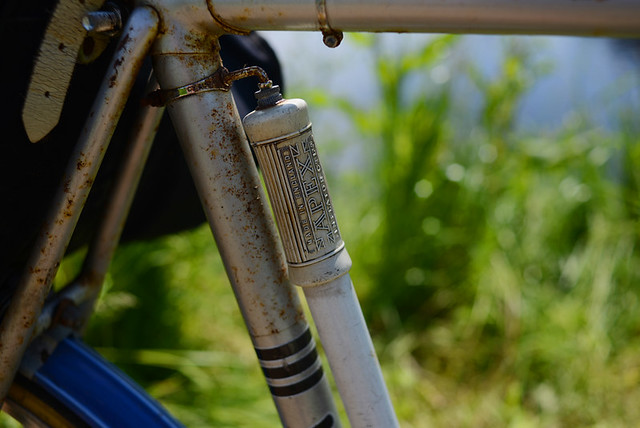
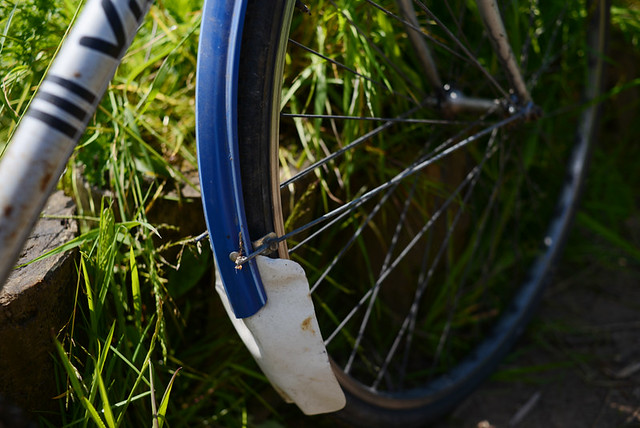
Doing errands in the city today, I spotted a woman rolling what I took to be a pre-1960s loop frame roadster. From my vantage point across the street, the bike had a look about it, suggesting it had known better days: a wobble to the front wheel, a crimp to the rear fender, a lumpiness to the saddle, an orangey aura around the black silhouette suggesting a generous coating of rust, and a general ramshackleness that marked it as a tired, creaky, longsuffering thing. The rod brakes and generator bottle corroborated my impression of its age. By the time I reached the bike, the woman had locked it up to a pole and disappeared into a building. Carefully I approached to examine the decals - or what remained visible of them, as most of the frame's surface was caked in dirt and blighted with all manner of exotic fungal growths. When I finally could make it out, the writing surprised me: Gazelle Toer Populair. At first I thought the owner might have plastered new decals onto an old frame. But identifying features in its construction confirmed that I was looking at a retro, not a vintage bicycle, made, at the earliest, in 2009.

What could account for such exuberant decay in a machine only 5 years of age? I imagined the bike being tossed, as a prank, off the Peace Bridge into the Lough Foyle, where it served as a playground for aquatic life before being fished out by local boys and sold at a car boot sale. I imagined other scenarios, too. But even as I played them out in my mind, I knew the bicycle's real history was nowhere near that exotic. Though this specimen was one of the worst so far, I have met others here with prematurely aged bikes, with bikes in horrendous condition for which they have no particular explanation.

Ireland is a strange, damp place. Vegetation flourishes. Man-made things fall apart. Both can happen with breathtaking speed.

I am slowly renovating the house I live in, which, judging by its condition when I moved in, I had at first thought lay empty for decades. It was in fact last occupied just 3 years ago. In this time span, rot and mold had crept in with methodical determination, while on the outside weeds and stinging nettles the size of trees smothered the once-manicured garden, their roots cracking brick walkways and stone walls. The plastic on the decade-old kitchen counters had softened and browned in the manner of pre-war cellulose nitrate. In the upstairs bedrooms I peeled off decomposing wallpaper I was certain had been put up in the 1950s, to discover children's scribbles behind it with the date 2007. Even the overall age of the house is not what I had first assumed from its look and feel. It was built not in the century before last, but in the 1940s. I wonder now how many other lovely old houses I spot in the area are really fairly new constructions.

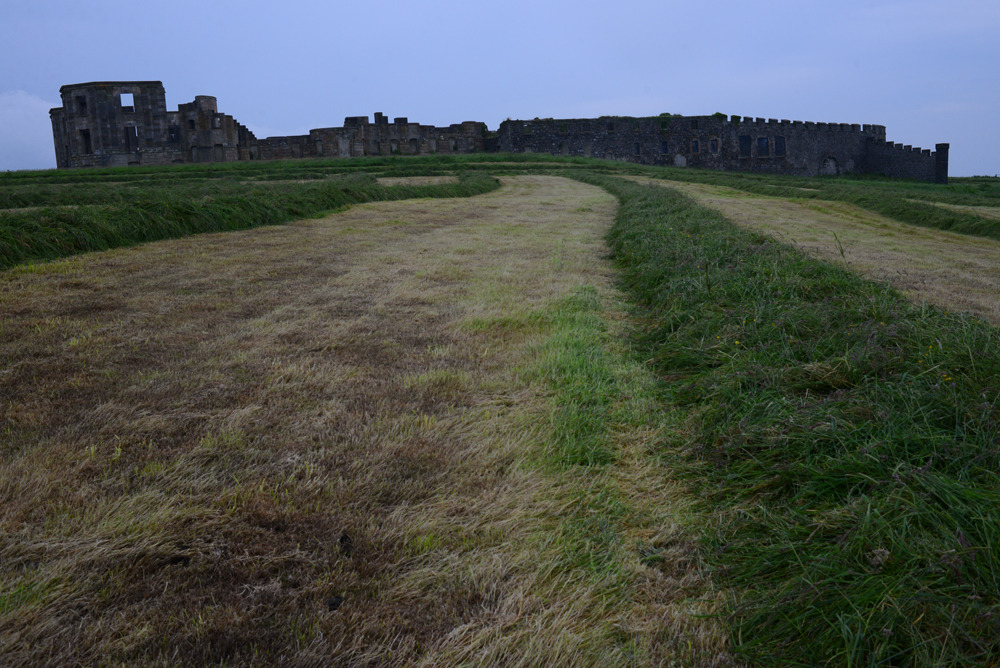
On a cliffside 4 miles down the road stands a North Coast landmark, the enormous skeletal remain of Downhill House. When new to the area and not yet familiar with this structure, I heard locals refer to it as "ancient" as if it were some excavated archaeological site or an early medieval castle. Considering that even from a distance I could spot obvious neoclassical elements, this struck me as unlikely. Still, when I looked it up I did not expect the dates to be as recent as they were: The latest version of the house was built in the 1870s and remained inhabited until after World War II, its trajectory toward disrepair beginning mid-20th century. To think that within that time, the sturdy-looking giant, built no doubt with the finest materials available in its day, became this roofless maze of crumbling stonework - so thoroughly dilapidated that locals (some of whom must surely still remember it intact!), prefer to playfully re-imagine it as an ancient ruin.
There is a trend in some circles of cyclists to celebrate - and even try to hasten - signs of aging on their modern machines. From tattered grips to chipped paint, even spots of rust and tiny dents, such things are cherished as evidence that the bike is authentic and "well loved." This trend can be observed all over contemporary culture, from distressed jeans to the "shabby chic" style of decorating. To a critical theorist, this hunger for decay is symptom of a desire for history in an ahistorical era. But I wonder also whether it is specific to areas where things tend to preserve well - decay requiring either many years or special effort. Here in Ireland, if I want "history" to happen to a modern bike all I need to do is leave it in the garden for a week, then watch it succumb to stunningly early ruin.
Senin, 16 Juni 2014

Beach Cycling and Its Contents

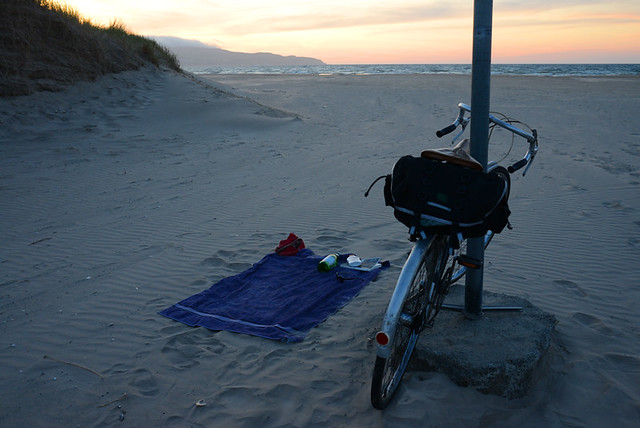
Beach Bike
For years I've dreamt of combining two activities I love: riding my bike and swimming in the sea. Considering that Boston was right on the water, cycling to the beach proved a surprisingly elusive goal during my time there, with successful two-wheeled beach trips few and far between. But now that I live practically on the shore I am determined to make the most of it. 
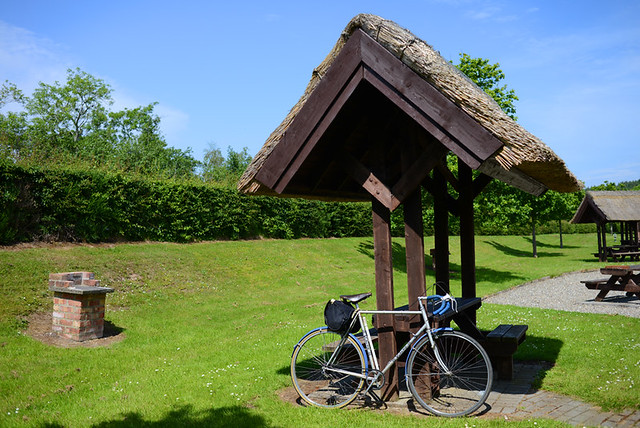
But what are beaches like in Northern Ireland, you might ask with a suspicious shudder - picturing scenes of frigid waters and relentless winds, clusters of pallid holiday-makers in ponchos shivering on soggy sand as black clouds loom overhead. Well, in reality it isn't nearly that bad. For instance, when I first came here I was told it was too cold to swim without a wet suit. Foolishly, I believed this and didn't even try to go in the water at first. Then one hot day I walked in the waves and discovered the water was perfectly within the boundaries of what is considered swimmable in Northern New England! Not quite lukewarm, but not ice cold either - with a good half hour of swimming possible before cramping sets in and limbs begin turning blue. And to top it off, it is sunny nearly every day! Not for the entire day of course, but more like for an hour at a time in between bouts of fog and rain, but let's not be nitpicky here. Summer is here and the beach trips have commenced!

Beach Bike
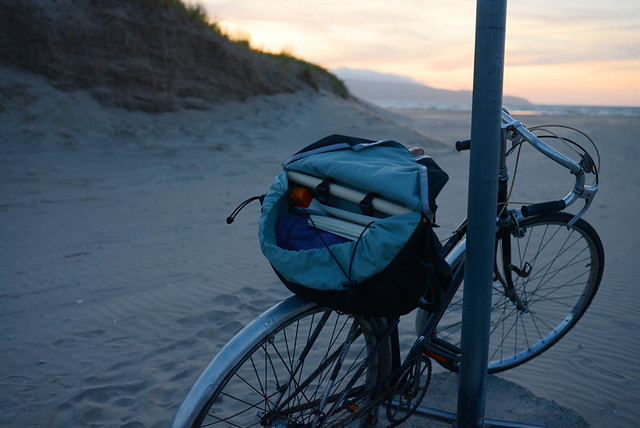
Though technically I live right on the water, the nearest official beach - staffed with lifeguards and lacking in dangerous riptides (well, relatively speaking) - is 3.5 miles away. It's a pleasant ride that can be accomplished on almost any bicycle. The easiest is to ride my Brompton, with its bottomless pit of a front basket into which I can throw anything a beachgoer could desire, laptop and portable wifi unit included. But really any bike that will accommodate a large Carradice-style saddlebag will do, and sometimes a faster bike can be more fun. 

Cycling to the Beach
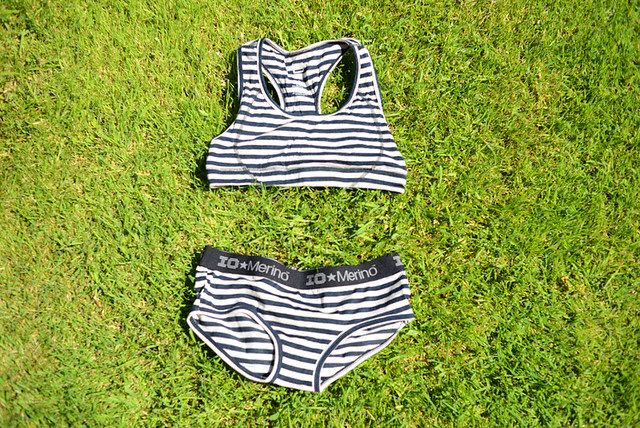
On the bike I wear my regular street clothes, with shoes that are easy to slip on and off and underwear that can pass for a swimsuit. Some time ago I discovered that wool underwear - both short and long - feels amazing to wear in the water, keeping me warmer than an ordinary swimsuit would. The wet wool also keeps me cozy once I get out of the water, and begins to dry relatively quickly. When I'm ready to leave, I just put my clothes back on over it and pedal home. Even if the wool is still damp, this feels surprisingly okay - nothing like cycling in a soggy synthetic swimsuit or wet cotton underwear. And being able to do this eliminates need to deal with the logistics of changing or transporting a soggy swimsuit by bike (though the latter is not especially complicated - just wring it out and use a plastic bag).

Cycling to the Beach
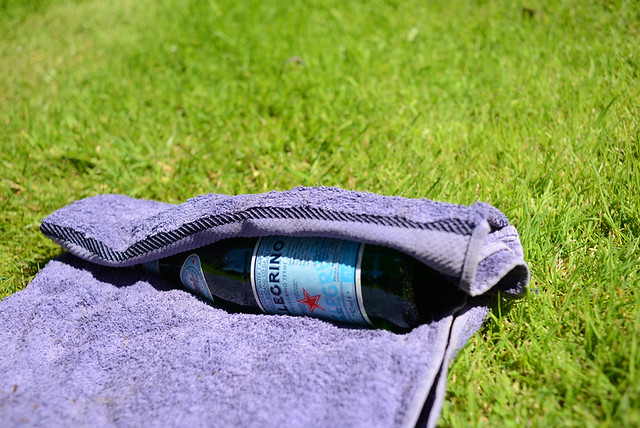
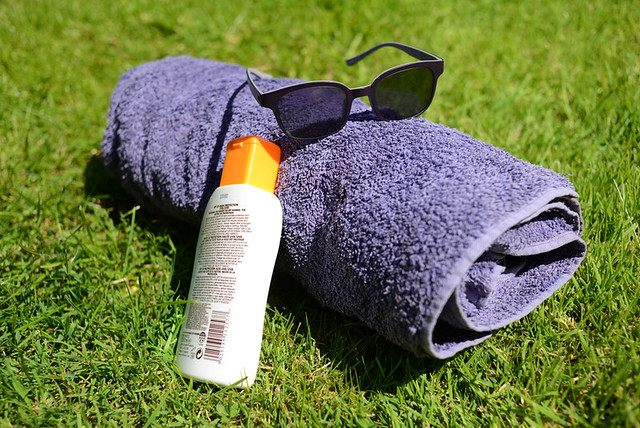
The rest of things I bring along, I will wrap in a towel - starting with the fragile stuff first, so that it's surrounded by the most padding. 

Cycling to the Beach
This makes for a neat bundle that can then simply be stuffed in a bike bag or basket, with everything held in place and not bouncing around too much. 

Beach Bike
And voila: Beach bag and beach bike. Heaven!

I've been to the beach plenty of times this summer already, and though it isn't quite warm enough to submerge myself fully yet (oh yes it is! finally swam after writing this post) I find just spending time there - reading, writing, photographing, living -  to be boundlessly enjoyable, and all the more so if I come and go by bike. There is something about cycling down a sunbaked road, in anticipation of smelling the salt, seeing the waves, and touching the sand with my bare feet, that makes for an out of this world experience. True, Ireland isn't exactly a tropical island. But something this good is best in measured doses, and worth getting rained on once and again… and again!

Senin, 02 Juni 2014

Once There Were Vikings

Viking Superstar
Over the weekend my pal Bryan visited from Donegal, and he brought along his current daily rider - a 1970s Viking. Chances are, you've never heard of the rather obscure Viking Cycles. But around here they are not uncommon, as they were once produced in Derry, Northern Ireland. This reminds me of a request I've had from bicycle enthusiasts with an interest in the Emerald Isle: to talk about Irish-made bikes. Were there any local manufacturers back in the day? 

The short answer is that Ireland does not have a rich history of bicycle production. There was a handful of framebuilders active in Northern Ireland who made machines to order, and I've been gathering information about them with interest. But as far as manufacturers, large scale or small, my understanding is that there weren't any native to the island. At some point Raleigh opened a factory in Dublin, but they were a huge company with facilities all over the world. Viking Cycles, with their production exclusive to Derry from the 1970s until their demise, might be the closest thing to a local manufacturer. 

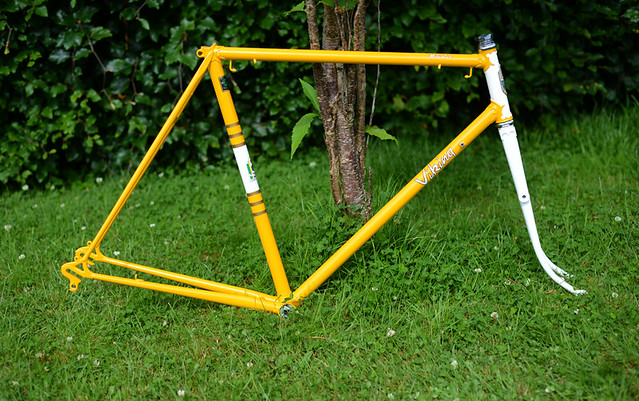
Viking Wolverhampton
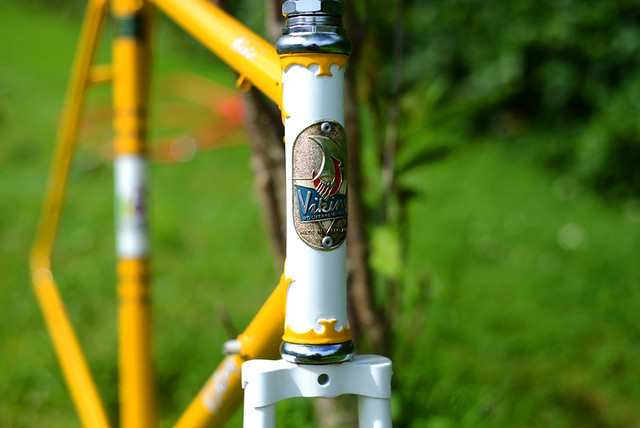
Originally an English company, Viking was formed in 1908 (though this is debated) by Alfred Victor Davies in Wolverhampton. By the 1930s they were focused on "lightweights" and began sponsoring racing teams. 

Viking Wolverhampton
The beautifully lugged race bikes from this era were, by all accounts, of excellent quality, if not especially unique. "You're behind the times if you're not riding Viking!" the adverts from this period proclaimed. 

Viking Debbie
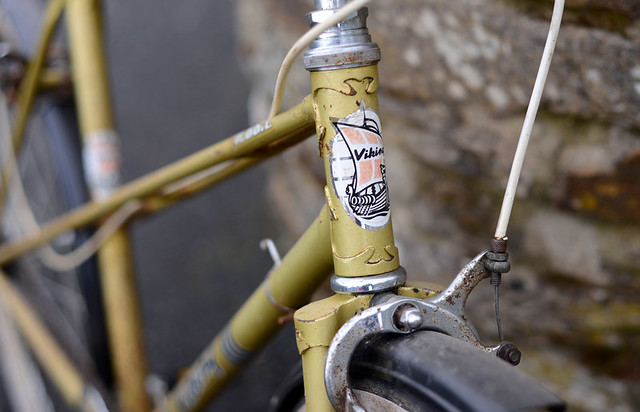
This went on successfully until the 1960s, when Viking began to decline and eventually folded, its remnants sold to Lambert/Viscount (UK/USA), then Trusty (USA), then possibly to a man named Roy Clements. What happened during this period precisely is not known, but by 1977 Viking Cycles re-emerged as a new company, with production facilities in Northern Ireland. 

Viking Debbie
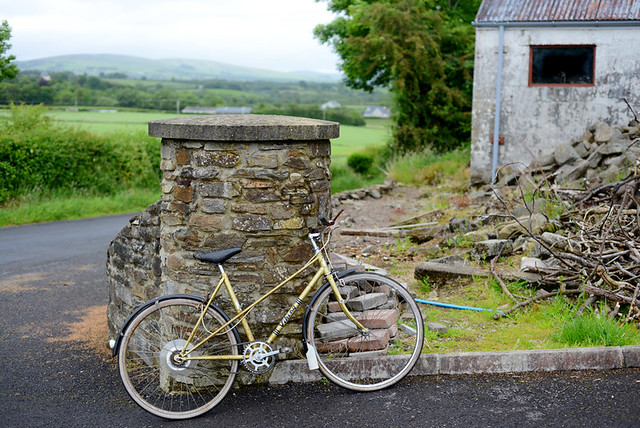
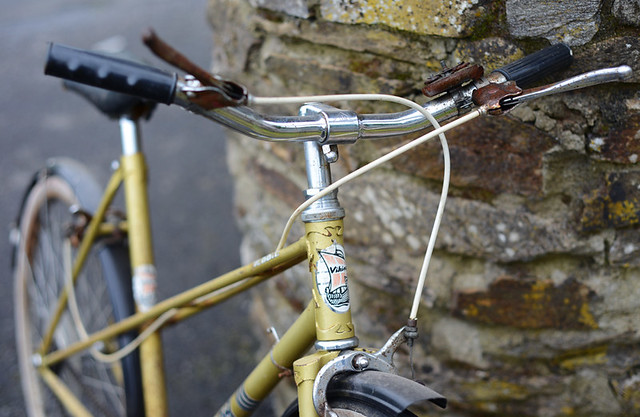
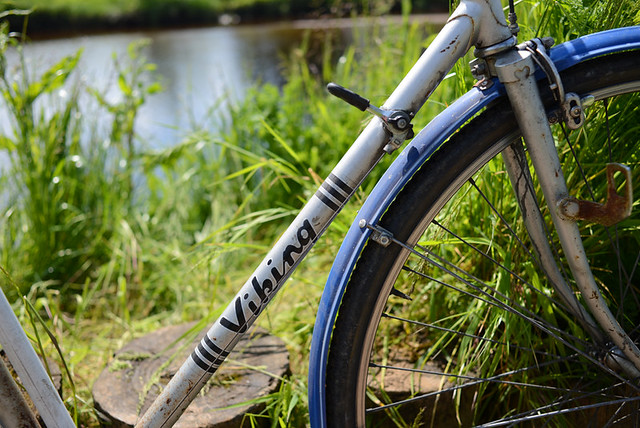
Over the course of the year I've been here, I have seen perhaps a dozen NI Vikings, some as part of collections and others "in the wild." The description of these machines as "competent but uninspired bicycles" seems pretty much spot on. A couple of high-end, handbuilt models existed during this period as well, but examples of those show up very rarely.

Viking Debbie
The Vikings I've seen have been low to mid-range 10-speeds from the late '70s and '80s. The diamond frames and mixtes look well ridden, and by their owners' accounts were decent, no-frills bikes.  

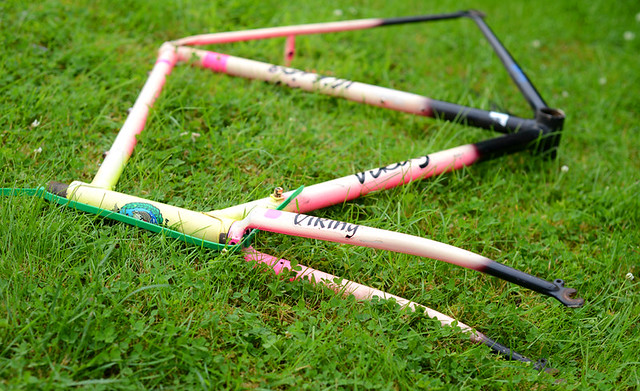
Flourescent Viking
When exactly the Derry-based Viking folded is unclear, but production probably ended by the 1990s and officially the company was dissolved in 2012. Though the brand was hardly legendary, to local bicycle enthusiasts it is significant as a remnant of bicycle manufacturing in Northern Ireland.

Viking Superstar
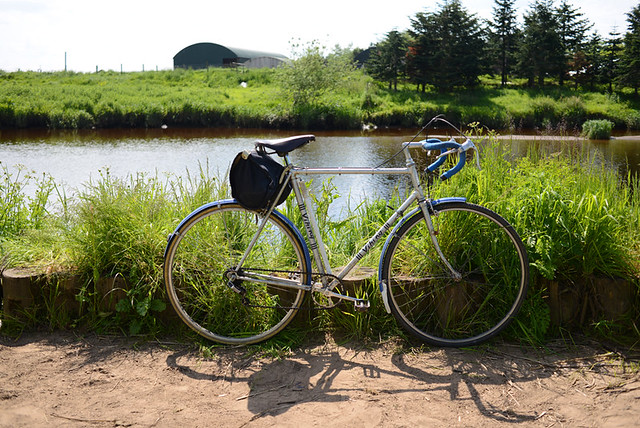
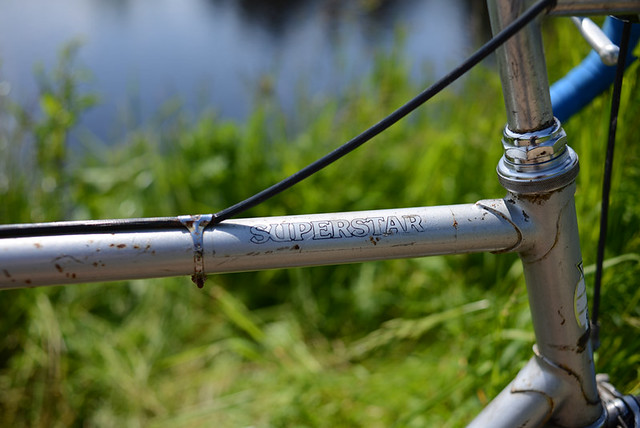
The bicycle Bryan brought along is a Viking Superstar 5 - 

Viking Superstar
- a basic lugged road bike with a single chainring 5-speed drivetrain

Viking Superstar
operated by a single downtube shifter. 

Viking Superstar
This bike was rescued from the trash some years back, and Bryan nursed it back to health with some used replacement parts, including a Brooks Competition saddle, a rear wheel to replace the damaged original, and a set of 27 x 1 1/4" tires.

Viking Superstar
He replaced the original 46t chainring with a 40t to lower the gearing, and fitted some nice blue fenders. I thought these were Bluemel mudguards at first, but they are in fact a lower end alternative -  made by a Scottish company called Bantel. The rich vibrant blue adds some lively accents to the all- silver bike. 

Viking Superstar
In truth, to come up with much of interest about this machine other than its place of manufacture would be a struggle! But that's all right. It is a handsome bike, and a very ridable bike according to Bryan. He enjoys it as an everyday "user bike," as much as he enjoys knowing it was made just 20 miles from his house. Not many cyclists in Ireland can say that about their bicycle. 

For more information about Viking, visit the V-CC-affiliated Classic Viking Cycles site, as well as this history page from the Transport Museum. Bryan's photos of his bicycles and other things can be found here. The other Viking frames shown in this post come from this collection

Kamis, 29 Mei 2014

In Search of the Unpaved

Skinny Tires, Hidden Trails
If there is one thing I miss about cycling in New England, it is the abundance of unpaved roads. Dirt, gravel, flat, hilly, wide, narrow, technical, tame - you name it and it's there if you know where to look. It took me a couple of years to get comfortable cycling on unpaved terrain, as well as some time to develop a decent mental database of nearby routes. But once I did, riding on unpaved back roads became second nature. I enjoyed them tremendously and took their availability for granted.  

Roadster on the River Roe
When I first began considering a move to Northern Ireland, I was warned about the lack of unpaved roads - both here and in the Republic. "Decades ago, sure - practically the whole thing was dirt roads. But it's as if, in their enthusiasm to modernise, Ireland went overboard and just paved over everything at some point. Even the teeniest backroads are tarmacked or poured over with concrete."

Seawall Path, Myroe
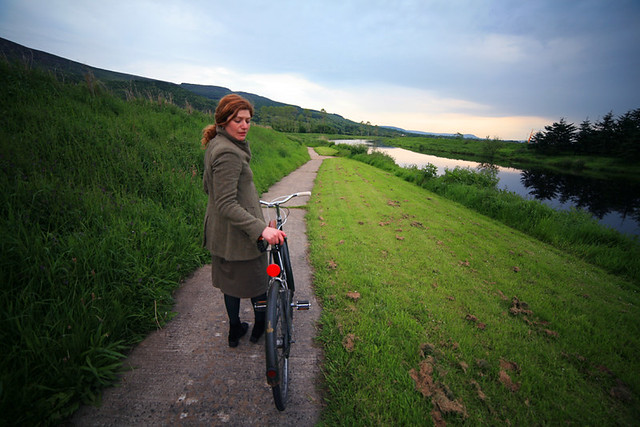
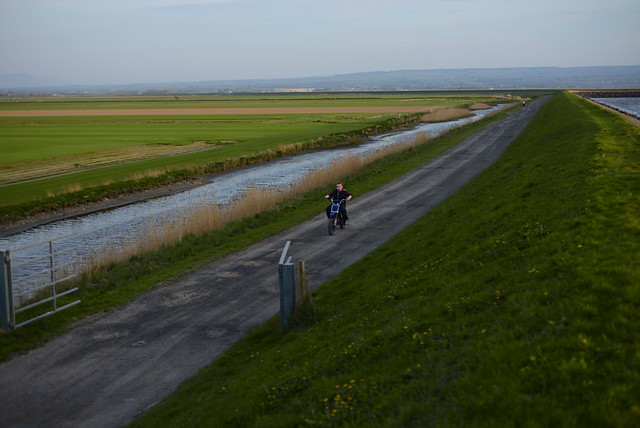
At first glance, I found this to be true in the Roe Valley area where I now live. There are stretches here and there: dirt roads and forest trails up the mountain, a gravel path along the Seawall, some grassy right of way tracks through farms. But overall paved roads and paths seemed the norm, and locals confirmed this.

Skinny Tires, Hidden Trails
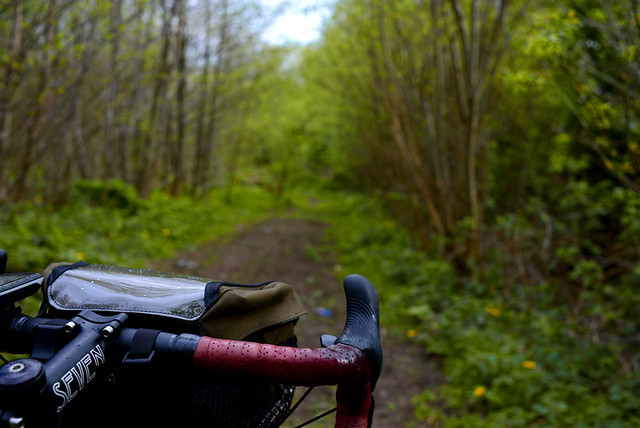
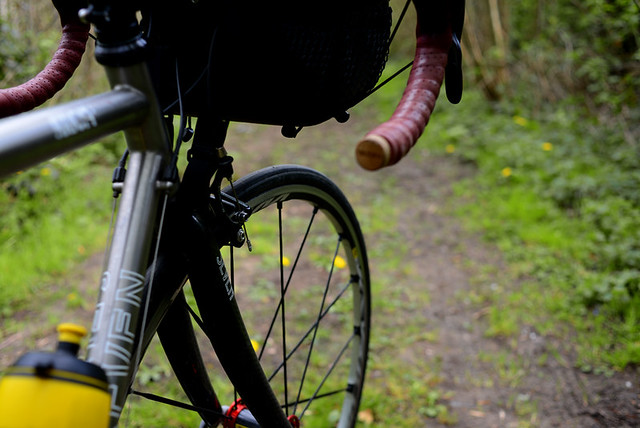
But as I grew bolder and began planning my own routes along roads I did not know except on the map, something unexpected happened - I began to "discover" unpaved roads. My first major discovery was of a network of gravel roads near the border, to the west, as I progressed along a 100 mile ride I'd mapped out myself. As I followed my route, the road I was on changed from the chipsealy surface it usually is in these parts, to plain gravel, sprinkled loosely over hard packed dirt. On the map, this stretch had not been marked any differently than the paved roads nearby, yet in practice it was not the same category of road at all. The narrow gravel roads went on for some miles, and I could see them continue in the opposite direction from where I was headed. Unfortunately, my GPS commanded a turn toward a larger road that brought me back onto tarmac, and I was too short on time to go off on an exploratory tangent. 

Later I made similarly accidental discoveries closer to home. Most recently I had routed a 50 mile ride over back roads I had not previously taken. One of these roads - again, marked completely normally on the map - quickly turned into a gravel lane with moss down the middle, featuring a daunting climb and a steep winding descent. It was a little challenging on my skinny tires, but overall fun. The friend who rode with me was a little shocked though, despite his wider tires. Many colourful curse words in relation to the gravel were used. 

"Do you know," I said, "in the US there are rides where the entire route is gravel? It's very popular now." 

"But surely not loose gravel like this what we just did! That's plain dangerous." 

"Loose gravel" is such a funny expression. I imagined gravel, on the loose, running amock. "You think this was loose gravel? Let me tell you about the Kearsarge Klassic…" 

River Path, Tyrone
Increasingly, I am starting to suspect that there are cool unpaved routes here if you know where to find them. They are neither promoted nor marked on maps. Even the local cyclists may not know them, simply because deliberately riding on unpaved terrain is not part of the culture here (unless it's technical mountain bike trails, and even that's not all that popular). But dirt and gravel lanes exist, and little by little I am stumbling upon them. Perhaps over time a database of routes could be made and shared among likeminded enthusiasts. After all - if there isn't a map, why not make your own? My optimistic search for the unpaved continues.

Senin, 19 Mei 2014

What Is the Point?

Point Road, Magilligan
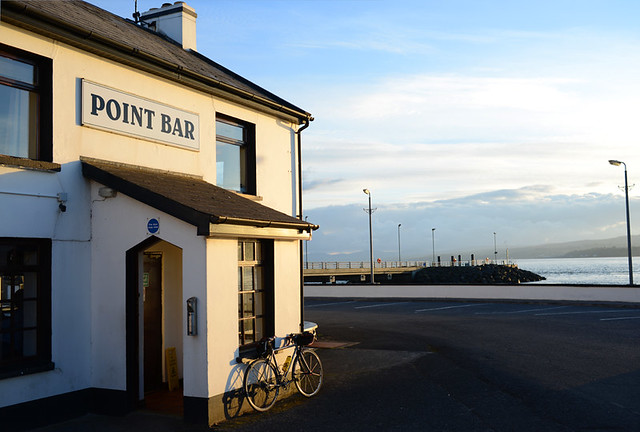
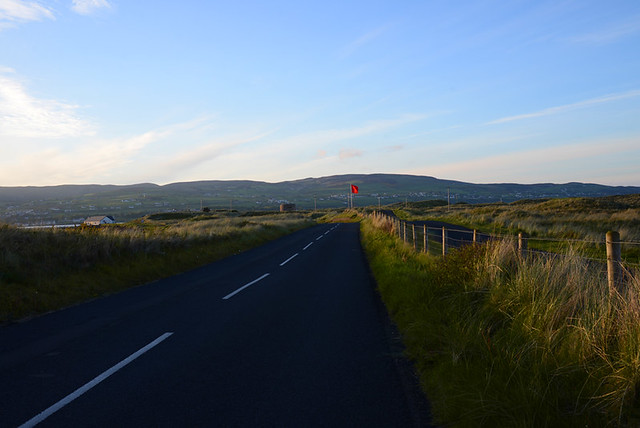
In the northwestern corner of Northern Ireland lies the Magilligan peninsula - a jolly, stout little triangle that juts out into the North Atlantic toward the Republic's County Donegal, to form the pool-like Lough Foyle. From base to tip, the peninsula is bisected by the aptly named Point Road, which winds through 4 miles of grassy dunes, then dead-ends at Magilligan Point. Because it is not a through-way, there is only a handful of reasons to be on this road. One is to access the ferry, which sails across to Donegal every couple of hours. Another is to visit the popular Point Bar, beloved by locals for its steak and Guinness pies and seafood chowders. 

Point Road, Magilligan
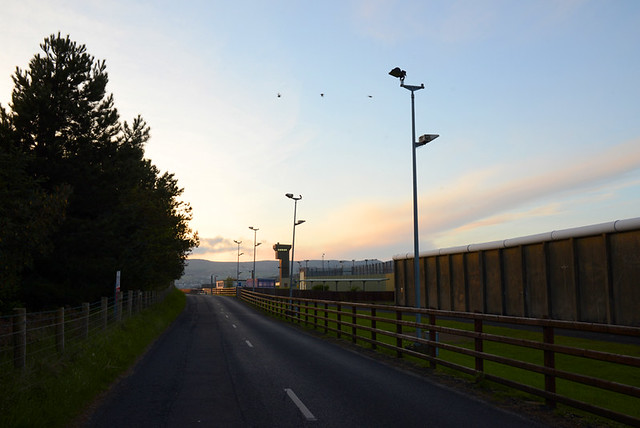
Then there are those who require access to the Magilligan Prison half way down the road.  

Point Road, Magilligan
As well as to the adjacent military firing range/ nature reserve - its sprawling grounds tranquil and golf course-like, with only discreet little flags and bits of terrifying signage warning that the range is sometimes "active."

Point Road, Magilligan
Aside from these attractions, there is not much reason to be on the Point Road. Unless you are a local cyclist doing interval training - in which case the flat, wide, gently winding, practically car-free 4 mile stretch makes for the perfect playground in which to let yourself go and push your bicycle's speed as far as your legs and lungs and gears can take it. To see a cyclist slingshot past you in this manner is exciting enough. To do it yourself - or at least try - is an otherworldly experience. 

Point Road, Magilligan
Though I've heard of interval training before, it was not until last summer that I actually tried it, on this very road. My casual imitation of the practice is to go as hard as I possibly can for several minutes, then soft-pedal until my breathing and heartbeat return to normal, then repeat, until I exhaust myself with just enough energy left to roll feebly home. Last year I would do this sometimes, on days when too busy for longer rides. This year I tried it again for the fist time last week. I am out of practice and couldn't go as fast and in as high a gear as I could at my "peak" last Autumn. But it was breathtaking nonetheless. The speed at which the scenery flashes past, sky blending with earth and water. The feeling in my legs from this special flavour of acceleration, when I no longer feel the effort of pushing and instead the gear appears to push itself, taking my legs with it. Finally, the teleportaion-like magic of fixating on a distant object - say, a flagpole ("firing range status: Active") - then finding myself passing that flagpole with no sense of time having lapsed in between. 

Beside such a flagpole, after my last interval, I now spot a figure that's vaguely familiar. I roll past and recognise a prison guard, now off duty, taking a walk. Our usual banter consists of him reminding me not to point my camera at the prison buildings directly as I attempt to capture their unique greenish hue at sunset - in response to which I test how loosely I can interpret his definition of "indirectly." But today I don't have my camera and he is not standing guard, and only grinning glances of acknowledgement are exchanged between us in the sun's golden glow. 

Point Road, Magilligan
Later, I stop and a cyclist I know pulls over beside me. He asks if I'm racing this summer. Last year I said to myself - and also, apparently out loud - that, if I stayed here, I would try time trials "next season." But now this next season is here, and I am not feeling the inclination. I tell him this, and he nods understandingly. Going to give road racing a try then? God no, I say, not with my handling skills. Sportives? I shake my head. Out of ideas, he looks at me quizzically. Why are you training then? I mean, what's the point of killing yourself for nothing? For a moment I feel defensive and almost tell him about my 300km audax. That should make for a satisfactory answer, I think. He would say "Ach!" finally feeling he has a handle on what's going on, and then we'd move on. 

But that would not be an honest answer. Because, in truth, my flying down the Point Road till my vision blurs and I can't feel my legs has nothing to do with this audax, or potential future audaxes, or any local races I may or (more likely) may not ever take part in. There is no point to what I have just done. I simply felt like doing it - my heart so full it had to be done. There was no point, only an impulse. And though I enjoyed it, I cannot really tell you why. So I don't mention the audax, and instead smile stupidly and shrug, and we go our separate ways with the matter unresolved. In the setting sun, the Foyle shimmers behind us. And in the distance ahead looms the compact and jagged Binevenagh Mountain - standing slightly apart from the rest of the Sperrins, like a lone guard tasked with watching over Magilligan's tip.