Tampilkan postingan dengan label not cycling. Tampilkan semua postingan

Rabu, 23 Juli 2014

Come On, Pilgrim! ...Or, Why I Could Not Ride My Bike for Days

“Old women climb it in their bare feet.”

I believe that was the phrase that drew me in. First, because of the sheer exuberance of the mental picture it painted. I imagined a tight procession of tiny octogenarian ladies – faces weather-beaten, backs bent under the weight of rucksacks, tanned limbs chalky with mountain dust under long skirts, callused feet leaving a trail of blood up a narrow path that winds, winds its way up the mountain to the tiny chapel in the clouds.

The mention of the old women also serves to make the climb seem accessible. If the frail devout dears do this bare-footed, it cannot possibly be that difficult. What is a pilgrimage anyway? If the Cantenbury Tales are anything to go by, basically a long walk.

Croagh Patrick is known as Ireland's Holy Mountain. In year 411, St. Patrick climbed upon it and fasted there for 40 days. And now we, feeble mortals that we are, can climb it in honor of this to atone for our sins. We can climb it to find inner peace, or for good luck. We can climb it for the views, or for the mere satisfaction of having climbed a thing that can be climbed. So say the descriptions of this County Mayo attraction. And having read them, I wanted to climb it too.

We set out on a day that started off hot. 20 degrees may not seem like a lot to those from warmer parts of the world, but there is something about the climate in Ireland, with its special flavor of dense mid-summer humidity, that makes 20 feel closer to 40, and the term “heat wave” does not feel misapplied when used unironically by locals.

The mountain sits right on the coast, and making our way to it from the nearby town of Westport we marveled at the luxurious bike paths spreading in all directions with fantastical island and mountain views. Today Croagh Patrick, but tomorrow certainly bikes.

Marked with a discrete sign, access to the climb was just steps from the main road, behind a clump of woods. There, at the foot of the mountain, stood a white statue of the namesake saint around which crowds gathered for photos. And just beyond that, a steady stream of people could be seen scrambling up a rockface. Funny, because I did not see a trail. They were sort of half-climbing, half-crawling up jagged slabs of stone alongside a stream. As I followed, it slowly sank in: This was the trail.

The start of the climb was immediately tight and steep. So steep, that after climbing for just a few minutes one could turn around to see sweeping views of Clew Bay and its scattered islands.

The climb was also immediately rocky. At first the rocks weren’t loose, but firmly embedded into the soil. Jutting out from the steep pitch at strange angles, they made for extremely awkward footholds, making the climb like an intense, vertical game of Twister. An additional layer of excitement was added by these rocks’ sleekness. Perhaps that had to do with the stream nearby, or maybe whatever kind of rock this was just inherently slippery. But even in my good hiking boots, stepping on some of these rocks was not unlike stepping on ice - the larger and more stable a rock looked, the more likely this being the case.

After nearly a mile of this, the trail widened and began to resemble an actual trail, while the terrain changed into what in cycling terms is known as loose gravel. In some sections the rocks were small, pebble-like. In others they were more like boulders. But as we climbed the pitch kept growing steeper, the loose stones sliding and rolling downward beneath the soles of our boots as we fought gravity to progress upward. It required a great deal of focus, and it never let up.

For someone moderately fit like myself, the difficulty of the climb was a little embarrassing to acknowledge, especially considering how many other people - (pilgrims!) - were attempting it alongside me without complaint. There were no devout old women in bare feet as had been promised. But there were elderly persons of both genders, as well as children and variously aged adults, dressed in a dazzling variety of footwear and clothing from technical climbing gear to sundresses and sandals. Most moved very slowly, taking plenty of breaks, but with an air of determination about reaching the top. The heat and humidity of the day had risen a few degrees by now, and my clothes - a thin wool top and lightweight leggings - were already drenched in sweat. I had drunk a third of the 1L bottle of water I'd brought with me, and eaten a handful of trail mix.
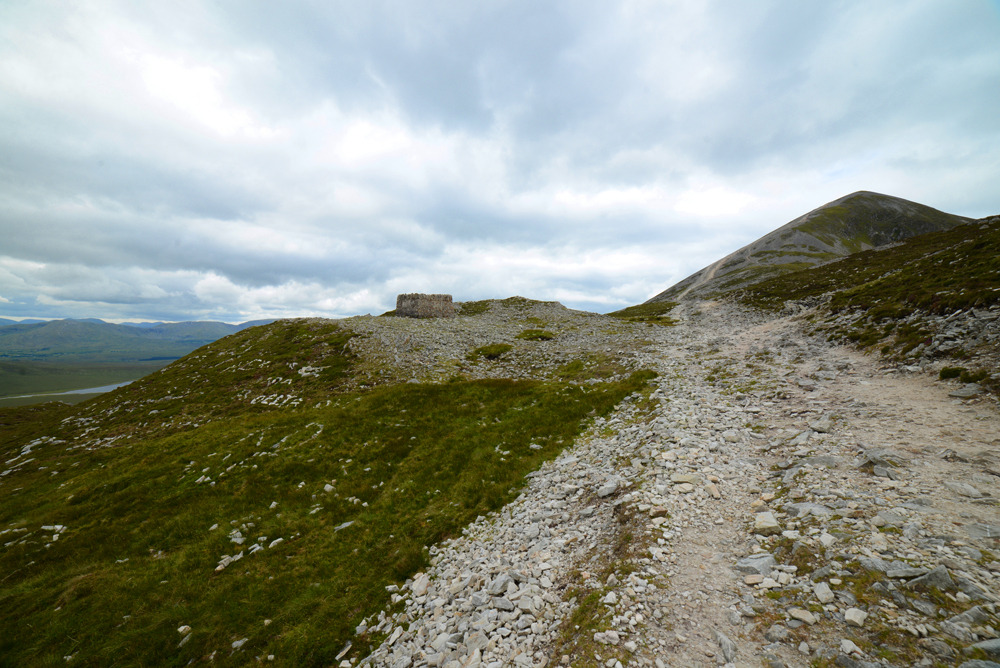
As the climb progressed, it continued to grow steeper, until it reached a plateau. Here the final stretch to the peak loomed in the distance like a mountain in its own right.

At this stage there was only a third of the way left (the climb being 3 miles in each direction), and this fostered a sense of being "almost there." However, the last stretch to the peak was the most difficult. Here again the trail as such disappeared, with climbers struggling to pick the least treacherous line up the now near-vertical rockface. The surface here consisted not of loose rocks in the standard sense of that word, but of loose thin flat slabs of what must have been quartz. These slabs combined the sleek properties of the large sturdy stones in the first part of the climb, with the unstable, crumply properties of the loose gravel in the second part of the climb. This, in addition to the steeper-than-ever pitch, made the final section stunningly difficult and time consuming. As I climbed, gaining height proportionally to distance, not only did the flat jagged slabs of stone give out under my feet, but my boots also slipped on the rock surface itself. Now and again I would lose my footing and fall forward onto my knees, bracing with my hands so as not to slide backwards and down. It was then it occurred to me how difficult it would be to get down this slope on the return trip, with my sense of balance. But for the time being, I suppressed this thought, aiming for the top.

The top came into view with excruciating slowness, but eventually come into view it did. Though I did not know it at the time, I was exceptionally lucky for the day on which I climbed Croagh Patrick to have been crystal-clear, as more commonly the top of the mountain is obscured by cloud. But on this day, the humidity had disappeared by the time we neared the peak and there was a crispness to the atmosphere that made even the most distant feature of the landscape sharply visible.

To one side stretched the mountains of inland Mayo and the neighbouring County Galway. To the other, acres of peat fields spread across the mossy hillside, dotted by sprinklings of young heather.

But the most prized view was that of Clew Bay, showing the mad messy scattering of tiny islands it is famous for, of which there are said to be 365. Here, several sheep - their coats and improbably clean shade of white - patrolled the viewing point, charging pilgrims admission for approach - the currency being banana peals and sandwich crusts.

Since not long after St. Patrick’s time, there has stood on this mountain a chapel of some sort or another. The current one is a white, tidy little structure that is kept functional by a caretaker who climbs to it 4 times a week (albeit along a less steep alternative route to the Pilgrimage trail). On special occasions, Mass is held here, with thousands of people attending - which also means climbing to reach it.

Considering how many people had been climbing the mountain alongside me, there were not a great many at the top - perhaps a dozen, which makes me think that many turn back at some point. Here I also finally saw a barefooted woman. Looking to be at least in her mid-70s, she was sinewy and tanned, dressed in high-tech hiking gear and a bandanna around her forehead, her bare feet sturdy on the slippery rocks. Just as I reached the top, she began to descend, singing songs radiantly.

Alas, my own descent was neither celebratory nor composed. To put it bluntly, I could not get down the steep top part of the mountain. I tried it this way and that, but I only slid and tumbled, losing my footing with nearly every step down the vertical rockface.

Above me and below, the pilgrims who had made it this far and now needed to get down did so the best way they could. Their methods varied wildly, from running with jaw-dropping confidence, to a weepy slip-sliding down on their behinds. The latter was a method I had seriously considered. The tops of my thighs began to burn with the effort of bracing myself against gravity's pull and the rocky downslide. My legs trembled and gave out form underneath me, weakened by effort and anxiety.

At one point, I found myself unable to pick a line through the dangerous slippery rock and, exhausted, I collapsed on my behind and began to sob involuntarily. A woman on her way up seized the opportunity to remind me triumphantly that Jesus was with me. "Be brave my girl, and Christ will save you!" I stopped myself just in time before replying with the first thing that popped into my head. "Does he have a helicopter?"

Anyway. Whether it was due to Christ saving me or not, I got off the mountain intact, and proceeded promptly to the pub with a few of the other pilgrims, where we had a "feed" of local lamb. I could not walk down stairs or properly pedal a bike for the next 3 days, coasting around Westport feebly for the remainder of my holiday while the coastal bicycle trails mocked me with their crisp white markings.

At the pub hung vintage photos of Mass held at Croagh Patrick Chapel at the turn of the 20th century. Men in suits and brimmed hats. Women in long skirts and high heeled boots with elaborate Edwardian hair. Feeling my own still-drenched top, I imagined doing the climb in a long tweed skirt and heels, then pedaling home on a high-geared fixed wheel roadster. People must have been hardier in the day, as well as more religious, to subject themselves to such an adventure. A pilgrim I am not. But there's nothing like ruining your legs for days that makes you pine for cycling, singing a song of thanksgiving once you're fit to pedal again.

Rabu, 02 Juli 2014

Running and Cycling

Over the winter I wrote about my dislike of running, and moreover my inability to understand how someone could stick with something initially so painful and unpleasant. While cycling lured me in with its gentle, romantic demeanor, running had all the charm of a back alley beating - each encounter leaving me clutching my side, tasting blood and seeing stars. I have tried running at various stages of my life, usually as part of attempts at "fitness," and each time with the same result: hating every moment of it so much, that to continue after several efforts just felt like masochism. The same thing happened this winter. After 5 years of cycling and a general increase in fitness, I had hoped things might be different and, inspired by several local friends who are runners, gave it another try. Through sheer force of will I'd manage a mile up and down my lane, but again hated every agonising second of it so much that I soon gave up.

This makes what happened this summer all the more bizarre. One time I accompanied my boyfriend on his evening run - not to run myself, but to keep him company on the way there and back. I took my camera and wandered around photographing while he did his 10K. A short while later he returned, eyes glazed over and in a state of thorough depletion, yet so elated that he seemed to be levitating. Seeing him this way, something shifted in my perception of what running was, or could be. And I felt jealous - in an "I want what he's having!" sort of way. Next time I would try running too.

Cautiously excited that I actually wanted to do this, he offered some suggestions when I described the problems I've had in the past. Ankles hurt? Try hard sand or dirt instead of pavement. Lungs hurt? Start ridiculously slow. I replaced my 10 year old sneakers with a new pair of running shoes. And then off we went to the beach.

My first time I ran 3 miles on sand, slow and steady. I expected this to feel like some tremendous feat, but when I finished the loop I realised that I could have kept going. I had none of the symptoms of misery I recalled from previous attempts. My lungs were not coming out of my throat; I had no aches or pains. I felt a tightness in my legs, and I would have been bored out of my mind if it wasn't for the music in my earphones, but that is it.

The next time I ran 4 miles and felt much the same. This time I started slow and then sped up when I felt my energy increase on the return leg. Two days later I ran 5 miles in the same manner. And two days after that, I increased the distance to 7 miles. All of this was on sand - trying to pick a line close to the water, where the stuff is hard packed.

My boyfriend was greatly entertained by my sudden success with this activity I used to hate. He had not expected me to increase distances so quickly. At the same time, he felt I was not getting much fitness training out of the running if I was able to do it this way, my breathing close to normal at the end. He suggested next time I try a shorter distance but make it more intense. So we decided to cut back to 3 miles, but incorporate sprints - bursts of very fast running.

On the day of the evening we had planned to do this, I forgot about it and went on a 35 mile bicycle ride. Then on my way home I remembered, but figured I could still do the run since my bike ride was not all that long or intense and there would be a break of about an hour.

The result was interesting. Starting the run so soon after a bike ride, I felt a distinct shallowness in my reserve-pool of energy. At the same time, stretching out to run felt good as a contrast to my scrunched up position on the bike; it was as if my limbs and torso were unfurling.

While normally we run each at our own pace after the first few minutes, this time my boyfriend accompanied me most of the way to demonstrate sprints. We ran slow to start with, then increased the pace, then ran fast, then back to slow. On the return leg this was repeated more intensely, the fast part replaced with "as fast as you can." After doing this last bit, I had trouble catching my breath even after the final stretch of very slow running. My legs were killing me, my lungs were on fire, my entire body was overheated, and my heart was pounding so fast and so loud it blocked all other sensory input. But I wasn't miserable and I didn't hate it.

What changed this summer to make me not only able to run but actually enjoy it, I don't fully understand. But I do know that cycling the next day felt delightful …if a bit unnervingly easy!

Senin, 30 Juni 2014

Meditations on Early Ruin

Doing errands in the city today, I spotted a woman rolling what I took to be a pre-1960s loop frame roadster. From my vantage point across the street, the bike had a look about it, suggesting it had known better days: a wobble to the front wheel, a crimp to the rear fender, a lumpiness to the saddle, an orangey aura around the black silhouette suggesting a generous coating of rust, and a general ramshackleness that marked it as a tired, creaky, longsuffering thing. The rod brakes and generator bottle corroborated my impression of its age. By the time I reached the bike, the woman had locked it up to a pole and disappeared into a building. Carefully I approached to examine the decals - or what remained visible of them, as most of the frame's surface was caked in dirt and blighted with all manner of exotic fungal growths. When I finally could make it out, the writing surprised me: Gazelle Toer Populair. At first I thought the owner might have plastered new decals onto an old frame. But identifying features in its construction confirmed that I was looking at a retro, not a vintage bicycle, made, at the earliest, in 2009.

What could account for such exuberant decay in a machine only 5 years of age? I imagined the bike being tossed, as a prank, off the Peace Bridge into the Lough Foyle, where it served as a playground for aquatic life before being fished out by local boys and sold at a car boot sale. I imagined other scenarios, too. But even as I played them out in my mind, I knew the bicycle's real history was nowhere near that exotic. Though this specimen was one of the worst so far, I have met others here with prematurely aged bikes, with bikes in horrendous condition for which they have no particular explanation.

Ireland is a strange, damp place. Vegetation flourishes. Man-made things fall apart. Both can happen with breathtaking speed.

I am slowly renovating the house I live in, which, judging by its condition when I moved in, I had at first thought lay empty for decades. It was in fact last occupied just 3 years ago. In this time span, rot and mold had crept in with methodical determination, while on the outside weeds and stinging nettles the size of trees smothered the once-manicured garden, their roots cracking brick walkways and stone walls. The plastic on the decade-old kitchen counters had softened and browned in the manner of pre-war cellulose nitrate. In the upstairs bedrooms I peeled off decomposing wallpaper I was certain had been put up in the 1950s, to discover children's scribbles behind it with the date 2007. Even the overall age of the house is not what I had first assumed from its look and feel. It was built not in the century before last, but in the 1940s. I wonder now how many other lovely old houses I spot in the area are really fairly new constructions.

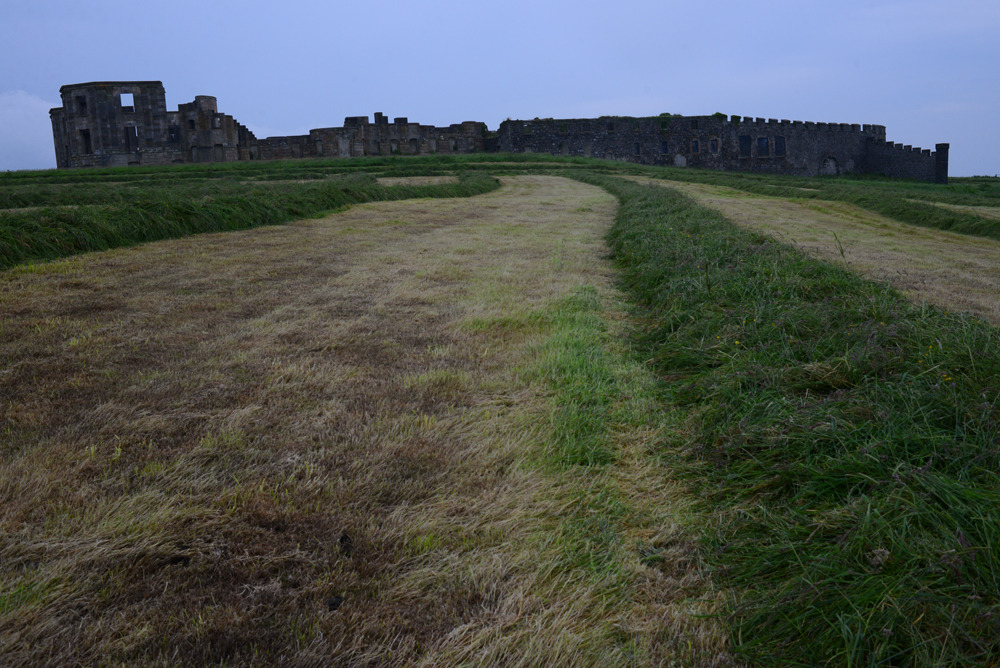
On a cliffside 4 miles down the road stands a North Coast landmark, the enormous skeletal remain of Downhill House. When new to the area and not yet familiar with this structure, I heard locals refer to it as "ancient" as if it were some excavated archaeological site or an early medieval castle. Considering that even from a distance I could spot obvious neoclassical elements, this struck me as unlikely. Still, when I looked it up I did not expect the dates to be as recent as they were: The latest version of the house was built in the 1870s and remained inhabited until after World War II, its trajectory toward disrepair beginning mid-20th century. To think that within that time, the sturdy-looking giant, built no doubt with the finest materials available in its day, became this roofless maze of crumbling stonework - so thoroughly dilapidated that locals (some of whom must surely still remember it intact!), prefer to playfully re-imagine it as an ancient ruin.

There is a trend in some circles of cyclists to celebrate - and even try to hasten - signs of aging on their modern machines. From tattered grips to chipped paint, even spots of rust and tiny dents, such things are cherished as evidence that the bike is authentic and "well loved." This trend can be observed all over contemporary culture, from distressed jeans to the "shabby chic" style of decorating. To a critical theorist, this hunger for decay is symptom of a desire for history in an ahistorical era. But I wonder also whether it is specific to areas where things tend to preserve well - decay requiring either many years or special effort. Here in Ireland, if I want "history" to happen to a modern bike all I need to do is leave it in the garden for a week, then watch it succumb to stunningly early ruin.

Jumat, 25 April 2014

The Point of No Return

Plumbridge
A friend of mine is a glider pilot, whose specialty is cross country flights. While the comparison is not fitting in all aspects, cross countries to gliding are a little bit like what brevets permanents are to cycling. You declare a task involving a long distance route, pick a day when thermal activity is conducive, and take off - in a tiny unpowered plane. Because glider planes have no engines, the pilot must rely entirely on their aviation skills to stay up in the air over hundreds of kilometers, to cover the route they set out to do, and to land safely. It is an unsupported, challenging activity that, as the consequences of failure are high, would to most people seem insanely dangerous. To the pilot, however - who is typically the sort with nerves of steel and a pathologically high fear response threshold - it is a nice day out. "My favourite part," says my friend, "is when you pass that point where there is no longer an option to turn back early - when you've committed yourself to doing the entire distance…" 

Merely imagining experiencing this inside a glider sends a chill down my spine. But it is also deeply familiar. It is something I feel every time I cycle long distance, whether as part of a brevet or on my own. As the miles roll I can sense that point approaching, and a subtle, yet delicious excitement builds up within me. Mile 10, 20, 30 … mile n …if I'm not feeling up to this, I can turn back and cut the ride short, yet still get home on my own power. I'm in the safety zone. But then comes that mile n+x when I know that, if I continue, there is no turning back. Or rather, no sense in turning back, as doing so wouldn't diminish the distance left to travel compared to completing the route. I am in the deep end now. I am out at sea. This awareness, rather than making me anxious, fills me with an unexpected inner calm. 

For a glider pilot, to abandon a cross country flight once that point of no return is passed involves the skillful act of "landing out" in the nearest field where an emergency landing can be accomplished. Then comes the phone call to that lucky designated friend or family member, who will have to drive out to the site with a special trailer in tow to bring pilot and glider back. The riskiness of an unplanned landing, the inconvenience of the rescue, and the pervasive aura of failure accompanying it all, make this an experience pilots want to avoid like the plague. Abandoning a ride and requiring a rescue (while far less  fraught with danger) is similarly traumatic for cyclists - particularly on a brevet, with its stress on self sufficiency. A year after the fact, the one and only time I've had to be rescued remains an open sore. 

I do not make the decision to pass the point of no return frivolously. Do I have the legs? Do I have the energy? Is the amount of food and water I've brought proving sufficient? Is the weather shaping up to make for a safe return? Am I doing okay for time and are my lights adequate if I run out of daylight? These are all questions I run through my head, like a check list, before re-committing to the intended distance at that mile n+x marker, where I still could turn back and cut the ride short. But once I do decide to keep going, there is no second guessing. And a wonderful feeling of being untethered comes over me, bringing with it a fresh rush of energy. There is a sense of freedom in the awareness that there is nowhere to go but onward. 

Selasa, 04 Februari 2014

Two Wheel Affinity

As a cyclist I've never felt much of a connection to motorbikes. Yes, they have two wheels, they lack an enclosure, and they are kinda sorta bike shaped. But so much of the cycling experience is about pedal power, which is not part of the motorbike experience. They are motor vehicles. For me, this put them in a category closer to cars than bicycles.

It's been interesting to learn that in Northern Ireland many see it differently. There is a lot of overlap here between cyclists and motorcyclists, both in racing and in recreational riding cultures. One friend did short circuit motorbike racing in parallel to bicycle road racing through the '80s and '90s. Several others spent their youth involved in motocross or trials. Others collect vintage motorcycles along with vintage bikes. And others simply enjoy riding motorcycles for pleasure or touring much like they enjoy these activities on a bicycle. To explain the connection, they describe the similarities: The feel of being out in the elements, the handling skills, the sensation of wind on one's face. It's similar, with enough of a difference to make switching back and forth interesting in its own right. "You should try it!" Oh of course, ha ha.

Two big-deal motorcycle races are held on the open roads of Northern Ireland: the North West 200 and the Ulster Grand Prix. Unwittingly I became a spectator of the former when I visited in Spring 2012. The course passed nearby and one day I sat on the grass watching the machines fly past at incredible speeds (top speeds of over 200mph, I later learned). Even for someone with no interest in the sport, it was an exciting thing to see. The following summer I was staying with friends and they watched the Ulster Grand Prix on television. This was around the time I was starting to get a feel for cornering and other bicycle handling skills. And watching the racers go around the bends of roads that looked just like the roads I cycled on - leaning their motorbikes this way and that at dramatic angles - I grew absolutely absorbed in their movements and could almost feel the road from their perspective. For the first time, I felt the connection.

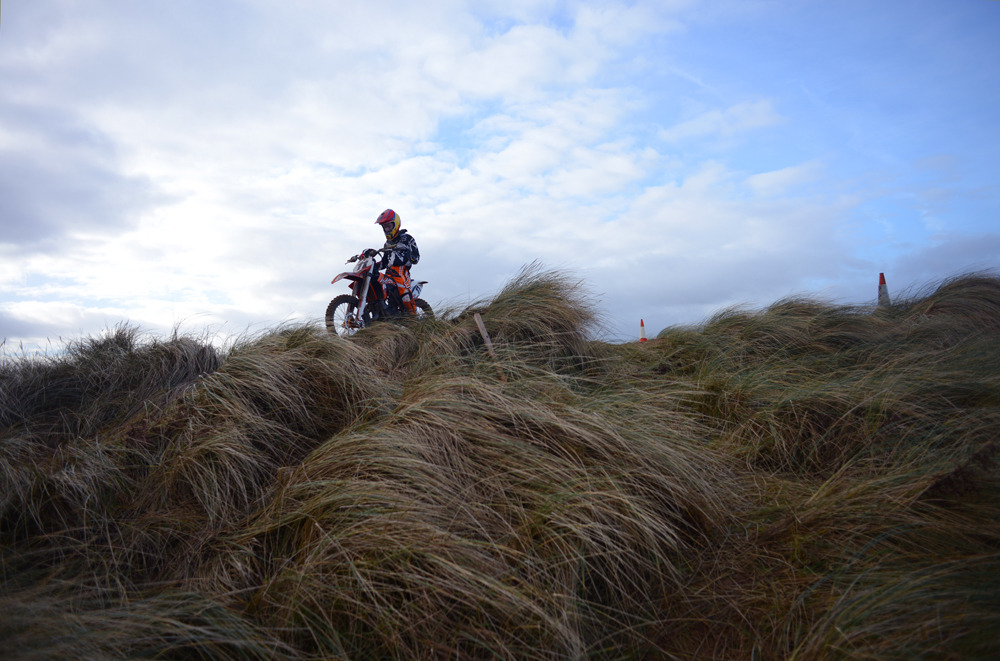
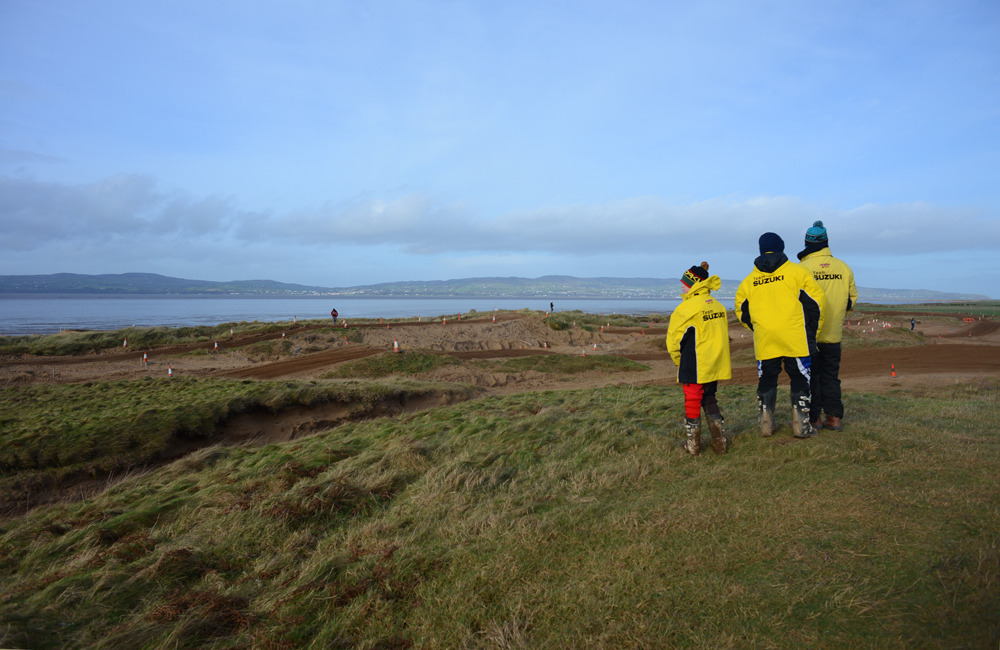
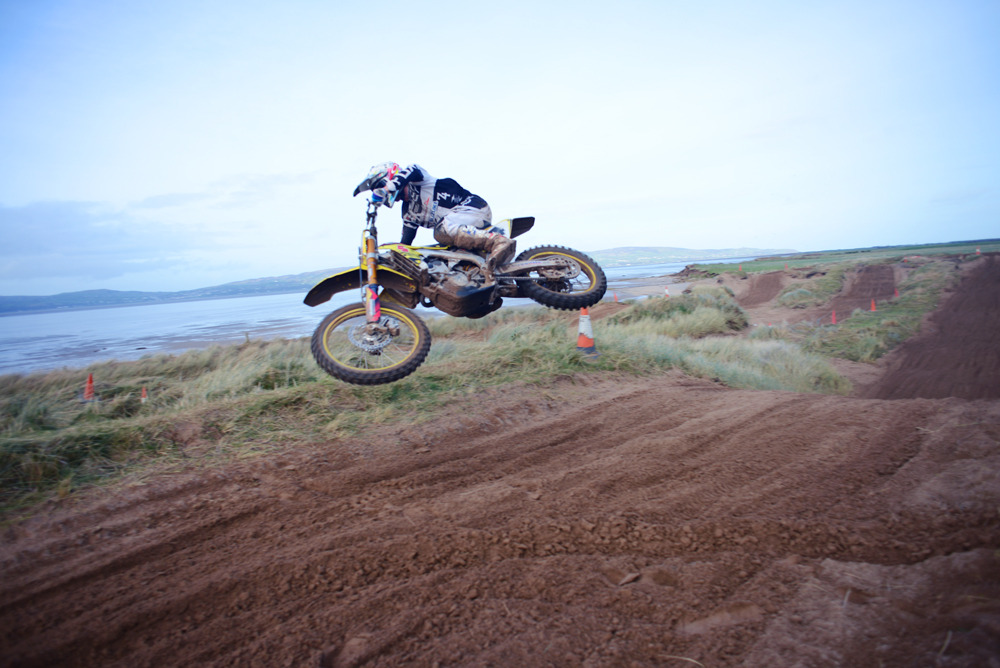
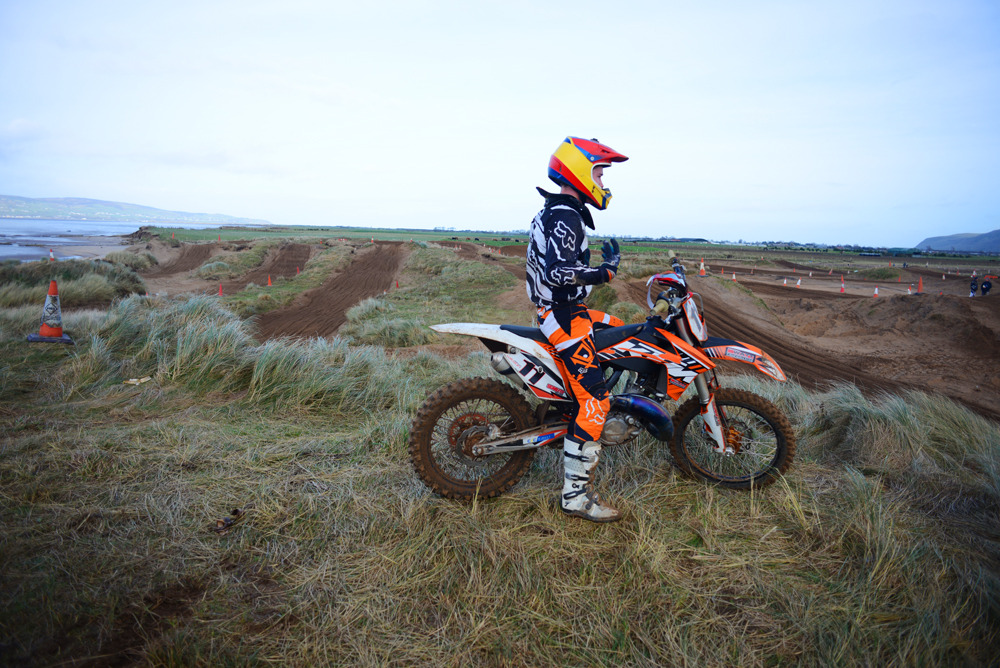
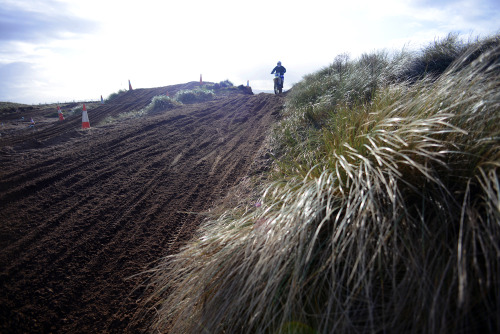
From the fields behind my house, I can sometimes hear a distant buzzing sound. I know there's a motocross practice track somewhere there and plan to have a look one of these days. When I finally do, the Magilligan Motocross Track is grander and more beautiful than anything I expected. An expanse of tall sand dunes on the shore of Lough Foyle, topped with windswept silver-green grass. With a crazed buzz and violent sprays of soil, dirt bikes race through these hilly muddy sandy loops, whirlwinds of colour. The impression is that of a naturally occurring landscape that happens to be perfect for their mad purpose.

Seen up close they are viscerally stunning. It is like being near enormous wild animals and watching their antics whilst keeping out of the way for the sake of self-preservation. Filthy bike and rider are one creature as they take to the air, twisting, roaring, spraying dirt, a controlled wildness to them.

Seen from a distance they are surreal. Bikes flying over dunes, over water, over the mountains of Donegal. Bikes in the sky, bikes in the clouds. In their flight they trace a perfect arc and there is an illusion of slow motion. In this scene there is overwhelming serenity.

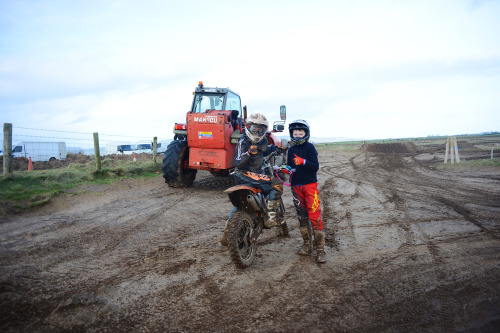
Motocross is likely the most popular form of motorcycling here. Kids ask for "scramblers" for birthdays and special occasions. They can start riding (on kiddie tracks) as early as age 5.

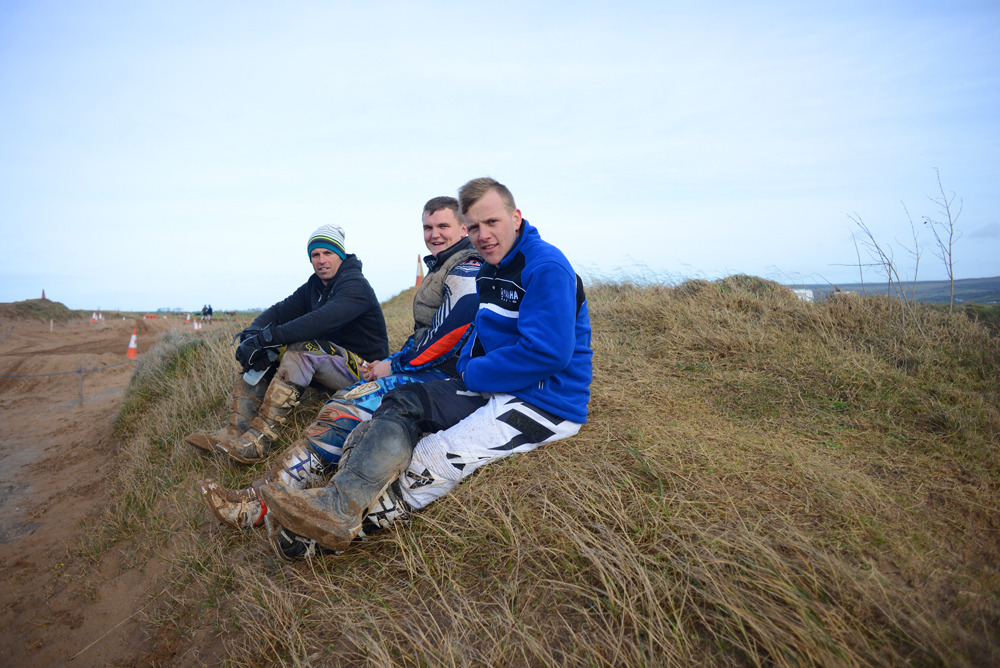
Motocross bikes are made to race off road. They are sporty-clunky, vaguely MTB-esque looking things, with wide knobby tires and lots of front suspension. They are made to accelerate quickly and can go from zero to "whoa" at the blink of an eye. You can tell the manufacturer by the colour. And aside from that, I don't know much - other than that a mad sparkle glistens in the eyes of friends who used to be into the sport whenever they talk about it. Most of them quit before they entered their 40s, not wanting to risk injury once the responsibilities of family or steady employment set in. Safer to stick to cycling.

Though I've yet to even ride on the back of motorbike, I do feel more of an affinity with them than I used to. How do other cyclists feel about this?

If you're a fan of motocross, you can see some more photos of this beautiful track here.

Rabu, 11 Desember 2013

Common Threads

The Blayleys, Northern Ireland
To watch The Blayleys walk across the pasture beside my house felt surreal, if only because it seemed so natural. John Bayley is Irish, so his presence registers as entirely normal here. But also, Ireland just doesn't feel that far from the Greater Boston area. It was almost as if we were meeting in rural Vermont or Western Massachusetts. Well, not quite. But the setting did not feel wildly foreign. 

What did feel foreign was the complete absence of cycling. Pamela is still recovering from her injury earlier this year. And they were not staying long enough to make it worthwhile for John to bring a bike along. So here we were - interacting not as three cyclists, but simply as three people. Meeting at the train station, we walked to my house along the country roads as the sun set over the mountain. Then we lounged indoors by the fire until 2 in the morning.

Dave Smith and John Bayley
Throughout the evening, others came. For a place as remote and under the radar as Northern Ireland, it is surprising easy to end up in serendipitous situations. Cycling persona Dave Smith - aka @ffflow - happened to be in the area. Now here he was, at my house, in the flesh, bearing a bottle of wine and stories that had nothing to do with cycling. International man of mystery Clive Somerville joined us as well, just back from a trip to Abu Dhabi. Wine and food appeared. Introductions were mostly dispensed with. Conversations began from the middle and went in unexpected directions, as if we all knew each other better than we did. 

How does that happen exactly? None of us were from the area. And all had had something unusual happen to us in recent times. Maybe that was the common thread, the disinhibiting factor. As well as the knowledge that we were all connected by our love of bicycling, even if the topic was hardly mentioned.

Fun with Fire
I used to think that I would not know what to do outside a cycling context with those whom I knew through cycling. This year has proved that to be entirely wrong. And as strange as 2013 has been, that is one thing I am grateful to it for. 

The Blayleys, Northern Ireland
In the morning, I walked with Pamela and John to the shore, across the fields of faded grass. Pamela is tough and resilient, and the next time we meet we could very well be riding bikes together. But, as with my other guests from last evening, the cycling aspect seems almost irrelevant now to our connection. The threads that bound us might be threads of wool and lycra, but somehow they have helped us transcend the realm of cycling. 

Jumat, 06 Desember 2013

Acquired Taste or Love at First Try?

Tyrone Flyer, Magilligan
image by Chris Sharp

A good friend of mine here is a runner. He cycles as well, but it’s running that’s his passion. He runs mostly off road - on wooded paths, through forests and up mountain trails, along rugged shorelines. And when he talks about running, he makes it sound wonderfully appealing. So much so that, willfully suppressing awful memories of my own tortured attempts at running in the past, I began to ask questions and to consider giving it another try. 

So we had a chat about it, at the end of which I said that I'd like to try running again - making a comment to the effect of “I think I'm going to enjoy it this time.” To this he quickly replied “Oh no, you’ll hate it at first for sure!"

"Oh?"

"But stick with it," he added brightly. "Once you pass the tipping point, you'll not be able to live without it." 

Okay, not exactly what I had in mind. But I remained optimistic. "So how long did it take until you began to enjoy running?" 

 "About three months." 

"Three months?!" Okay, definitely not what I had in mind. But the idea of willingly doing something that feels awful until that point where it begins to feel good intrigued me. What motivates people to run for 3 months if they don't enjoy it? And how does the experience transition from an unpleasant to a pleasant one? 

When I started asking these questions, my friend turned the subject to cycling. "Well didn't you feel the same way on the bike? Is the pain not terrible until you get used to it?" 

It never occurred to me to think of cycling in that way. Because no, it never felt terrible. It felt good from the get go - wonderful even - which is why I wanted to do it again and again. Sure I was sore and out of breath after my first few bike rides when just starting out. And even now I feel plenty of pain whenever I push my limits. But I would compare this to the experience of dancing all night: While I don't get to do this as often as I'd like nowadays, in my 20s I used to love going to clubs and dancing until near-collapse. I'd feel the physical stress toward the end, and definitely the day after. But while I'm dancing, the fun of it and the getting lost in the moment overshadow the pain. On a bike - whether toodling along a river path or  taking part in the most grueling of training rides - I feel something akin to this. But at no point had I ever felt it while running; at no point during any of my attempts to run did it feel "fun," and at no point had I been able to lose myself in the act of running to the extent that the pain and discomfort of it would get tuned out. I had always thought this to be a sign that running was simply wrong for me, and assumed that dedicated runners got that way because they did enjoy it from the start. But now here was a runner telling me that he too was miserable in the beginning. I have since questioned a few other friends who run and got similar feedback. Their description of running as initially unappealing, but habit-forming, reminded me of the stories people tell of how they began smoking or drinking: "I hated the taste at first..." When it comes to stories of how people got into cycling, there is instead a theme of love at first try. 

So, does running tend to be an acquired taste, whereas cycling is innately pleasurable? Or is it more about the person, the intensity, and other factors? I've stuck with cycling for 5 years because I loved it from the get-go, so the idea of running "until I grow to like it" is hard to wrap my head around - but I am not closed to the idea. There is considerable overlap between cyclists and runners, and I am curious how those who've done both feel about these activities.