Tampilkan postingan dengan label rural cycling. Tampilkan semua postingan

Kamis, 07 Agustus 2014

The Ghost Bike of Magilligan

Magilligan Ghost Bike
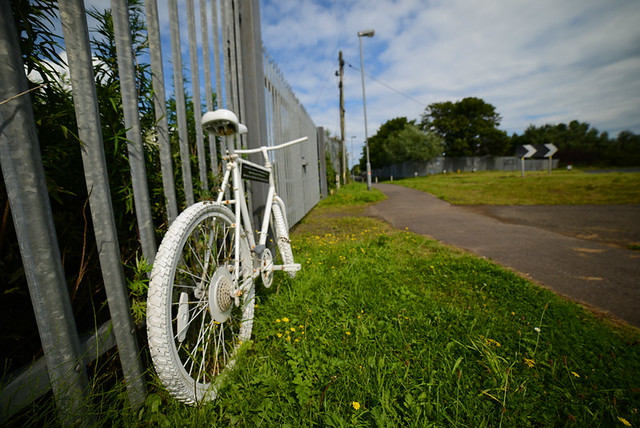
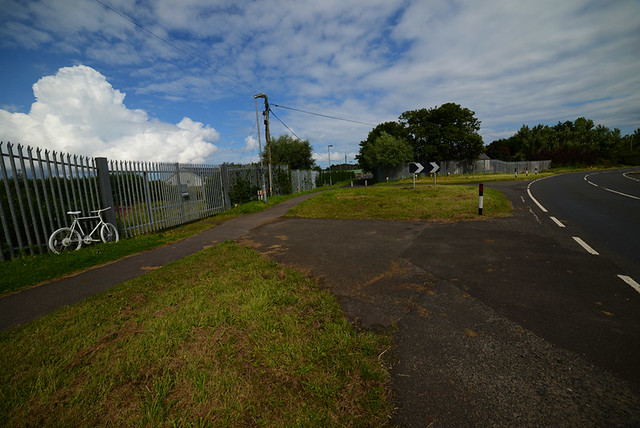
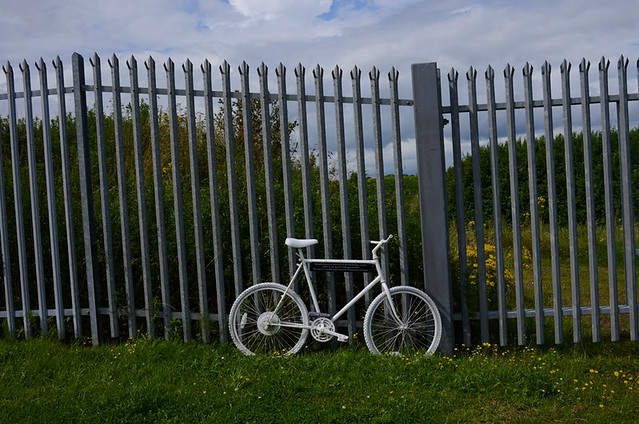
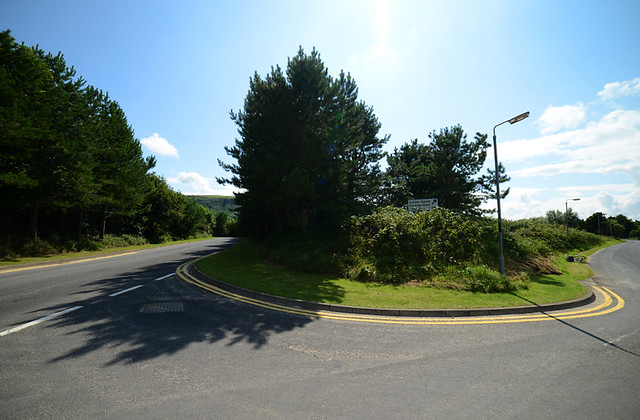
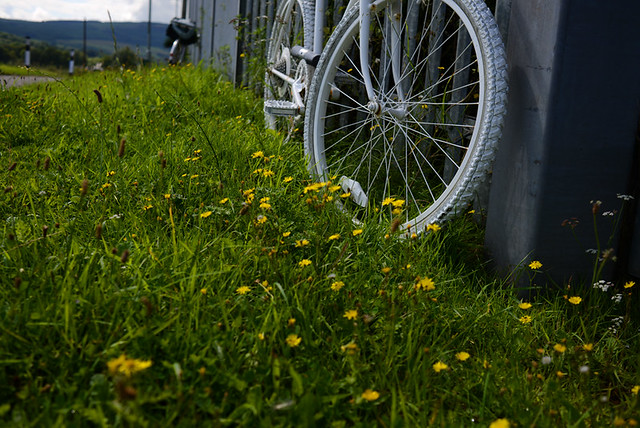
The shortcut to the beach is hidden along the main road, just before the big bend leading into Benone. Sun-drenched and shelterless, this stretch of road is like a child's drawing of a sunny day: blue skies, white clouds, yellow fields; the colours oversaturated; the edges unnaturally crisp. Veering away from all this, the shortcut plunges into leafy shade as it winds through parcels of forest all the way to the strand. The tiny lane is easy to miss if you don't know where to look. But if you do know, it is unmissable: Just watch for the handpainted stark white bicycle, chained to the caravan park fence.

Magilligan Ghost Bike
No matter how often I pass it, the sight of the Ghost Bike rattles me. Perhaps it is the location. I am accustomed to seeing these monuments to fallen cyclists in cities. But this one is jarringly out of place on a rural coastal road. In this unexpected environment, the ghost bike is more noticeable, more striking. Isolated and uncamouflaged by urban clutter, it refuses to blend with its surroundings; it is unignorable.

As the eye wanders from the bike to the sharp bend in the road, the imagination engages, activating a sequence of horrible stills. How did it happen? Who did it happen to? The plaque attached to the top tube names Gareth, aged 16. I know that I can ask around and learn the whole story in great, terrible detail. But I don't. Once I pedal past the bike and turn into the shaded backroad, I try to put it out of my mind. Because when I ride to the beach on a beautiful summer day, I do not want to think about ghost bikes.

Magilligan Ghost Bike
I do not want to wonder, for instance, whether the bike in front of me was the boy's actual bike. The very bike that got hit and… I close my mind's eye before the sequence is finished.

Benone
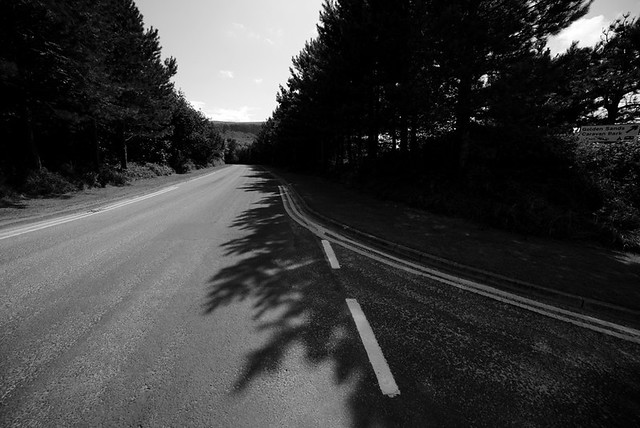
Smelling heavily of pines and, more faintly, of seaweed, the road to the beach disorients with its un-Irish feel. It is more like Maine, or Croatia. The sun filters through dense pine needles and the shapes dance on the rough pavement. The beach is not visible, but its presence is felt beyond the pines, and at any moment you expect to glimpse it around the next bend. It is the kind of road where, even before you've gone where it wants to take you, you are gripped by a pre-emptive nostalgia for the experience you're about to have.

Benone
And when I feel this, I do not want to think about ghost bikes. I do not want to think about death, or injury, when the sun is on my face and the waves of the ocean beckon. The ghost bike intrudes, but I shake it off as I would a fallen leaf tangled in my hair.

Benone
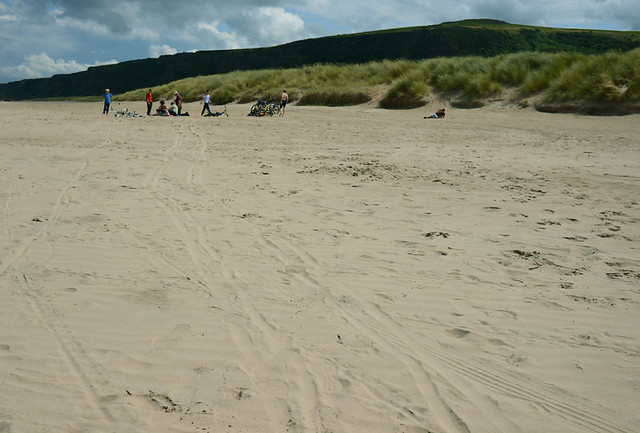
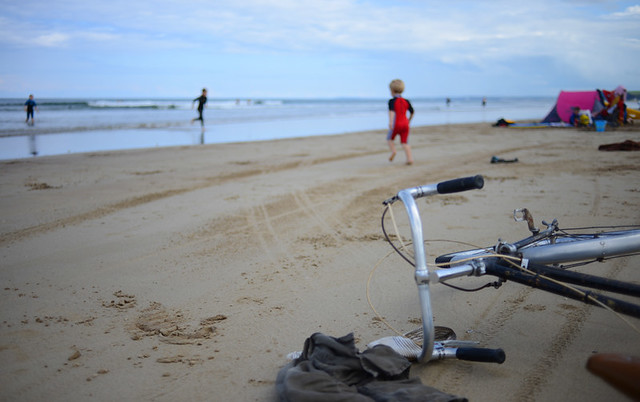
Through the pine needle shadows, past the caravan park and the holiday homes, a steady stream of kids makes its way to the Strand. They throw their bikes down in haste and run to the water.

Benone
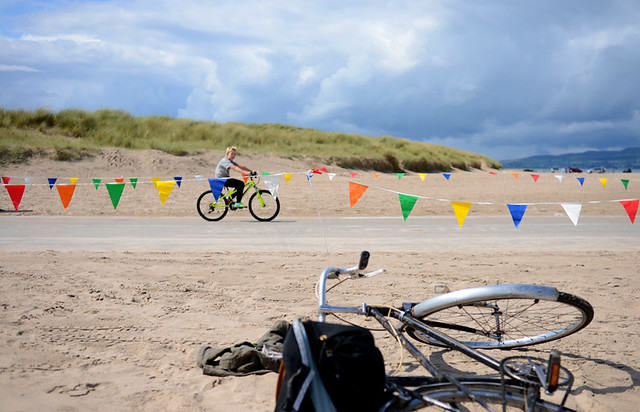
Past the too-vibrant bunting that delineates the entrance and exit points, more kids pedal.

Benone
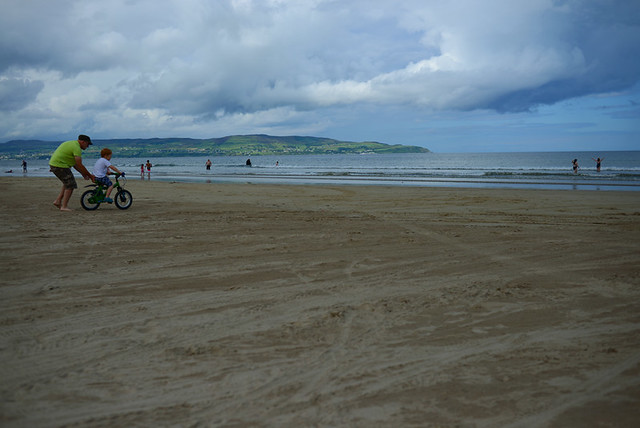
By the water, a father teaches his son to ride a tiny two-wheeler. The boys falters and tumbles into the soft sand, unhurt and undeterred. They laugh and try again. The sun shines.

Benone
I try to relax, to enjoy myself, to swim. But the children on bikes are all around me. As I watch, I catch myself wondering about the parents of the boy for whom the ghost bike was put up. Are they resentful when they watch such scenes? Are they merely sad? Or, are they happy for these other children, feeling the sun and the water on their healthy, intact bodies?

Magilligan Ghost Bike
I try to shake these thoughts off, so at odds they are with this beautiful summer day. But as I pass the ghost bike on my return, I stop and something compels me to sit on the grass beside it. I look again at the bend in the road, and I read the plaque, and I take it all in without trying to push the imagery away, as I run my fingers through the buttercups and the Queen Anne's lace that flourish around the scuffed white tires. The bike will be here every time I ride to the beach. Perhaps I'll grow immune to it over time. Or perhaps not, and every time I see it my mood will darken and these thoughts will haunt me. And maybe that is as it should be. I just hope the motorists driving past feel a least a trace of the same reaction. 

Selasa, 08 Juli 2014

A Drafty Morning

Today something amazing happened to me on the way into town. I was cycling though the countryside,  half way through my usual 7 mile commute, when behind me I heard the put-put-put of a tractor. I scooted over toward the hedges and slowed down, to make it easier for the cumbersome heap of metal to pass me. And it did, huffing and creaking as it maneuvered around me on the narrow winding road. It was one of those smallish things with a flat-bed at the rear, piled high with freshly cut grass. These types of machines are not meant for the road and they move slowly - faster than a typical bicyclist, but closer to bicycle speed than car speed. In the cabin, the driver gave me a friendly wave as he passed. He then made some other gesture I could not make out and slowed down. I did not understand what he wanted at first. Why did he pass me only to slow down to a speed slower than mine? Soon I was a foot behind him and applying brakes. Now what? If I pass him, we will only play leapfrog.

Confusing me further, at this point the driver turned around, made eye contact and gave me a thumbs up. Then he began to speed up again. I followed suit, and as I did, it finally hit me what was happening: He was offering me to draft him!

Quickly I scanned the back of the tractor.  A metal ledge and a pile of cut grass; no sharp edges to impale myself upon. This was crazy, but what the heck!

As he increased his speed, I followed suit and increased mine, so that the distance between us remained the same. I did not have my computer, but by feel alone I could tell I was traveling faster than I would on my own power. It was just like riding in a paceline, sort of.

Occasionally, the driver would turn around and give me a questioning nod, like "speed still okay?" And I would reply with a thumbs up.

Cruising along at what was probably 25mph on my folding bike, I spun madly in my high gear feeling little resistance. It was just like that scene in Breaking Away, sort of. I kept expecting him to stick his fingers out the window to challenge me to daredevil speeds - three fingers, four, five! Alas, the rickety farm vehicle was no more capable of such feats than I.

At the next roundabout, the tractor turned off and I rolled into town, beside myself with giddiness in the flickering sunshine. There are plenty of drafty mornings. But not quite like this one.

Kamis, 05 Juni 2014

Visceral Entertainment

When we glamourise urban transportation cycling, a favourite fantasy activity of this genre is cycling to the theater. A civilised evening out and you can do it on a bike! Oh my. Wistfully we picture elegant sophisticates pedaling stately steeds unhurriedly, their tranquil faces luminous in the neon glow of storefront signs. 

Meanwhile, there I was… bracing against the headwind, sweat streaming down my face, as I cycled 7 miles past endless fields stuffed with grazing sheep, the smell of freshly spread manure filling the evening air. Ah, rural cycling at its finest. A civilised evening out and you can do it on a bike! 

At last, and only slightly worse for wear, I arrived in the tiny town of Limavady to see the much-recommended Flesh and Blood Women. The community arts center where the play was staged has this multi-purpose room that makes for an intimate auditorium, with the audience clustered close to the stage. When I walked in, the place was packed. The only available seat that offered a decent view was in the front row. I took it. And, as the lights dimmed and the performance began, I found myself face to face with the actress delivering the first monologue. 

I have seen my share of plays, but it's been a while since I'd seen one in a venue this small, sitting this closely to the stage. I had almost forgotten that, when a play is good, the physical presence of the actors is so viscerally engaging as to be overwhelming. It is as if a real event unfolds in our presence. We don't just watch it happen; we feel it happen.  

The actress in front of me was so very there I could see her eyes tear up, her forehead glisten with sweat and her calf muscles twitch as she paced in stiletto heels. I could feel the force of her breath when she spoke. Her emotions vibrated and these vibrations in turn resonated through my own body. Weakened and relaxed by the physical effort of having cycled into town, I found myself especially receptive to this stage presence physicality. There was a rawness to watching the play that matched my own state of being.

Feeling all this, I could not help but recall the previous week, when a friend and I had driven to see a movie. These experiences were parallel, but so interestingly different. Seeing a movie on a screen versus seeing a play, and driving versus cycling. In one there is a degree of separation introduced that dampens the visceral and makes for a more detached, abstract experience. In many ways, this is a more comfortable way to be - to travel, to observe, to seek entertainment. There is privacy, protection. There is a reduction in effort. But in spite of this - or perhaps because of it - it cannot pack a punch as strong as direct experience. 

Riveted by the persons on stage in front of me, I hear the final click of their heels as they leave the stage and imagine pedaling home in the cool country night. What a strange and visceral entertainment. 

Rabu, 09 April 2014

Adventures in Cyclo Shepherding

Lamb Herding
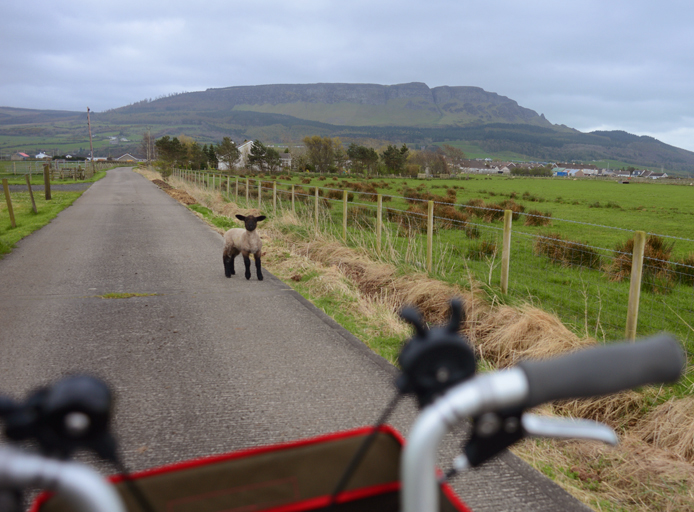
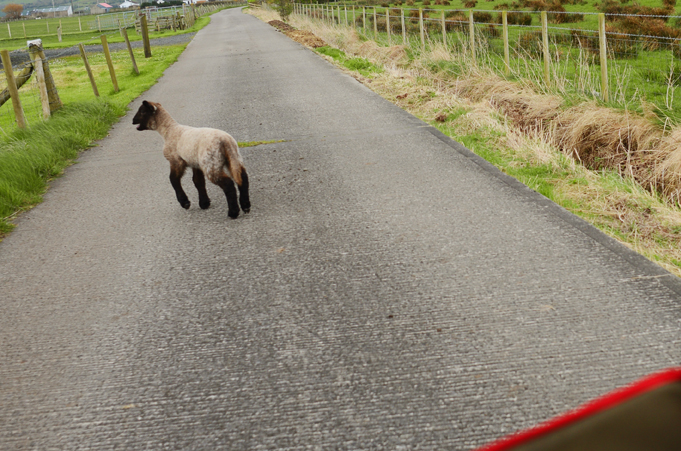
The first time it happened unintentionally. I was cycling down a neighbouring farm lane, when I noticed frantic activity in front of one of the cottages. The farmers - a man and woman in their 60s - crouched facing each other with their arms spread wide open, as if about to perform some strange circle dance. As I got closer I saw they were attempting to surround a tiny, highly vocal bundle of white fleece. The creature, sensing that capture was near, leapt and darted about wildly until it evaded the two pairs of outstretched hands and galloped away. Never having witnessed such a scene before, I stood frozen over my bike for a moment, mouth agape, watching the newly born lamb - hardly larger than a cat - disappear down the lane in the direction of the shore. For a moment the others stood silent as well. And then all at once we knew what needed to happen. By the time the farmer said "Would you go and chase it down on your wee bike?" my foot was already pushing the pedal.

Lamb Herding
So what exactly is involved in herding a lamb by bike? Luckily I had watched sheep dogs do this a few times, so I wasn't entirely clueless. First, I cycled fast, to catch up with the lamb. The rush from the escape having subsided, it now hopped along anxiously, its tail trembling, not sure what to do next. I slowed down and cycled directly behind it, coasting to let it hear the ticking of my hub and sense my looming presence. And then, ever so slowly and carefully, I maneuvered my bike as if I meant to cycle around it and into its path. 

Lamb Herding
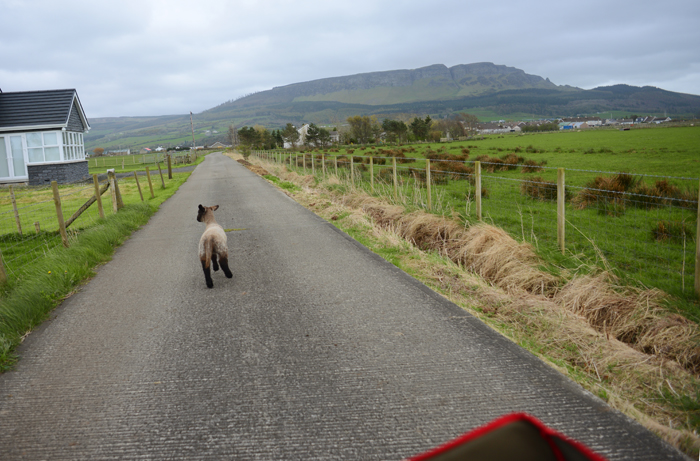
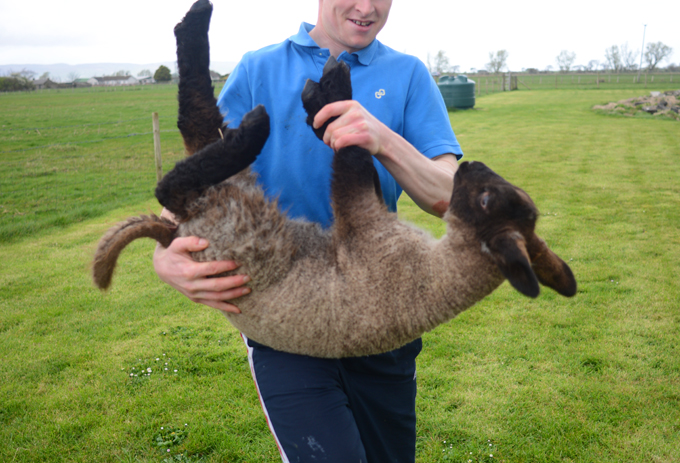
After some initial moments of indecision, the lamb did what I had seen others do when confronted with this maneuver - it made a U-turn and ran back in the direction of the farm. Slowly I followed close in its tracks to make sure it kept this course. It was growing dusky by this time and my bicycle's headlight was glowing bright, illuminating our path. When the farmers spotted us approaching they were ready and grabbed the twitching creature after I steered it into a narrow, fenced in part of the yard where the newborn lambs and their mothers were kept in a pen. The poor thing had gotten out by accident, but now it wanted its mother - wagging its tail happily and going straight for the milk upon seeing her. All was well.

Lamb Herding
I would not say that herding lambs has become a habit. But I've helped bring back a few of these wayward darlings now, including this fleecy fellow just earlier this morning. My little Brompton is hilariously perfect for the task - compact and easy to accelerate and maneuver, it can sprint after the lamb, then slow down and hover around it until it turns in the desired direction. The lambs seem to accept this two-wheeled shepherd and behave predictably.

Lamb Herding
Despite their erratic galloping ways, once caught the lambs are actually quite docile and cooperative. Cooperative enough to sit in my bike basket, I've wondered? But, considering they aren't house-trained, I've never gone as far as to try it.

Rabu, 05 Februari 2014

Transportation Cycling in Rural Areas: Some Food for Thought

The present-day culture of transportation cycling is predominantly associated with urban living. This makes sense, considering the realities of life in cities and their immediate vicinities. When commuting distances are short, motor vehicle traffic horrendous, and public transportation either overcrowded, unreliable or both, riding a bike can become an attractive option for getting around. Throw in some cycling infrastructure and perhaps a bike share system, as many cities are currently doing, and the appeal becomes greater still – especially as rising numbers of others take to the streets on two wheels, making it seem increasingly more normal and realistic.

But the desire to cycle for transportation is not limited to urbanophiles. Some rural residents may be commuting by bike already. Others may be considering it. Others still may be cyclists who currently live in a city, but are contemplating a move to the countryside. For the latter two groups a slew of questions and concerns might arise, with not a whole lot of resources out there to address them. This has become especially apparent to me since my own move to the countryside some months ago - in the course of which my email inbox has filled with questions from a surprising number of would-be rural bicycle commuters. Now that I’m feeling a bit more settled, I would like to start sharing some thoughts on the topic.

To state the obvious, there is a great deal of regional variation between rural areas. Differences in climate, terrain, distances and the availability of safe cycling routes will play a huge role in how realistic commuting by bike will be. Perhaps less obvious is that these differences can exist even within the same locale: pockets dense in amenities and pockets that are not, pockets that are hilly and pockets that are flat, pockets that offer safe routes for cycling and pockets that do not. As an example: My current house, while situated in what is generally a remote and shockingly hilly part of Northern Ireland, happens to be in a pocket that is unusually convenient and bicycle-friendly. I am just over a mile from a sort of farming hub, with several small shops selling basic provisions and local produce, and 7 bike-friendly miles from the nearest small town. Being at the base of a mountain but not on it, I have easy access to flat routes and enjoy mostly ice-free roads in winter due to warmer temperatures than neighbours who are even slightly uphill. In a pinch, I am also only a mile from a bus stop and two miles from a train station. Other parts of this very same region are far less handy for getting around by bike. This is all to say that it is essential to get to know an area thoroughly before forming an impression of what commuting by bike will be like there. Even to assume regional homogeneity would be a mistake. 

But speaking more generally, rural transportation cycling, as I see it, is not just about locations, distances and terrain. It is a categorically different kettle of fish from urban cycling. Why? Because it is fueled by a different set of motivations. Whereas in the city, cycling might be the faster, more convenient transportation option, in the countryside that is extremely unlikely to be the case. With long miles to cover, little in the way of traffic congestion and parking easy to come by, the car is clearly the more convenient choice here. So in devising ways to commute by bike in rural areas, we are doing so because we value cycling in of itself more than we value convenience. For some, this could boil down to physical fitness. Commuting by bike make take longer, but it is in fact two activities in one - commuting and keeping fit, saving time that would otherwise be spent at the gym. For others the real issue is financial. The bike costs next to nothing to run compared to the costs of a car, and for that some loss in convenience could be seen as worth it (or simply, necessary). There could be other underlying factors. Environmentalism. Or the inability, be it for legal or physical reasons, to operate a motor vehicle. But all that considered, I would venture to say - and this is just a guess really, a hunch, an intuition - that for a great portion of dedicated rural bicycle commuters in the developed world, the love of cycling for its own sake is the dominant motivating factor. It may be an irrational love. A love that goes against what's reasonable or practical. But it's a love strong enough to, however creatively, turn it into reality. Otherwise, it is just too easy to opt for other forms of transportation. And people generally do what's easy, unless they love the other option that much more. 

In the coming months, I hope to continue sharing thoughts and ideas on different aspects of rural transportation cycling. I would also like to compile a list of rural cycling blogs and post it here. My collection of links to those is pretty small so far, so if you know of any - or write one yourself - please do share!

Sabtu, 04 Januari 2014

How Could They?

A little while ago I got the chance to ride a vintage roadster again. It's been a while, and let me tell you - that magical, floaty feeling was just as wonderful as I remembered.

The owner's great uncle rode the bike as a young man. After that, the machine languished in a shed for decades until the nephew discovered it and gave it a new life. "I gave it lower gears," he said, "to make it easier on the knees." And he pointed to his strong-looking, athletic 40-year-old knees. Having done the same to nearly every vintage bike I've owned, I nodded understandingly. Then I took him up on his offer to try the bike out on a longer loop.

About a mile down the flat main road, I turned, unthinkingly, left, onto a lane that winds around the side of the mountain at a steepening grade before coming back down. I've grown used to making this turn, as it's a loop I often do to get to several of my favourite photo locations. Despite the climbing involved, it is easy enough to manage on my own transportation bike with its low, low gears.

Now I'm riding the roadster up this lane. Almost immediately, I get into 1st gear. And almost immediately after that, the 1st gear is not nearly low enough. I pedal harder. I grind. Then I stand up on the pedals and push with all my might. After it feels as if I've been at this forever, I look back over my shoulder and see that I've made little progress. It is safe to say, the magical floaty feeling of the roadster is gone.

Miserable minutes, that feel like years, go by. I am in decent shape and not averse to hard work on the bike. In fact I've recently been introduced to the concept of "strength training," and will now often climb a hill in a harder gear than comfortable deliberately. But the difficulty of pushing this thing up the hill stuns me - in a way that is perversely motivating to keep pushing past the discomfort, to keep going just to confirm that it is humanly possibly to ride this bike up a hill without breaking my legs! After all, I say to myself… Back in the day people used to do this all the time. And they didn't even lower the gears! Imagining riding the bike up the same hill in its original gearing nearly makes me throw up, and as I finally arrive at the top of the slope, drenched in sweat and wild-eyed with effort, the question rings shrill and loud in my mind: How could they?!

Seriously. If we are to believe that ladies on loop frames carrying their shopping in front baskets, and men on roadsters going to and from work, were once a ubiquitous feature of the Irish rural landscape, then we must also believe they could tackle with ease the very hills that today make their grandchildren weep - or at least demand a 1:1 gear. Were the older generations inherently more fit than us? More stubborn? More willing to put up with physical difficulties?

In Boston, I remember trying one loop frame roadster where the 1st gear was so high I had trouble starting the bike on flat ground. I asked the owner, who happened to be a vintage bike collector, how ordinary women could ride these things 40 years ago. And his reply was, that in fact these bikes were not ridden much, and the high gearing must have been one of the reasons for that. And it's true that most of the vintage 3-speeds found in New England are in remarkably good condition, many of them blatantly unridden and suffering only from damage due to age and neglect.

By contrast, vintage roadsters found in Ireland and the UK tend to show signs of heavy use. In fact my theory as to why it is comparatively difficult to find vintage 3-speeds here is that most of them have been ridden into the ground by the original owners. Considering that the terrain here is hiller than what the Boston area has to offer, the argument that the high gears made the bikes as difficult to ride then and they seem now does not fit.

When I returned the borrowed roadster to its owner, by the colour of my face he could tell I had tried to ride it up a mountain lane. "You know," he said, "my great uncle used to live up a hill just like that and I've often wondered to myself how in the world he rode this bike every day!" He shook his head, and I did too, as if we both shuddered at the thought of it. Then he gave me a wave and pedaled the old roadster down the flat main road, as I got on my easy bike and rode in the opposite direction, feeling like an utter weakling with legs like boiled spaghetti.

Selasa, 26 November 2013

Roadsters on the Sand

Clive and His BSA
"So what on earth are you doing here?..."

In a village cafe with impressively bleak sea views, we said this to each other almost simultaneously, as if really questioning ourselves. Clive is here from New Zealand, via England, via... well, it's a story not easily summarised. Much like myself, he does not have a neatly packaged explanation for how he ended up in Northern Ireland. He is simply here. Existing in what sometimes quite overwhelmingly feels like the middle of nowhere. Floating really. Coasting. 

Clive and His BSA
To put it frankly, befriending Clive Somerville has made me question my sanity. And as I worked beside the television last night, the Secret Window playing in the background, I was reminded of why. Clive Somerville could very well be a figment of my imagination. A stress-induced hallucination, an imaginary friend to keep me company in unfamiliar lands, whatever you want to call it. Bottom line is, his realness is worrisomely implausible. Take the name, for instance. Somerville? I moved here from Somerville, Massachusetts. And "Clive"? I'm sorry, but that's a fictional name if ever there was one - a film noir character. Or, a name I might give to one of my bikes... 

Clive and His BSA
And speaking of bikes, the one he rides could have been plucked out of my imagination. A racing green BSA roadster, 1960s vintage, with Sturmey Archer hub and full chaincase - a beast he maneuvers as adeptly as if it were a BMX bike. 

Clive and His BSA
The BSA's frame has been drilled for rod brakes, yet the bike appears to have been fitted at the factory with rim brakes (which Clive fitted with Kool Stop "Vans" brake shoes - in white, to match the bike's grips). In all other ways, it is a traditional roadster. 

Clive and His BSA
Clive bought the bike (named Lady Huck) while living in England two years ago, in a vintage shop in Dorset. He describes it affectionately as having been in "nightmare" condition, rough shape with most components on the brink of failure. 

Clive and His BSA
Once he started riding it, the bike promptly began to fall apart - which in turn inspired Clive to learn how to fix it. Enter the Sheldon Brown website. Enter the classic and vintage bike forums and various blogs. Enter the world of vintage parts hunted down on ebay, wheels rebuilt by hand, hubs repacked, and cottered cranks replaced. With Lady Huck, boredom is a non-issue.

Clive and His BSA
Then there is also a matter of Clive's commute. He cycles 6.5 miles each way, from his home in Portstewart to his job in Coleraine - utilising the rural cycling highway. With my own impressions of cycling in Northern Ireland overwhelmingly positive, I sometimes wonder whether my sense of this is somehow skewed. But, having lived here for nearly a year, Clive agrees: "Cycling in NI seems really well catered for. The cycle paths are convenient, the drivers are mainly extremely courteous and friendly, the local roadies wave, the police ignores me - it's all round a nice place to ride." Of course, his co-workers nonetheless think him nuts for commuting by bike - but neither Clive nor Lady Huck are phased. 

Clive and His BSA
Though his favourite place to cycle so far has been the New Forest in England - an area he describes as so idyllic, I have difficulty picturing it. And as far as cycling in his native New Zealand, Clive describes it as great for mountain biking and BMX, but "hostile and dangerous" for commuting, roadcycling and touring in most parts of the country. This is interesting to me, as it's pretty much the feedback I get from all those who've lived in New Zealand - yet the place is rather enthusiastically promoted as an ideal bicycle touring destination. Goes to show that it's always good to talk with locals. 

Clive and His BSA
While neither Clive and I feel anything like locals here and probably never will, we've each been getting to know the area and the people, while riding our bikes and snapping photos. Meeting up a few times, we've discovered some common ground - including complicated life stories, a shared interest in film photography, and a giddy admiration for Malachi O'Doherty. We could be figments of each other's imagination, for all we know. And I suppose there is nothing wrong with that. 

Having photographed Clive on his BSA, the following night I had a dream where a group of people - all on vintage roadsters - were cycling on the sand, for miles and miles and miles as the sun slowly set. It was more than a bit surreal, but also quite doable here. Who knows, it could be a theme for a future V-CC Northern Ireland ride...

Selasa, 19 November 2013

How Dark Is Your Dark?

Dark Commute
Well, it looks like we've entered that magical time of year... the season of 5pm nightfall. Today I rode home along a pitch black road under an ink blue sky, my path illuminated by a faint hint of stars and my bike's dynamo headlight. There was precipitation in the air that was not quite snow, but a fluffy sort of sleet, and bits of it fluttered, mothlike, in the headlight's beam. I could see nothing else around me, save for the vague outlines of scraggly trees. 

Having happily ridden my bike through the past four winters, at some point I began to take it for granted that I was equipped to cycle at night. This changed during my attempt at a 300K brevet last spring, when I found myself absolutely unable to navigate a hilly, winding country road in Central Massachusetts in the dark, despite (multiple) powerful headlights. Part of the problem was no doubt exhaustion and nerves, but part of it was how absolutely dark that particular darkness was! 

Those of us who cycle mostly through populated areas are accustomed to streets being lit at night. In cities, the ever-present blaze of street lights and store fronts, and the constant stream of car headlights means we are never in the dark at all. In suburban areas, the lit up windows of residential homes provide a soft background glow. Even many of the unlit country roads tend to have reflective features or white lines along the shoulders that - in the beam of a bike's headlight - reveal the shape of the road ahead and guide us around bends. 

But what of areas where there is nothing - and I mean, absolutely nothing - to provide illumination other than our bicycle's lighting? It's an environment difficult to imagine until you've experienced it, and cycling through it can be just as much about being able to tolerate it psychologically as it is about having adequate lighting. When it's so dark that we see nothing other than what's in front of us, the imagination can run rampant and the mind can play tricks on us. 

I am getting myself used to cycling in the rural dark here - mainly by sticking to short stretches of familiar roads. More than anything, I am finding that knowing the road is helpful, as well as knowing how far I have to go until the next well-lit stretch. So far, I feel fairly comfortable doing this - the biggest challenge being that I tend to get sleepy. Nothing like complete darkness to fool us into thinking it is bed time, even when it's hardly dinner time.

In the winter season, some portion of our transportation cycling will almost certainly take place in the dark. How dark does it get where you ride, and how do you deal with it? Do you feel that, aside from equipment issues, cycling at night requires some mental or emotional adjustment?

Senin, 18 November 2013

A New Context

Misty Mountain
The transportation choices we make tend to be context specific. This goes for the "big" choices such as bike versus car versus train versus bus versus spaceship versus horse and carriage. It also goes for specifics such as what kind of car or what kind of bike we choose, as well as the ways in which we use them. 

It should come as no surprise that my own preferences and viewpoints have been largely shaped by cycling in and around Boston for the past four and a half years. At the beginning there were stretches of Vienna mixed in as well, and later Ireland. I've cycled in NYC a bit, as well as in various smaller East Coast towns. I've cycled some through the New England countryside. But mostly my experience as both cyclist and bicycle lover (and these are separate things) is undeniably Boston-specific. And as far as Lovely Bicycle - Had I been living elsewhere I doubt that I would have started the blog, or developed it in the way I have. 

As I explained a few posts ago, I am now living in Northern Ireland - in a rural area on the North Coast. I have no idea how long I am here for, but for the time being this is home. And of course being here has changed - and will continue to change - the context and content of my writing here. 

At various points over the years, I've mentioned that I see myself eventually living in the countryside, and wondered how feasible cycling for transportation would be in a rural environment. Well, it looks like I am in the process of finding out. And the one thing I'm sure of so far, is that context matters here a great deal as well. Not all rural areas are alike. Specifics of topography, road layout, proximity to various amenities, weather-related nuances, even cultural factors, can make all the difference in how feasible commuting by bike is. 

When I first visited Northern Ireland last year, I stayed in a tiny coastal town in County Antrim called Ballycastle. It was a beautiful area to visit, but as a cyclist I would not want to live there. Ballycastle itself has all the basic amenities one would need, but it is best navigated on foot, not by bike. And once you get out of town, the nearest signs of life in any direction are both far and uphill, as Ballycastle is situated in a valley. This makes going anywhere by bike a major project. When I stayed there I was highly motivated by sightseeing and photography, so I did cycle a lot. But for everyday living, I would find cycling for transportation there daunting.

By contrast, the Roe Valley area in Country Derry, where I stayed earlier this summer, is cycling paradise. Not only are there fantastic roadcycling routes in all directions, but getting around for transportation - either to neighbouring rural destinations or to the nearest town Limavady - is very manageable on a bike. Limavady is only 30 miles west of Ballycastle and in photos the scenery appears similar - all glens, sheep, mountains and sea views. But the layouts and the general "vibes" of these areas are very different - and this isn't something you can know unless you've stayed in both places. 

Even areas situated close together can feel like different worlds to a cyclist. Bouncing around between informal living arrangements with friends, most recently I had moved from the village of Aghanloo (pronounced "Anna-Lou") in the Roe Valley to the village of Castlerock just beyond it. I thought I knew what to expect from life in Castlerock, as it was only 6 miles away. But the specifics of the way this place is situated make it feel somehow extra-bleak and uncozy, to the point that it really bothers me. So despite Castlerock's stunning scenery and the availability of a fantastic cycling highway that serves as a direct route to a major town, I would not choose to settle down here - preferring the area where I stayed earlier.

As I'm about to finally move to a place of my own, in a location just right for me, I feel that I have a good grasp of what I need from a rural environment to combine my love of the countryside with my love of cycling for transportation. After some consideration, I will not be getting a car. And while I can't make any sweeping statements about the direction of this blog, I suspect my feelings on the loveliness of bicycles and the romance of cycling will endure.

Kamis, 14 November 2013

The Rural Cycling Highway

Rural Cycling Highway, Coleraine N Ireland
Most of us have probably heard of cycling highways in the Netherlands. These long distance segregated bicycle paths run through suburban and rural areas, making it easy for cyclists to commute into cities and towns. Perhaps less known is that cycling highways also exist elsewhere - for example, in Northern Ireland. Considering NI is not especially famous for its cycling infrastructure or high rates of bicycle commuters, I find this interesting and would like to share my experience. 

Rural Cycling Highway, Coleraine N Ireland
The place where I am currently staying is about 7 miles from Coleraine - a good sized town by local standards, with multiple shopping centers, a variety of businesses, and a university. It is a major commuter's hub for surrounding rural areas - including the village I am closest to, which is Castlerock. There are two routes from Castlerock to Coleraine. The direct one is along the A2 - a country highway with high speed traffic. The indirect one is along a quiet backroad that meanders along the coast and is quite hilly. When I am on my roadbike riding for sport or recreation, I prefer the hilly backroad. When I need to get into town in my regular clothes, laptop in tow, without being absolutely spent and dripping with sweat upon arrival, the comparatively flat and more direct A2 makes more sense. Luckily, a fully segregated mixed use cycling/pedestrian path runs along the entire length of the country highway.

Rural Cycling Highway, Coleraine N Ireland
The path is wide enough to accommodate 2-way bicycle or pedestrian traffic. It is buffered from the road by a 3 foot wide grass strip and a raised ridge. The tarmac is a well maintained chipseal. Blue MUP signs as shown here are posted every half mile or so. 

Rural Cycling Highway, Coleraine N Ireland
One of the nicest things about this path, is how few interruptions there are. I only counted about 3 during the entire 6-mile rural stretch before hitting the Coleraine suburbs. 

Rural Cycling Highway, Coleraine N Ireland
In the more populated areas, the intersections look like this - but navigating them is intuitive, and it's easy to watch for traffic.

Rural Cycling Highway, Coleraine N Ireland
Once in the suburbs of Coleraine, the segregated path transforms to a bike lane. At this point an additional two-way MUP appears across the road.

Rural Cycling Highway, Coleraine N Ireland
Once in the town proper, a segregated bike path takes you over the bridge across the river Bahn into the town center - a largely pedestrian area closed off to motor vehicle traffic. And so before you know it - voila, you arrive in the city after a very pleasant commute from the countryside. 

Rural Cycling Highway, Coleraine N Ireland
Overall, I would say the most challenging aspect of the cycling highway here is the weather. In mid-November, it is getting cold, bleak and damp, with strong winds. The landscape here is wide open, with little in the way of shelter from the wind or rain. Another thing to note, is that - for the most part - there is no illumination at night. The structured and straightforward nature of this route makes navigation in the dark doable with bright LED lighting - but not everyone will like the spookiness of riding through the middle of nowhere in pitch dark.

Rural Cycling Highway, Coleraine N Ireland
As far as the nicest parts of the cycling highway, it is things like this. Riding along the segregated bike path, I can take it easy and enjoy the scenery and animals. It is a pleasant and relaxing way to get around for transportation. 

The cycling highways in Northern Ireland exist without much fanfare. But they are here, and they are lovely. If others have experienced cycling highways - either in the Netherlands or elsewhere - I would love to know your impressions. 

Minggu, 30 Juni 2013

Sharing the Road: Notes from Rural Northern Ireland

Traffic is different here. I have shared the country roads with everyone and everything - from cars to oversized trucks, to tractors, horses, cows, other cyclists, runners and pedestrians. Some go very fast, some go very slow, some go somewhere in between. Many of the roads are narrow, winding, with no shoulders - oftentimes with barely room for a full sized lane in each direction. Situations frequently arise when travelers are in each other's way. An old truck putters along below the speed limit. A herd of cows is moved from one pasture to another. A jogger runs wearing earphones. A cyclist takes the lane on a winding descent. A pony and trap race is in progress on a Sunday afternoon. At the same time, the roads are teeming with fast sports cars, long distance lorries, and sedans full of people rushing to and from work in one of the industrial parks or factories nearby. With the limited space, this mix sounds like a recipe for disaster - or at least regular incidents of road rage. But I have seen no signs of that yet. On the contrary, road users across the spectrum are eerily patient and courteous. 

I noticed it at first as a cyclist. Out on my bike every day, and sometimes at peak commuting times, I am never made to feel as if my presence on the roads is inconveniencing anyone - even though technically, sometimes it is. But if I am in the way, drivers will simply pass me, or wait until they can. They genuinely don't seem bothered. Sometimes a driver will wave as they pass - not in a hyper-friendly sort of way, but more like in casual acknowledgement of my presence. 

Riding as a passenger in a car with locals offered a glimpse of the driver's perspective. Whenever we had to slow down for another road user, that was exactly what the driver did - without altering his emotional state or breaking stride in the conversation we were all having inside the car. There was no impatience, no eye-rolling, no "Jeez, what's this guy doing stopped in the middle of the road?" on the driver's or other passengers' part. Put simply, they did not seem to process slower road users as inconveniences or obstacles. 

It would be tempting to explain this attitude as country manners or something specific to "Irishness" - except being here in the midst of it, that doesn't feel like it. The attitude is more matter of fact than friendly or polite. There seems to be a system in place that road users implicitly acknowledge being a part of. Cooperation is necessary for the system to work, and everyone understands that. 

Is this system really so different from what goes on in congested cities and chaotic suburbs? In some ways yes, but in other ways not so much. I am not sure whether planners interested in road sharing dynamics ever look at areas like this one for ideas. But I propose they should; it might yield some unexpected insights.

Sabtu, 22 Juni 2013

An Oldie but Goody Brompton

Early Brompton, Limavady
Do older Bromptons qualify as "vintage" bikes? With production dating back to the late 1980s, many would consider them too young for that status. But to me, the vintage vs modern distinction is more about a bike's feel than birth year. Vintage bikes just have that that special something that sets them apart from modern ones - even if the looks are similar. In that vein, I would consider the gem of a bike I am riding in Northern Ireland vintage: A first generation Brompton built in 1993, loaned to me by local collector Chris Sharp. Back home I ride a Brompton as well, so in a way it was a seamless transition. All the more reason the differences are so noticeable.

Early Brompton, Limavady
And one major difference is fit. Early Bromptons were a bit less stretched out (shorter "unitube") than the ones in current production. The change was made in 2004, when an extra 20mm were added to the length. For me, this makes the older bike a better fit than my own. Riding it feels like someone has magically shrunk my bike ever so slightly, putting me in a more natural position.

Early Brompton, Limavady
Another difference is the ride quality: The older bike feels "softer." I wonder whether a change to the tubing was made at some point. The wheels or other components could also be responsible for the difference in feel.

Early Brompton, Limavady
Notice, for instance, the bar across the handlebars. These were added to the early Bromptons as stiffeners: The early production bars were too flexible, known to occasionally warp or break.

Early Brompton, Limavady
The fold of the older bike is the same, with the exception that the rear triangle does not lock in place when fully unfolded (the rear frame clip was introduced in 2007). This makes it more difficult to pick up and carry or even move the bike in an unfolded state; the rear starts folding under as soon as it lifts off the ground.

Early Brompton, Limavady
The components are a bit outdated - with bottle generator, not too strong halogen lights, an older drivetrain, and brakes not as grippy as modern ones. But everything functions smoothly and has held up well after two decades of frequent use.

5-Speed Gearing, Early Brompton
The older drivetrain works excellently and is pretty interesting. The hub is a "Sturmey Archer 5 Star Gear System," controlled via dual shifters. The way this is explained to me, it is actually two hubs in one: a 2-speed, controlled by the left shifter, and a 3-speed, controlled by the right shifter. The resulting gearing is a 5-speed rather than 6, because one gear (neutral) is redundant. 

Stronglight Crankset, Early Brompton
While Brompton did not offer a lowered gearing option in 1993 as it does now, it was possible to achieve this aftermarket by replacing the chainring on the Stronglight crankset, which is what the bike's owner did here. The gear range works nicely on hilly terrain, including on the 10% pitch I encounter on the way home from town.

Early Brompton, Limavady
One surprise to me was that this bike came with a front block: I hadn't realised the first generation Bromptons already had them. The block looks identical to the one on my own bike, so it should be compatible with current production bags and baskets. But the bag on this bike is original.

Early Brompton, Limavady
I have never seen mentions or even pictures of the original front bags before, so I thought this might interest Brompton enthusiasts. Made of a thin lightweight canvas, the bag is about the size of a small rucksack. Zipper closure in the front, with two zip-up pockets in the rear. Blue, with red thread and zippers. Small red logo on the front. Not much structure to it, so there has been some sagging and stretching over the years. But aside from the stuck front zipper, the bag is perfectly intact and functional.

Early Brompton, Limavady
The rear rack is also pretty useful. The integrated bungee cords have remained firm after two decades of use, and hold parcels secure over bumpy roads. I don't have a rear rack on my own bike, but this older one looks the same as the new ones I've seen.

Brompton, Limavady Center
I am staying in a rural area here. When I need to go into town for errands, I get around on the Brompton. It's a 7 mile round trip, with an uphill stretch and a gentle descent in each direction. This bike has been the perfect little vehicle so far: swift, compact and comfortable, with plenty of carry capacity. The handling is pretty much identical to my own Brompton at home, as is the easy ability to throw stuff in the front bag. It's neat how little the basic design of the Brompton has changed over the years. Any tweaks along the way have mostly been been improvements, such as component upgrades and stronger hinges. But I must admit, I will miss the way this older Brompton fits me, as well as its "vintagey" ride quality.

Any owners of early Bromptons out there? Curious what you think of them compared to the newer versions.