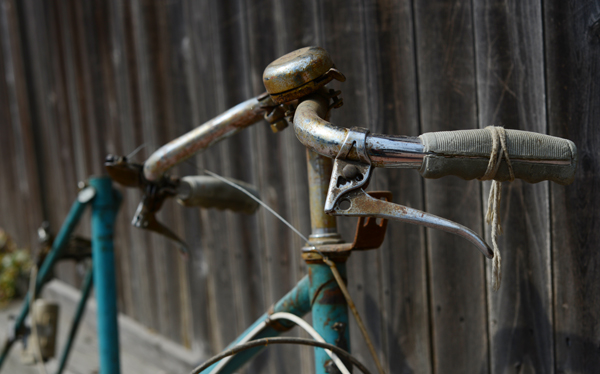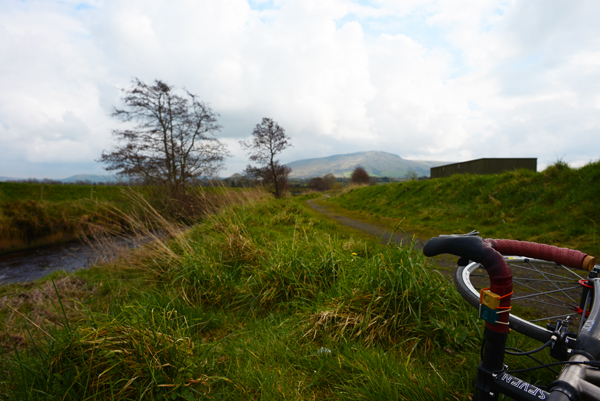
Rabu, 02 April 2014

Of Miles and Mountain Vistas: A Spring Initiation Ride

View from Burnfoot
Having told myself I would not stop until at least ten miles in, it worried me that I was already tired so early into the ride. But when I rolled into the center of Burnfoot - with its view of the Pointy Mountain and its titillating village shop selling 60p sausage rolls - I saw it was mile 15 already. Somehow the time, or the distance, or both, flew faster than I realised. So far so good for the first big ride of the season. With my piping hot sausage roll and electrolyte-laced water, I sat by the stream and took in the landscape that spread out in front of me. It looked far. And it was where I was headed. 

I've tried not to whine about it too much. But, as far as road cycling goes, winter in Northern Ireland was disappointing. Because it rarely snows here, I hoped to ride year-round without breaking stride. But the powerful winds put a damper on that. From mid December through a good part of March, I was lucky to get out once-twice a week, and even then for 20 or so flat miles at a time. I had not done any significant hills or milage since before the winter holidays. When finally the weather turned enough for proper cycling to commence, the expression "Two steps forward, one step back" came to mind. I panted up climbs and panicked down descents that I had come to think of as easy by last summer's end. Good thing I did not start with the intermediate ones!
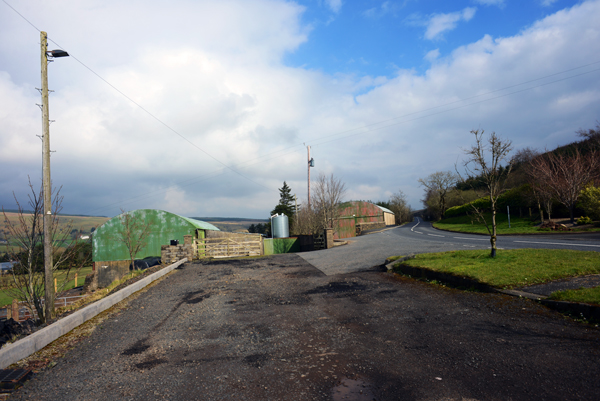
Farm Road to Garvagh
Last spring I worried about working up to longer rides and even put together a training schedule. This year I did nothing of the sort. The feeling of readiness happened organically. One day I just knew: Tomorrow. I sat down and planned the route, a meandering 60-odd miles along the shoulders of a couple of local mountains, through the villages of Drumsurn and Garvagh. The route would begin with some flat miles, followed by a warm-up climb, then two long climbs and descents, before turning flat again for the final stretch home. I designed it mostly along back roads and to maximise mountain views. The climbs were a side-effect of that, rather than the objective. Still, I saw this ride as a sort of jump-start to the season, as a shot of adrenaline, as something to shock my system and jog my body's memory, to establish a reacquaintance with the miles and the climbing. As part of this spring initiation rite, I accepted that, along with the beautiful views, some degree of pain and misery awaited me. 15 miles in and already tired, I braced myself for what was to come. "This will be difficult. But get it over with, and future rides will be more enjoyable."
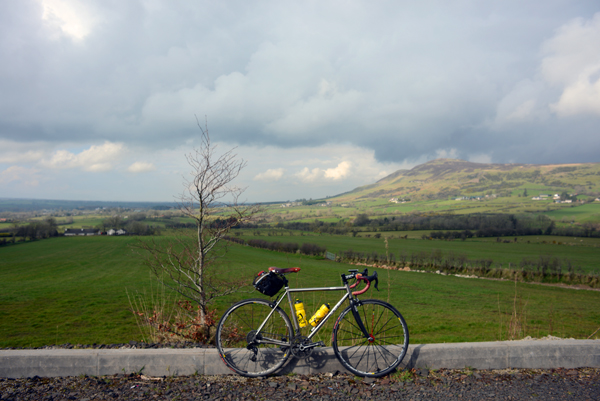
Legavallon Pot
But as flat roads gave way to rolling hills, which gave way to the first real climb, I began to feel better, not worse. Somewhere from deep within, an energy emerged, as if out of winter hibernation. The energy did not come in bursts, but seeped out in measured doses, at once calming me and waking me up. The eight mile climb along Legavallon Road wasn't difficult. It just Was. It didn't hurt or feel miserable. It was merely slower than a non-climb. And this slowness was a welcome one, affording plenty of opportunity to study the valley that spread out to my left more dramatically with each foot of elevation gain.

They call this part of the country the Legavallon Pot. Cycling up a mountain ridge in Drumsurn rewards with a dizzying view of a round gap, green with pastures and milky with low cloud, like an enormous bowl of matcha. Interestingly, the official observation point does not show off this feature of the landscape particularly well. But the stretch of the road that does is awkward to stop at. The best way to observe it is from the bike itself, rolling through the view.
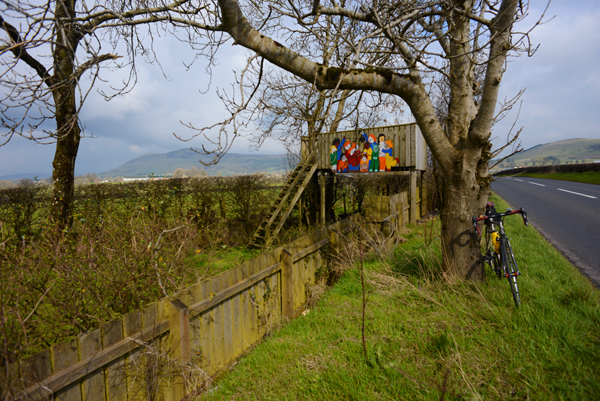
Tree House Mural in Drumsurn
In addition to the natural landscape, the country roads that criss-cross these hills are full of fascinating oddities. My favourites are the mysterious murals in the middle of nowhere. 

Here a boy dangles a giant spider over a group of other children and one green alien, who respond with an impressively realistic variety of emotions. Some look amused by his antics. Others are terrified. Others still appear aloof, or saddened by being on the sidelines of the game rather than at its center. I thought it a nuanced portrayal of child group dynamics. The tree house and mural were not near any sort of residence or child care center, as far as I could tell.
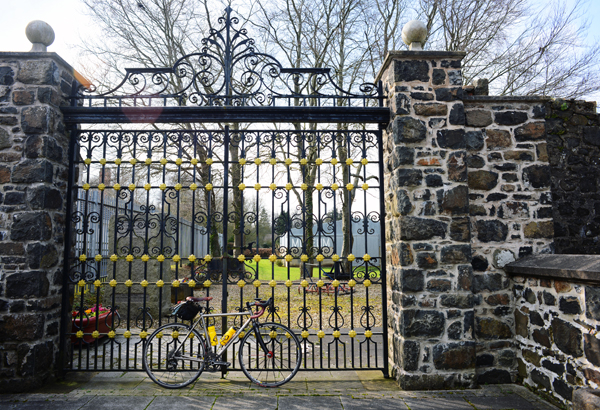
Garvagh Museum Gate
The village of Garvagh is an old one and deserves a post dedicated to it exclusively. While tiny, it boasts a surprising number of attractions - including a forest, a museum, its very own pyramid, and a history of vampirism. But on this occasion, I was more interested in its eating establishments. I stopped at a fish and chips shop and ate a late lunch as school children in their uniforms descended from buses, staring at my bike and attire with undisguised curiosity. Allowing for the school run traffic to die down, I set off for home. 
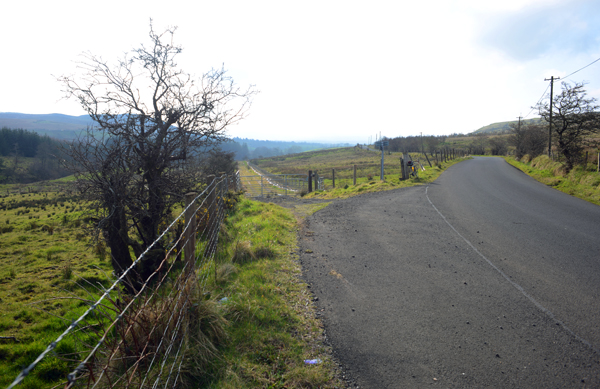
Descent to Limavady
The second big climb was on the return leg and steeper than the one before …which, when I noticed this fact, made me think of Pamela Blalock and her signature rides. She is known for, shall we say, throwing in some wake-me-up hills at the end of a long ride. And while at first I dreaded this, eventually I not only got used to it but began to look forward to it, feeling disappointed if a ride did not feature a good so-called Pamela Climb at the end. 

With a mental salute to my friend, I cycled up the mountainside appreciatively. My legs, however, were now growing heavy and I could sense the wilting point on the horizon. It also grew unseasonably warm, and soon I was sweating under my jacket. But seven miles later the descent came, and with it the cooling rush of breeze against my face and chest. The mountain views ahead grew dense and layered, like overlapping bits of construction paper in subtle shades of slate blue and lilac. Of course during the beautiful parts I was going too fast to want to stop for pictures. But seeing this landscape I made a mental note to return here via a more direct route soon, specifically to photograph it.

The descent went on and on. And to think that I had almost forgotten over the winter that dream-like sensation of falling. Now it came back to me in full emotional force. Miles and miles of plunging down a mountainside. On descents like this, the bike becomes something other than a bike. A flying carpet?

A day and a short recovery ride later, I still feel buoyed by the sensation of that last descent, by the rush of following the curves of the road while staring ahead at those layered hazy mountain ridges. That sort of descent really does feel like a dream. Or like a long swoon. The 60 miles and the climbing and the feel of being out of shape are not what I remember after this ride. Perhaps that is why I want to keep going further. 

Selasa, 01 April 2014

Brevet-Ready

A friend said latterly to me,
"Why don't we ride the PBP?"
It's in two thousand fifteen,
we've time to train if we are keen!"

"How shall we train?" to him I say.
"Easy - we cycle every day!"
"That does sound very nice indeed.
Let us make ready and god speed!"

And so I hummed a happy song
and wondered what to bring along.
Some like a bag in front, some rear.
But which to choose, oh dear oh dear?

And then I thought, why choose at all?
I shall take both, and they'll fit all!
Some spare tubes and tires and tools,
some knitting needles and fine wools,

some notebooks, inks and fountain pens,
some fat and juicy sautéed hens,
some wine, some cheese, some clothes, some books,
a fishing rod and reel and hooks,

some Wellies and some dancing shoes,
some records, mainly jazz and blues,
some pillows, quilts and woolen socks
computers, cameras and clocks,

a loofa, soap, perfumes and lotions,
some gauze, syringes, pills and potions...
To Paris we shall ride prepared.
The unprepared have poorly fared!

But oh what bicycle to ride
and carry such a load in stride?
What tubing and of which fine metal
will suit me as I knit and pedal?

They say it's not about the bike,
you ought to ride the one you like.
The one that's comfortable and sturdy,
sports fenders, lights, and can get dirty.

Just then I saw her by the door
and my dilemma was no more.
Her rod brakes might not stop till Brest,
and turning does take some finesse,

her wheel rims are full of pits,
she's heavy as a trunk of grits,
she's sixty years old and rusty,
but! She stays upright when it's gusty,

and although gears she has but one,
she's oh so hardy and she's fun!
The Triumph shall roll smooth and steady.
"My friend," I shout, "I'm brevet-ready!"

Senin, 31 Maret 2014

Spring O'Clock

The Bike Obscured
Did you know that Daylight Saving Time begins on different dates in different parts of the world? In the US, the clocks went forward an hour on the 9th of March this year. In Ireland and the UK this happened on the 30th of March. With the timing of my recent visit back to Boston, I got to experience both. 

It felt odd to have the clocks go forward twice. But it also seemed fitting. So reluctant and fitful was Spring's progress that it begged for a second chance, a restart. And a restart it got. You know how some years, after a watery March bleakness there is suddenly this one day when you go outside and are shell shocked by the explosion of green? 

Spring in the Roe Valley
The day the clocks went forward, this happened. And I found myself on the bike, tripping out of my mind at the sight of this colour burst and its accompanying scents. 

Starting off with one of my usual winter flat routes, I found it hardly recognisable. Where flooded brown fields used to be I now flew past carpets of buttercups and swathes of whin hedgerows, past clusters of fledgling fruit tree blossoms and pastures of freshly cut grass dotted with daisies. At first my eyes, unused to such splendor, kept averting defensively, reluctant to accept such a feast after a months-long famine. "Don't take it in all at once after a winter of colour-starvation. You'll make yourself sick!" 

But I don't care, I want to eat it all up. I let my eyes open wide, and I stare, I take it all in - already knowing that these images will flash and replay in my mind as I try to get to sleep later that night, after a day shortened by the time change.

Yellow, Red, Blue and Green
A gentle 15mph crosswind pushes at my shoulder playfully, as if to show how friendly and benign it is. As if to say, "Remember all those times this winter I tried to knock you off the bike with 40mph gusts? That's all in the past now. I am a changed wind, honest!"

Do I believe him and head for the hills for the first time since December? I go for it. The backroads that twist their way up and down the Roe Valley look rejuvenated since the last time I'd seen them, like a friend after returning from holiday - fresh-faced and healthy, glowing in their breezy jewel-tone resort attire. 

Amidst the greenery and the sunshine and the road's seductive undulations I get lost in the moment, and that moment turns into hours. 

Shadow Over Buttercups
Finally turning up the farm lane toward home with the waning still-warm sun at my back, I inhale the dizzying scent of cut grass one more time. And then I wave an eager good-bye to that grim, wind-battered, teary-eyed ordeal known as Winter Cycling. It took two clock changes. But spring has gotten a reboot, and so have I. 

Jumat, 28 Maret 2014

The Call of the Robin's Egg Blue

Raleigh Sports in Robin's Egg Blue
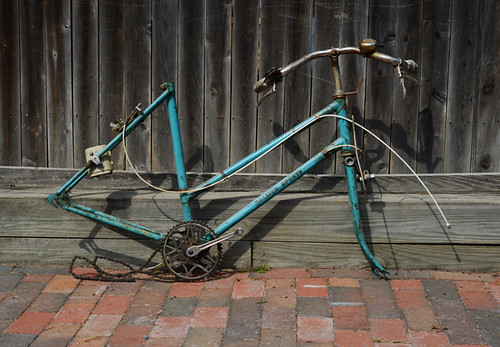
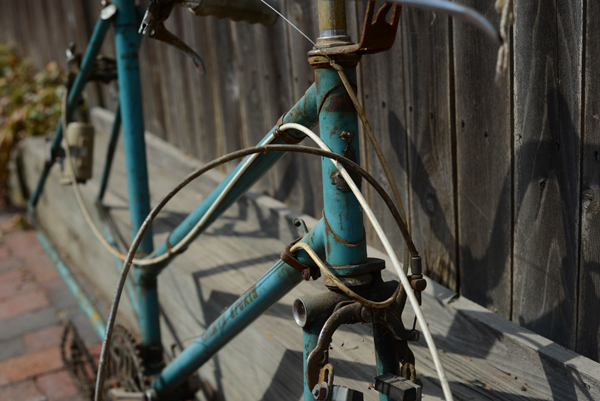
When I first saw the turquoise hued frame, I assumed it was an aftermarket repaint - not an unusual state of affairs around these parts. But drawing nearer, it became obvious by the amount of wear and tear that its colour was original. An early '60s Raleigh Lady Sports, in robin's egg blue. An iconic colour in the bicycle industry, to be sure. Just not iconic to the English 3-speeds of that era - a breed better known for its sombrer palette of oxide greens, matte blacks and root-beery coppers.

Raleigh Sports in Robin's Egg Blue
At some point all bicycle lovers experience that feeling of "Man, I am way too into this." For me this happens about once a week. And yet, it never gets old. "I've never seen one in this colour," I whisper, my heartbeat quickening. 

Raleigh Finish Selection for Export, 1960s
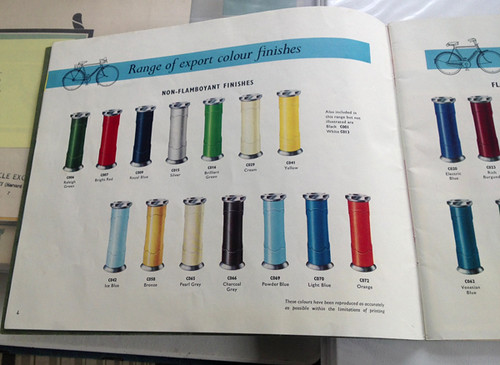
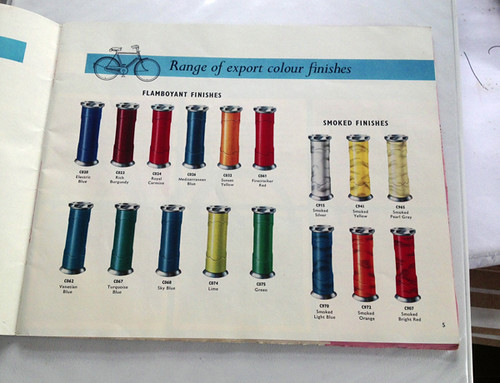
In response a 1962 Export catalogue is swiftly produced, its pages flung open to a rainbow-like spread of finishes. A dazzling range of powders and pearls, the likes of which most have never seen on an old 3-speed.

Raleigh Finish Selection for Export, 1960s
Let alone the "flamboyant" and the "smoked" finishes.

So, if all of these colours were offered, why did so few Sports models survive in anything but the usual shades we're familiar with? No one can say for sure. But most likely the dealers were risk-averse, and stuck with the original green/black/copper palette they already knew would sell well. If a more unusual colour ended up in circulation, it was likely because a customer special-ordered it.

Raleigh Sports in Robin's Egg Blue
Such was the case with the frame I was now admiring. The original owner special-ordered the finish, and requested for the handlebars to be flipped when building up the bike. For the decades it was in use, she rode the bicycle with its original parts (notice the elegant grip repair method) and thoroughly enjoyed it.

Raleigh Sports in Robin's Egg Blue
It is amazing the way colour can change a bicycle's personality. Looking through my photos of the frame, a friend immediately commented that in robin's egg blue the Lady Sports looked "lighter and faster" than its traditionally-hued sisters (having lifted it, I assure you "lighter" is not the case). Another said "I thought this was a Betty Foy at first!" 

No doubt the robin's egg blue played some role in the wild popularity of Rivendell's mixte through its 2009-2012 production. And the 2011 Surly Cross Check (I am told people are still phoning bike shops on a hunt for that year's model, just because of the colour). Possibly it is the most common colour I've noticed for frame repaints for road and city bikes alike. There is just something about it, and the associations it evokes (blue skies? seaside holidays? Easter candy? vintage Vespas?), that strikes a cord. Seeing it so unexpectedly combined with a '60s Raleigh Lady's Sports was a nice treat, for which I thank, once again, Nick of the Three Speed Hub. 

Rabu, 26 Maret 2014

Bike Security for the Road Cyclist

Fit to Be Tied
When it comes to city bikes, I admit my lock-up strategy is on the lax side. Not without admiration, I watch others execute the Sheldon Brown method, employ multiple U-Locks of various shapes and sizes, and drape their bikes in 20 lbs of shackle-like chains. Me? I use a cable lock, same one I've had for 5 years. It's a good, thick, Kryptonite combination lock, but it doesn't hold a candle to these more formidable strategies. Still I use it for the convenience of its versatility and weight, consciously accepting the heightened theft risk. While I never leave an unlocked bike unattended, even to run into a shop "for a second" (Oh the sad stories I've heard that begin this way!) neither do I lose sleep over my choice of lock-up method. As bike theft prevention goes, I am a shoulder-shrugging moderate.

Or so I thought, until I started going on long distance rides with roadies. There I'd be, extracting cable lock from saddlebag, only to watch my companions rest their custom roadbikes against the wall of whatever distant diner we'd stop at and …simply walk away, apparently content to leave their precious machines unattended for a good 40 to 60 minutes. Say what! Now I was the conservative, paranoid one. I understand the idea that out in the suburbs bike theft is less rampant than in the city. But it also seems easier to pull up and abscond with some sucker's fancy bike left propped against a tree for the taking.

As I began to lighten my roadbike setup - with 60 mile rides no longer seeming long-distance enough to warrant a saddlebag and the kitchen sink - reluctantly I abandoned the lock carrying habit. But this never felt comfortable. When I'd go out with a group, I could tell myself there was safety in numbers when leaving our bikes in a heap. But what about on my own? When you're flying through the countryside and panting your way up hills on your pared-down machine, it is not exactly fun to lug around a hefty lock for that occasional bathroom break or lunch stop. But maybe it's a case of something is better than nothing?

Abus Combiflex 201 Lock
Eventually I came to a compromise, in the form of a tiny, lightweight Abus Combiflex - a retractable cable gadget that uses a 3-digit combination, fits into a jersey pocket with room to spare, and will please the staunchest of weight weenies. Truth be told, it is basically a step up from tying my bike up with string, and two steps up from not securing it at all. But for the brief amounts of time I leave my roadbike unattended, it brings the theft risk down to a level I can accept.

Speaking of string… There is a bit in Flann O'Brien's The Third Policeman about leaving a bike thus secured, which I thought was parody. But later I saw a man doing just that outside the town of Limavady. It was not exactly a string he used, but more like a thin piece of cord, extracted from the pocket of his hi-viz cycling jacket. With it he tied his race bike in a loose bow to a farm gate on the side of the road, before climbing over the gate and walking off across the muddy field in clipless shoes. Where he went I do not know, but I hope his bike awaited his return faithfully.

What is your bike security policy when you're out road cycling? Do you leave your bike unattended or must you always keep it in sight? Do you carry a lock …or a string?

Senin, 24 Maret 2014

Monday Mailbox: How to Tell If a Bike Will Have Toe Overlap?

Once in a while I get emails from readers who are either planning to buy a bike online, site unseen, or to order a custom frame, and are concerned about the dreaded toe overlap. Is there a way to figure out whether a bike will have TCO short of actually riding it? Can you tell by the frame geometry?

My intent is not to host another TCO debate, but to address this question for those who do want to avoid toe overlap. And the short answer is yes, TCO can be determined by a bicycle's frame geometry. The crucial measurement is what's known as the Front-Center - the distance from a bicycle's bottom bracket to the front axel (center to center), measured as shown in the picture above. Many manufacturers now provide this figure in the geometry specs. It is usually stated in millimeters.

Now, the key is to know what you need that figure to be in order for your toe to clear the front wheel. And this will depend on a number of things. Some of them will be specific to you, and will remain constant: the type and size of shoes you wear, and the way you position your foot on the pedal. Others will be specific to the type of bicycle you are getting: wheel size, tire size, and whether fenders will be used. To figure out your desired Front-Center figure, you will need to factor in all of these variables.

So let's start easy and say you are shopping for a new roadbike with 700C wheels and 23mm tires. Your current roadbike with the same wheel and tire size (that part is key) has a bit of toe overlap, and it's something you want to avoid in your new bike. So you measure your current bike's Front-Center and determine it to be 575mm. How much more room do you need for your toe to clear the tire? Well, put on your cycling shoes, clip in, and measure at the point of greatest overlap (by turning the wheel as if you are making a tight turn at slow speed). Maybe have someone else measure for you as well, to double check. And err on the conservative side just to be safe. 5mm of overlap? You sure? Okay, so this means that on a roadbike with 700C wheels and 23mm tires you need the Front-Center to be a minimum of 580mm.

And what if your current bike has enough toe clearance? Well, great. Measure the Front-Center and then determine how much tighter you can go while still avoiding TCO. That's the minimum figure you want to see in the geometry chart of your new bike.

If you plan to use wider tires, or fenders, or both, keep increasing that figure as appropriate. Because fender fit and true tire size differ from brand to brand, you will be estimating unless you have a chance to try a bike outfitted with the exact same tires and fenders your new bike will have. If you're cutting it close, consistency is key.

But what if you want to switch to a different wheel size? For instance, if you're shopping for a 650B x 42mm bike, and have no current basis for comparison? This is tricky, as you will basically need to calculate the difference between your current wheel + tire combination and that of the bike you're considering. But the numerical information for such calculations is freely available and, if you're mathematically inclined, figuring this out will be fun. And don't forget the fenders!

For a bike that will be ridden without clipless shoes (for instance, an upright city bicycle), toe overlap is more ambiguous. With your foot unattached, you'll be able to plop it onto the pedal every which way - which can result in the occasional fender bump even when there is plenty of clearance. There will also be greater variety in the footwear you will wear on the bike. On a given bicycle, you may have enough toe clearance when wearing sneakers and dress shoes, but find that you scrape the front fender on slow turns in clunky work boots.

So if you absolutely positively do not want any toe overlap what so ever on a non-clipless bike, be sure to wear your most toe-protrudingest shoes and to plop your foot as far forward on the pedal as you dare, when measuring for your desired Front-Center figure.

If you've determined your minimal Front-Center, but the geometry chart of the bicycle you're considering doesn't offer this information, you can always contact the manufacturer and ask. Just make sure you tell them the specific frame size you're looking at, because this measurement is size-specific. And if you are working with a framebuilder, you can of course simply tell them the Front-Center figure you need - or better yet, they can help you figure it out.

There is no substitute for trying a bike before buying. But if that is not an option, hopefully this has shed some light on how to ensure a TCO-free purchase.

Sabtu, 22 Maret 2014

One Hub, Two Purposes… The Elusive BSA DP Hub in Action

With its aged champagne-green finish and its outburst of shimmering lugwork, the bicycle was lovely enough in its own right - to admire, to ride, and to photograph. The beautifully proportioned English "lightweight" - a BSA Gold Column - was built not long after the Second World War. And, by the look of it, it was well ridden and well appreciated by previous owners.

But it wasn't for its looks or pedigree that I'd been brought to this undisclosed location specifically to see the old machine. And as I stood now before Aaron its keeper asking "Are you sure you want me to ride it?" I knew I was about to try something few even knew existed. I certainly hadn't, until a couple of hours prior.

Earlier, in the basement of the Three Speed Hub, Nick chattily sifts through piles of rare old bike parts with the air of a person accustomed to sights that might make other vintage enthusiasts faint. Casually he pushes aside stacks of NOS Bluemel fenders, boxes of jewel-like quadrant shifters, heaps of full chaincases polished to an obscene sheen. Absentmindedly he toys with springs of Brooks saddles with model names I'd never heard of. But none of these things are what he wants to show me, and his search continues until he retrieves a small gleaming object from a back drawer. "Ever heard of these?…"  It's a BSA hub. A nice, shiny one too. But okay …so what?

Nick flips the hub over to reveal the inscription "DP." He searches my face for traces of recognition, and seems all the more pleased when none is forthcoming. "You've heard of the Sturmey Archer ASC hub yeah?" (English accent, conspiratorial smile...)

"The vintage 3-speed fixed? Sure. And I've tried the modern remake, the S3X."

"Right. Well in the '30s, BSA made a 2-speed fixed hub…"

"Oh?"

"…the Dual Purpose. And you know why it was called that?"

"Why?"

"Because this…" (pulls on the indicator chain on one side) "controls the speeds, and, you see this…" And as he tugs at the chain on the other side, I suddenly know, incredible as it is, the punch line that is coming... "switches from freewheel to fixed and vice versa."

Bang! There it was. Mind blown.

For several long seconds the basement is silent. And then: "These hubs are very rare. But my friend's got another one and it's built into a bike. Do you want to try it?" And soon we're en route to the BSA Gold Column.

Under the still-wintry Belmont sky I shiver with cold and trepidation as I approach this most unusual of machines.

The saddle height fits me with chilling precision, the reach suits me nicely. I have been shown how to operate the hub and sent on my way. The BSA's owner seems dangerously trusting of my good intentions and bike handling skills, and this instills in me a keen sense of responsibility as I eye the busy road on which I am to cycle.

The downtube shifters look so innocently normal. The right one switches from first gear to second. The left one switches the drivetrain from freewheel mode to fixed. I start off in free and push off. The gear is nice and easy, and with a flick of the right lever, I make it higher, than lower again. So far it is an ordinary vintage roadbike experience - with the exception that, as I soon discover, once the bike is in motion I haven't adequate hand strength to activate the front (and only) brake. As unpanickingly as possible, I slow down, then shift into fixed mode and brake with my feet. The smoothness with which I am able to carry out this operation surprises me, and I continue down the road (which, blessedly, has a bike lane) switching from fixed to free to fixed to free again. This is not as disconcerting as I expect. At the slow speed I am going, there is an ever so slight jolt during the free-to-fixed transition and an equally subtle sensation of "being let go of" (not unlike a glider at the moment it disconnects from a tug plane…) when switching from fixed to free. But that is all, and the transitions are very smooth.

Riding the bike in fixed mode, shifting gears feels equally smooth and natural. And in neither first not second gear do I experience the off-putting "dead spot" sensation like I do whenever I try the modern S3X.

The awe-inducing rarity of the DP hub and the lack of a functional front brake make me too nervous to truly enjoy riding this bicycle. But the experience is memorable enough so that the following night I dream of riding the BSA again - this time in the countryside, at great speeds, switching between gears and fixed/free modes with abandon. If these hubs were more common, how great would it be to set up my Mercian with one.

But common they are not. Produced from the mid-1930s through WWII and discontinued shortly after, the BSA Dual Purpose hub is one of the rarest, most holy-grailest hubs out there. Its discontinuation is all the more mysterious and disappointing considering the glowing praise of its performance from riders who have owned it.

"This hub is so good," says Nick, "someone should really do a kickstarter campaign to get them manufactured again." Nothing is impossible. But it's unlikely. The BSA DP hub is a piece of bike lore so obscure that few will ever hear of it. How improbable and delightful to have experienced one in action.