Rabu, 27 Agustus 2014

Transporting Delicate Plants by Bike

Flowers by Bike
Every now and again I am asked which everyday items I find the trickiest to carry by bike. The expectation is for it to be something fragile, like eggs or glassware. But those I've actually found pretty manageable. Eggs do just fine in their cartons. Glassware and picture frames can be wrapped in crumpled paper or bubblewrap. Honestly, I have yet to break an egg or a wine glass on a two wheeled commute, and I'm not even especially careful. But what I do find tricky to transport by bike is plants - in particular, small potted plants with delicate stems and flowers. So easy they are to bruise and snap, that merely placing them at the bottom of a pannier or basket can result in a sad mangled mess by the end of a bumpy ride home. But you can't exactly wrap them in bubblewrap either! So for these dainty, fragrant beauties, I've come up with a system: 

Flowers by Bike
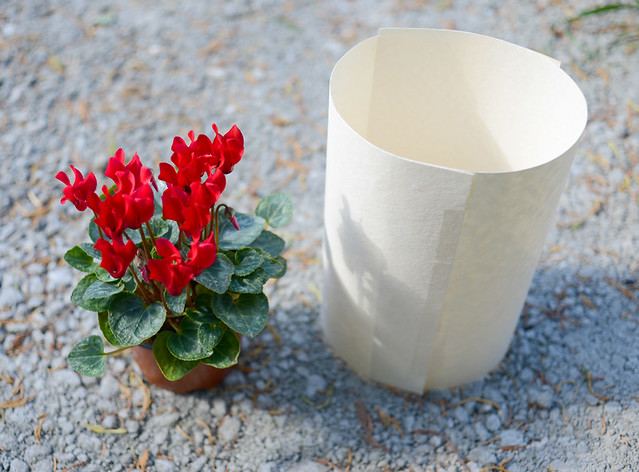
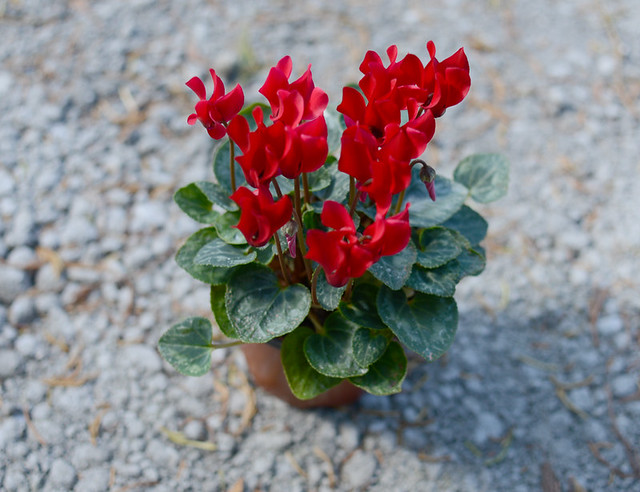
Take, for instance, the lovely little cyclamen. They come in beautiful shapes and colours and are fairly low-maintenance to have around the house. But they don't do so well in transport. The petals bruise easily when they come in contact with pretty much anything, and the flowers have a tendency to snap off at the slightest provocation. The stems go limp and droop from being jostled. 

Flowers by Bike
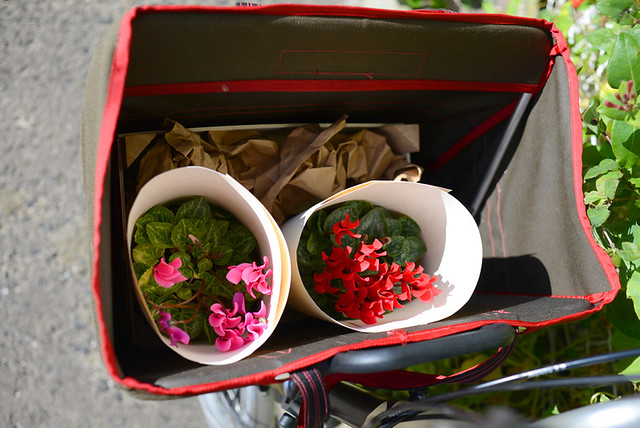
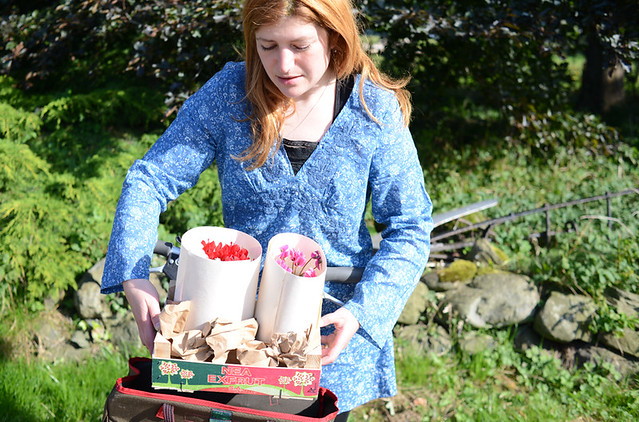
To keep this from happening, I have taken to constructing a protective collar. It is extremely easy to make: simply take stiff paper or thin cardboard, wrap it around your plant and tape it together. 

Flowers by Bike
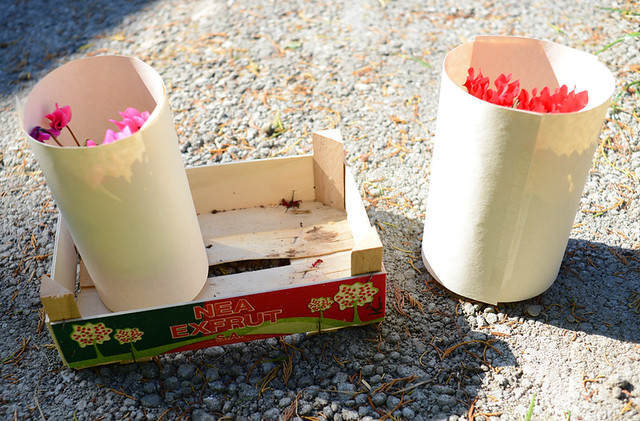
The idea is to fit it fairly tightly around the plant and to make it high enough to cover the whole thing. This way, the cardboard collar both contains the stems and protects the petals from contact with other objects - even if the plant should tip over in transit.

Flowers by Bike
But the key to preventing the plant tipping over is creating a stable platform. With the exception of rack-mounted crates, few bicycle baskets and panniers have stable, solid floors. More often the bottom of a bike bag or basket is curved, saggy, or uneven. So if you can find a small crate or box that will fit inside your bag and in which your plants can snuggly sit, this will make their transport a lot less perilous. 

Flowers by Bike
No matter what size you need, finding a suitable crate should not be difficult. Garden centers, flower shops and fruit and vegetable stands all have loads of crates and boxes that they happily give away to customers. 

Flowers by Bike
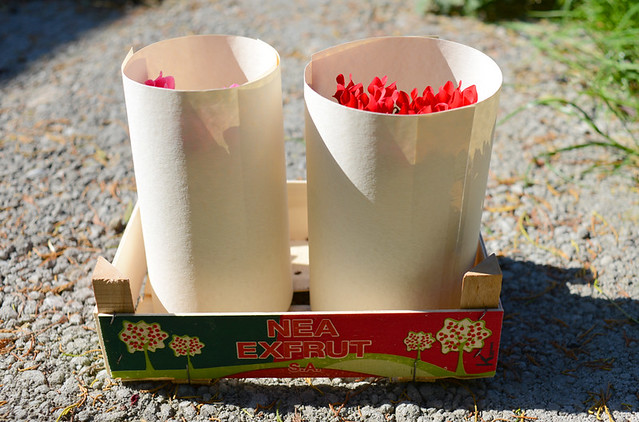
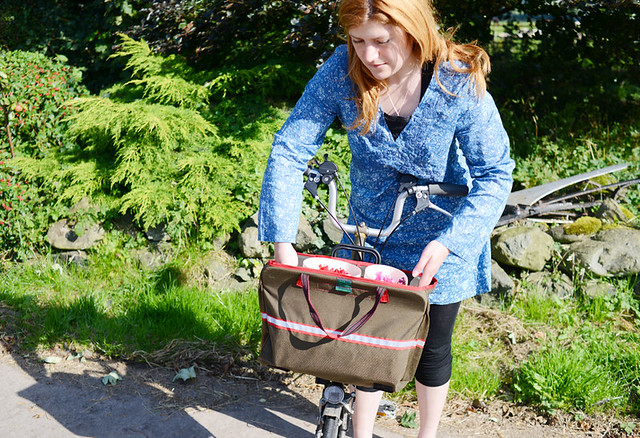
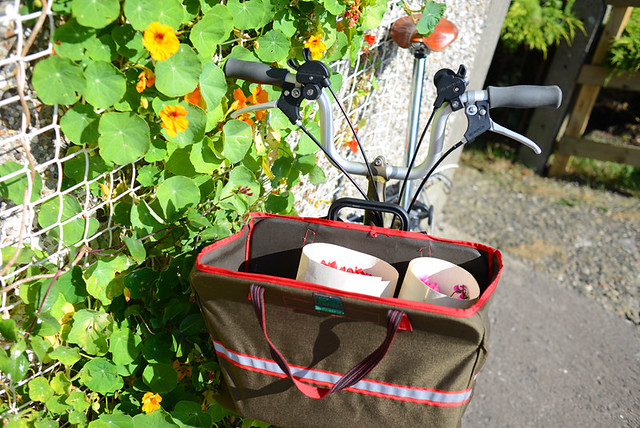
The crate I am using here is a tangerine crate that fits inside my Brompton "bagsket" snugly, and is extremely lightweight to boot (gotta shave off those grams where you can!).  

Flowers by Bike
To prevent the plants from shifting inside the crate, I stuff crumpled paper (or whatever soft objects are handy) into the gaps. 

Flowers by Bike
And voila, we are ready to ride! To provide some perspective, the places where I get my plants are 7+ miles from my house along bumpy roads. I've also carried my own plants as gifts to friends a similar distance away. And with the help of a stable platform and cardboard collars, they arrive intact. 

Geranium Portage
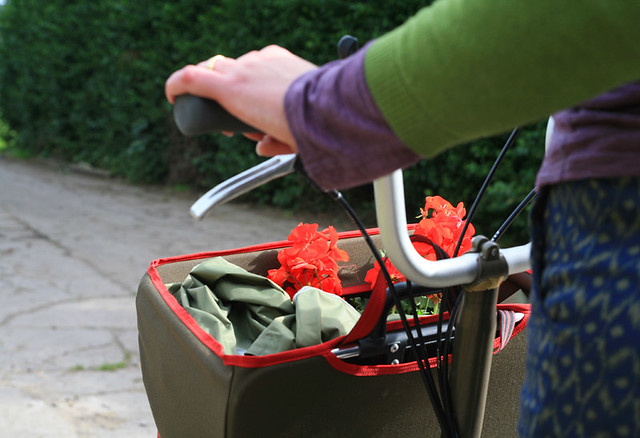
Of course, not all potted plants require this much fuss. Geraniums, for example, I have found to be surprisingly indestructible and can transport them without the cardboard contraptions. But it's good to be able to carry even the most delicate little blooms by bike if I feel like it, with the help of some simple DIY. 

Kamis, 21 Agustus 2014

Knowing When to Let Go: Are Old Bikes Always Worth Rescuing?

Bikes of Westport
Sometimes I think I'm a bad influence. Like, when a friend phones last week, excited by her two-wheeled vintage find. "You'll appreciate this - I think it's a mixte!" She texts over a picture. 

"What do you think?"

"Hmmm…" I reply.

"???"

" Did you buy it already?"

"Yea… why?"

"Fork's bent."

" :((( "

Now, I've owned a bike with a bent fork before - a beautiful vintage Gazelle. It rode great for the 2 years I had it and continues to ride great for the current owner. But in this case, I could tell from the picture that the fork at the very least would need straightening by someone who knew what they were doing. That, plus a few other problems I could readily see, made me think my friend was not equipped to deal with the work required to bring this bike to ridable condition. Sadly, at this point she was already attached to the idea that this specific bicycle was meant for her. So she shlepped it to a bike shop and asked for an estimate. I suspect the 4-figure quote they gave her was only half-serious and mainly meant to discourage her (a topic for another time, this!). But in any case, that was the end of it. Having paid very little for the bike to begin with my friend counted her losses and donated it to a local co-op. 

But we do not always let go so easily. 

At the moment I myself have two old bikes in the garage that are, quite frankly, probably destined to return from whence they came (the skip!)… But I am not quite ready to admit that yet, instead tinkering with them pathetically and agonising over whether to spend money on replacement parts that will probably do no good. 

Rebecca of velovoice recently documented the saga of her Puch swoopy mixte, which, despite her best efforts could not be made fully road-worthy due to a kinked rear stay. The bike was beautiful and unusual, and everything she had been looking for in a vintage machine, which perhaps made her more optimistic about its viability than she otherwise would have been. But after months of trying, she finally admitted defeat, stripping it for parts and throwing away the frame. Hopefully the parts will find a new home some day.

A former blogger I knew back in Massachusetts bought a sweet-looking vintage 3-speed that seemed to be in perfect condition, only to discover hidden problems that made it unridable. She took it to bike mechanics, and when that did not produce satisfactory results she enrolled in workshops to try and fix it herself. By the time she finally gave up, she was frustrated, exhausted, devastated and disillusioned in vintage bikes as a whole - which was the part I found most disappointing. 

It really is possible to find vintage bikes with few to no problems. And even those that start out worse for wear can be a joy to bring back to life. But a vintage bike can also become a white whale. And so it's important to recognise when to let go - when a restoration project is too much to take on, be it in terms of skills, finances, or even emotional investment. My advice when it comes to buying a vintage bike of unknown provenance? Acknowledge the risk. And don't get attached until you have it assessed. It's no fun to get trapped in an obsessive quest to restore the unrestorable. After all, you could be out riding a functional bike instead! 

Selasa, 19 Agustus 2014

Dry Cleaning Your Wool… with Fresh Air

Airing Out Wool
One of the much-touted attractions of wool clothing - and the basis on which it is recommended to cyclists - is its supposed odor resistant properties. In fact, it is not uncommon for proponents of the stuff to brag about how infrequently they wash their clothing (once a month! once a year! never!!!) As a wool enthusiast myself I am often asked about my take on this claim. Can wool clothing really be worn endlessly without washing? or - as one friend recently put it - "are woolsters just grungy?..." 

Well, speaking from personal experience I would put it this way: Wool retains odors to a lesser extent than cotton, and to a much lesser extent than synthetics. This is not to say that it does not pick up odors at all; only that it picks them up at a slower rate, and perhaps emanates them more subtly. Still, eventually there will come a time when you will have to clean your wool garment. But cleaning need not mean washing. And one thing I've discovered over the years, is that "dry cleaning" wool with fresh air can be amazingly effective. 

The practice of airing out clothing is of course nothing new. Compulsive laundering after brief periods of wear is a relatively recent trend, and it was once common practice to hang clothes in the window or even on the backs of chairs overnight to keep them fresher, longer. 

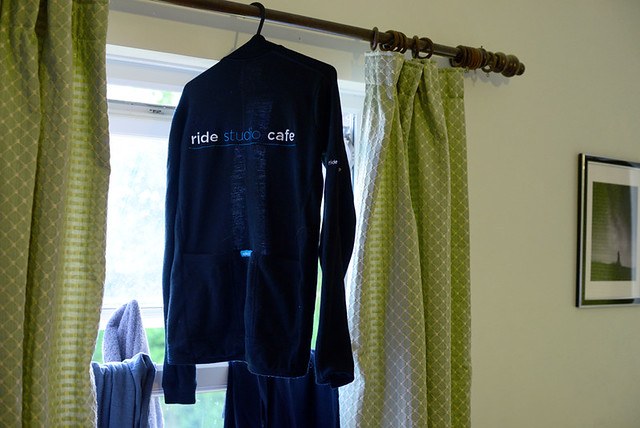
But with wool, this method is disproportionally effective. Just as wool is reluctant to retain odors, it's also eager to shed them if given a chance. The back yard clothesline does the trick best, especially on a breezy day. After I hang my wool clothes on the clothesline for half a day, they don't just smell fresh-er; they smell no less clean than had I actually washed them, then hung them out in the garden. They smell like the sun and the wind, that "fresh laundry" scent that detergent manufacturers try so desperately to bottle, but that can't quite compete with the real thing. And if you don't have a yard with a clothesline? Opening the window and hanging the garment off the curtain rod (or a hook) can work too. 

But why bother with this at all, you might ask, when you can just toss the clothes in the washing machine? Well, environmental and financial issues aside, there is incentive to wash wool as infrequently as possible. Wool tends to be more delicate than synthetics and cottons, as well as more prone to losing its shape. And while this is not necessarily true for all wool clothing (anything made of the "indie" fabric from Ibex I've found to be especially resilient), it has been true for enough of it, so that I avoid washing unless I have to.

While it may seem suspiciously simple, I have found that airing out wool works wonders to remove not only body odors, but also ambient smells picked from the environment, including strong food and cigarette smoke odors. Of course, airing out won't get rid of stains. So with a stain, I'll treat then handwash just the area around it - then air-dry. 

The only time I really wash my wool clothing fully and properly, is after I wear it doing something active on a hot day. When fabric becomes salt-encrusted from sweat, there is really no way to deal with it but wash the entire thing. Otherwise, the airing out method keeps my wool's contact with the washing machine at a minimum. Am I grungy or is wool just that cool? Try it out and decide for yourself!

Senin, 11 Agustus 2014

The Summer Lull

After several years of roadcycling, you start to see patterns: strengths and weaknesses, highs and lows, energy surges and dips - the mysterious ebb and flow of the drive and desire to be on a bike. One thing I've noticed in myself - though it took me some time to acknowledge - is the summer lull.

I fought it at first, so counterintuitive of a thing it seemed. After all, summertime is the best time to be on a bike. The long days. The dry weather. The scenery at its lushest. The abundance of group rides, with cycling clubs at their most active and cycling buddies with free time on their hands. In the winter, it feels natural to hibernate and take a break from the bike for a bit. But the summer seems like the time of year to take advantage of and spent every spare moment you have in the saddle.

And yet, quite reliably, there comes a time - typically in July - when something in me snaps and I go from being on my roadbike every single day (and thinking about being on my roadbike when I am off it), to being out only occasionally, if at all. Instead, I start to crave other activities. Swimming in the sea. Forest walks. Lying in the grass with a book. Friends suddenly find that they can easily lure me out to help shop for baby furniture and kitchen appliances. "Out riding much these days?" they ask, already knowing what the answer must be if I'd agreed to do this in my spare time.

Oh I still cycle for transportation of course; every day. But those waves of restless energy that compel me to pedal, hard as I can, over winding country roads till exhaustion for no reason at all except cycling itself? No matter how I spin it, they've abandoned me.

The first summer it happened, I panicked. What was wrong with me, was I sick? Or (worse) was I sick of bikes? Did I try so hard at something I can never be good at anyway, that I simply burned out?  Well, fine then. Maybe I was not meant to do this after all. Maybe utility cycling was enough. Feeling like an outsider to the athletic side of things, this seemed a reasonable conclusion.

But no sooner did I become resigned to this fate, then the summer lull ended. It ended as suddenly as it began. No pep talks were needed, no guilt trips, no encouragement. Those waves of restless energy, that compulsion, that boiling insanity - it was all back. One August morning I simply woke up and got on my roadbike …and practically never got off, till the winter frosts set in.

The following summer, this pattern again caught me by surprise and worried me. Only toward the end of the lull did I remember the same having happened the previous year and relaxed a little. And sure enough, it ended a month later, as before. After that, while I didn't exactly welcome the summer lull, I would expect it and stopped trying to fight it. Last year I hardly touched my roadbike from mid-July till mid-August - a month of rest sandwiched between periods of hyperactivity. This summer, the lull came a bit earlier, so that I already snapped out of it last week.

Why does this happen to me at a time that for many cyclists is their peak riding season? Probably because my body cannot sustain the intensity that begins in late March or April and grows through the early summer months. And as bodies go, mine must be an "all or nothing" kind of customer: Unwilling to simply cut back, it allows me to overexert myself day after day and month after month, then simply gives out - with-holding whatever cocktail of hormones is giving me the drive to ride until it's ready to sustain me through another 4 months of madness till winter.

The summer lull feels not unlike overtraining or bonking, only less intense but deeper-rooted. In one sense I feel more "normal," like cycling is not ruling my life. In another sense, I feel flat, empty, depleted. More disturbingly, the sight an smell of my bike lose their visceral effect on me. But when it returns, it does so with a vengeance. I don't need to wonder when the lull is over; when I'm pulled toward the bike again like a magnet, I know.

Kamis, 07 Agustus 2014

The Ghost Bike of Magilligan

Magilligan Ghost Bike
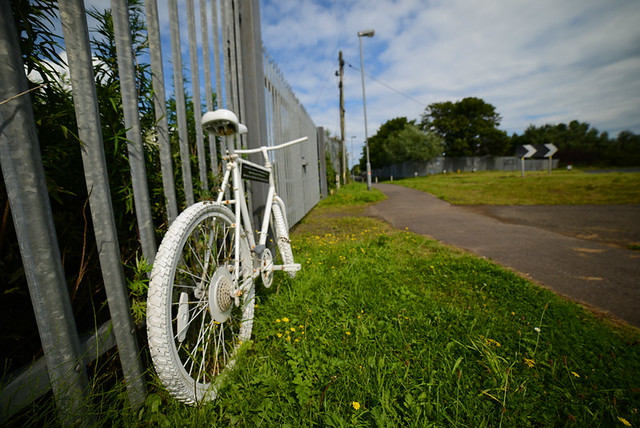
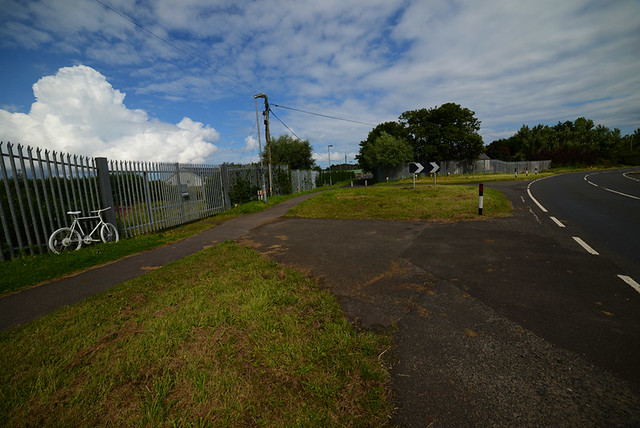
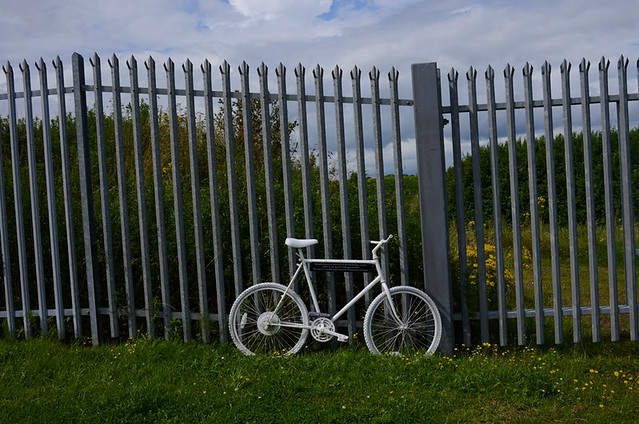
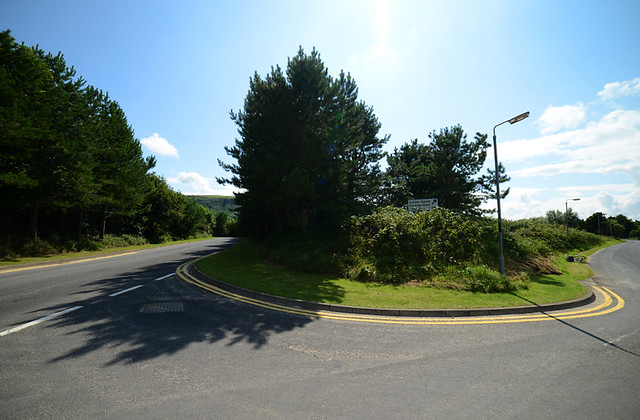
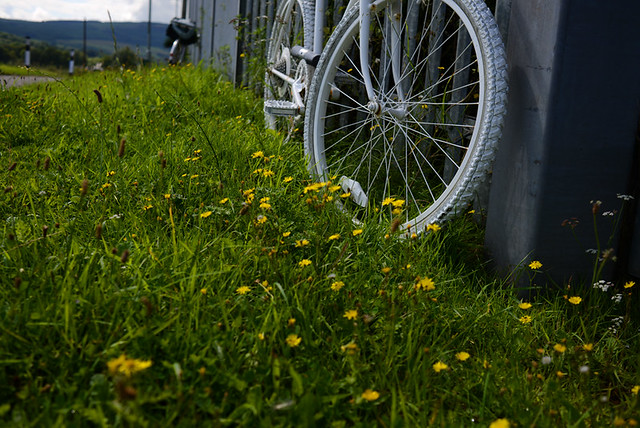
The shortcut to the beach is hidden along the main road, just before the big bend leading into Benone. Sun-drenched and shelterless, this stretch of road is like a child's drawing of a sunny day: blue skies, white clouds, yellow fields; the colours oversaturated; the edges unnaturally crisp. Veering away from all this, the shortcut plunges into leafy shade as it winds through parcels of forest all the way to the strand. The tiny lane is easy to miss if you don't know where to look. But if you do know, it is unmissable: Just watch for the handpainted stark white bicycle, chained to the caravan park fence.

Magilligan Ghost Bike
No matter how often I pass it, the sight of the Ghost Bike rattles me. Perhaps it is the location. I am accustomed to seeing these monuments to fallen cyclists in cities. But this one is jarringly out of place on a rural coastal road. In this unexpected environment, the ghost bike is more noticeable, more striking. Isolated and uncamouflaged by urban clutter, it refuses to blend with its surroundings; it is unignorable.

As the eye wanders from the bike to the sharp bend in the road, the imagination engages, activating a sequence of horrible stills. How did it happen? Who did it happen to? The plaque attached to the top tube names Gareth, aged 16. I know that I can ask around and learn the whole story in great, terrible detail. But I don't. Once I pedal past the bike and turn into the shaded backroad, I try to put it out of my mind. Because when I ride to the beach on a beautiful summer day, I do not want to think about ghost bikes.

Magilligan Ghost Bike
I do not want to wonder, for instance, whether the bike in front of me was the boy's actual bike. The very bike that got hit and… I close my mind's eye before the sequence is finished.

Benone
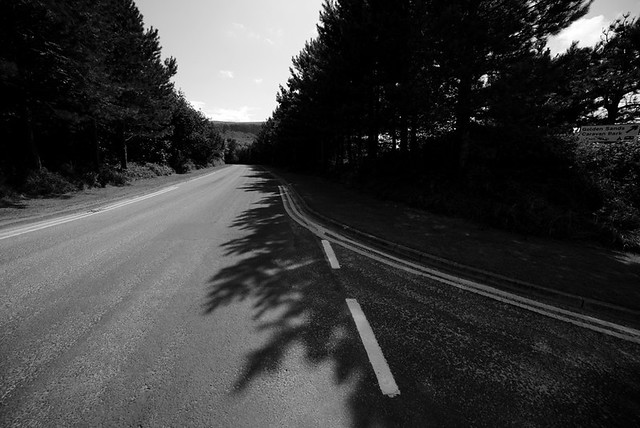
Smelling heavily of pines and, more faintly, of seaweed, the road to the beach disorients with its un-Irish feel. It is more like Maine, or Croatia. The sun filters through dense pine needles and the shapes dance on the rough pavement. The beach is not visible, but its presence is felt beyond the pines, and at any moment you expect to glimpse it around the next bend. It is the kind of road where, even before you've gone where it wants to take you, you are gripped by a pre-emptive nostalgia for the experience you're about to have.

Benone
And when I feel this, I do not want to think about ghost bikes. I do not want to think about death, or injury, when the sun is on my face and the waves of the ocean beckon. The ghost bike intrudes, but I shake it off as I would a fallen leaf tangled in my hair.

Benone
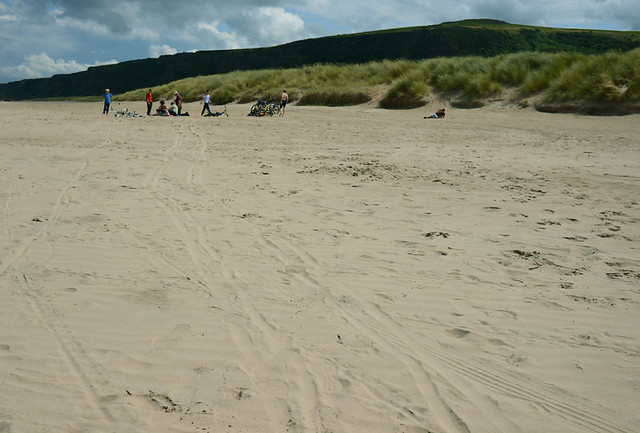
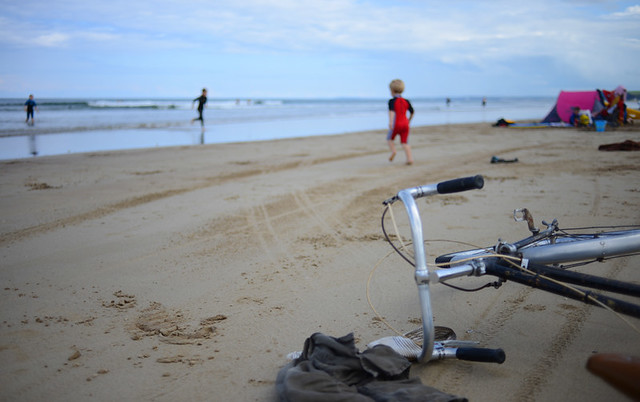
Through the pine needle shadows, past the caravan park and the holiday homes, a steady stream of kids makes its way to the Strand. They throw their bikes down in haste and run to the water.

Benone
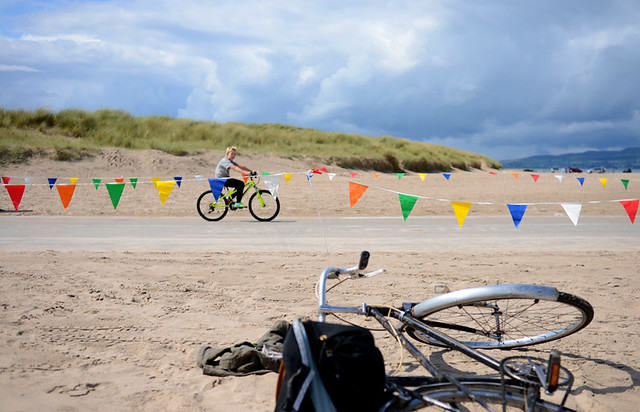
Past the too-vibrant bunting that delineates the entrance and exit points, more kids pedal.

Benone
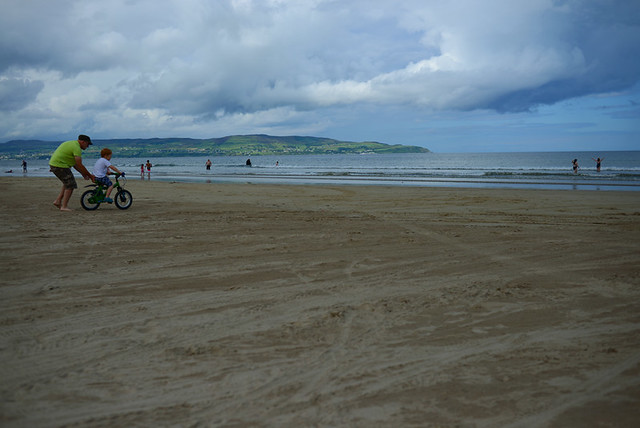
By the water, a father teaches his son to ride a tiny two-wheeler. The boys falters and tumbles into the soft sand, unhurt and undeterred. They laugh and try again. The sun shines.

Benone
I try to relax, to enjoy myself, to swim. But the children on bikes are all around me. As I watch, I catch myself wondering about the parents of the boy for whom the ghost bike was put up. Are they resentful when they watch such scenes? Are they merely sad? Or, are they happy for these other children, feeling the sun and the water on their healthy, intact bodies?

Magilligan Ghost Bike
I try to shake these thoughts off, so at odds they are with this beautiful summer day. But as I pass the ghost bike on my return, I stop and something compels me to sit on the grass beside it. I look again at the bend in the road, and I read the plaque, and I take it all in without trying to push the imagery away, as I run my fingers through the buttercups and the Queen Anne's lace that flourish around the scuffed white tires. The bike will be here every time I ride to the beach. Perhaps I'll grow immune to it over time. Or perhaps not, and every time I see it my mood will darken and these thoughts will haunt me. And maybe that is as it should be. I just hope the motorists driving past feel a least a trace of the same reaction. 

Senin, 04 Agustus 2014

Mapping Enchantment

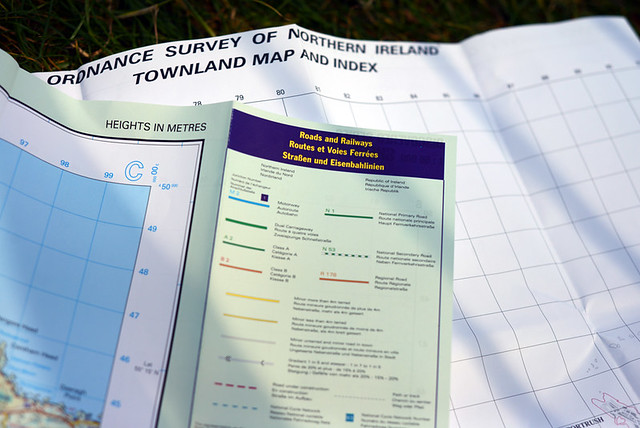
Northern Ireland Ordnance Survey Maps
A couple of months ago I decided it would be nice to get ahold of some Ordnance Survey maps, and I set out on a quest to purchase them. Like most things here, this was not without its share of adventure. At the local book shop the salesman looked at me like I had two heads. "Ach no," he said, "you're best to get them online." So I tried online, and sure enough there's a special government website that sells them and it all seemed straightforward enough …until their payment system deemed my debit card suspicious and then not only could I not order the maps, but a fraud alert was activated and I could not use my bank card for days. 

I was just about to give up, when who should I see, whilst hanging about the local airfield, but a pilot unfurling a delicious-looking map, full of all manner of dotted lines and squiggles, decidedly ordnance-surveyish. Eying the colourful paper with envy, I told him of my unsuccessful attempts to score one of my own. He smiled with some satisfaction, as if to say "of course this is what happens when you try to buy something in Northern Ireland without consulting an expert first." Then he revealed the name of the book shop where the maps could be got locally. 

The very next day I cycled there. The salesman nodded at my request so matter-of-factly you would think Ordnance Survey maps were the most natural thing in the world to ask for. I followed him around the store to a cavernous section in the back where he stopped beside a dauntingly overstuffed shelving unit. A subtle flicker of gratification illuminated his face when I looked duly impressed, and I wondered how often he got the opportunity to lead someone to this tremendous cache. 

Northern Ireland Ordnance Survey Maps
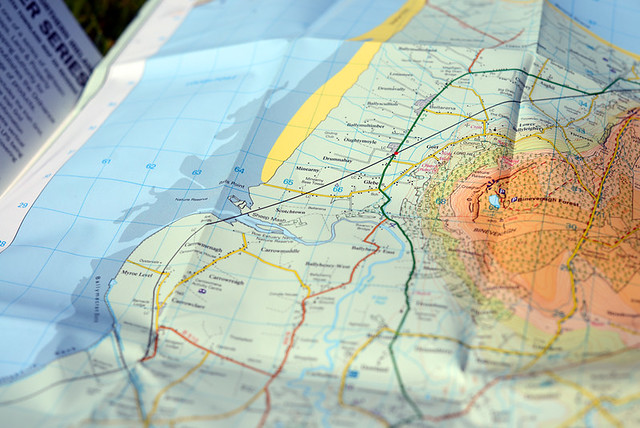
Done to a scale of 1:50,000, the maps were numerous, each covering a tiny section of the region. I could hardly decide which I wanted as they were all so lovely and shiny and the covers featured alluring photos, one more scenic than the next.

In the end I bought four maps that covered the areas closest to me. Clutching them to my chest like a bouquet of flowers, I carried them out into the town square. Then I spread them out on the stone bench and let out a sigh of happiness. What was it about these things that caused such emotional stirring? I had used maps before, for heaven's sake. But in these, there was something particularly enchanting. 

In the UK and Ireland, Ordnance Survey agencies put out maps beloved by walkers and cyclists for the level of detail and topographical information they provide. I wanted a set for the purpose of finding local trails and hidden right of ways to use as shortcuts when cycling through the region. Perhaps I could even piece together some local unpaved routes

My impression from stumbling onto such routes organically so far, had been that unpaved stretches existed, but were disjointed. Having studied the maps, this has proven to be more or less accurate. Unfortunately there is no cohesive network of trails running through the area where I live. But there are lots of individual fragments here and there - considerably more than I had thought. And in many cases they can be combined with quiet back roads to make for a cycling experience that's scandalously scenic and very nearly traffic-free. Discovering the local trails and rights of way also provides access to many interesting locations and landmarks that cannot be reached otherwise. 

Northern Ireland Ordnance Survey Maps
In a practical sense, this has certainly been useful. But the maps have affected me beyond that.  Profoundly altering the way I see the landscape, they have deepened and texturised it. It is as if the information gleaned from their dense markings has integrated with my sensory experiences to form a rich hologram, so that when I look at a stretch of land in front of me it has a luminous transparency that can be activated at will. Not only am I aware of all the backroads, and of the trails beyond those backroads, and of the hidden nooks and crannies beyond those trails, but I am also aware of how they all connect, interact, diverge. The through-ways and the dead ends. The lands that back up onto each other without quite touching. The woods with clearings and without. Bogs that can be criss-crossed and bogs that cannot. Paths rendered invisible by tall wheat. Shallow ledges that make for secret river crossings. Remnants of stone walls, buried under a crust of rotten leaves, that can be used as directional guides. Beyond and within what's in front of me, there are layers upon layers. 

As I pedal through my surroundings, neither the distances nor the views have changed, and the textures beneath my wheels are familiar. Yet there is an unprecedented newness to it; the fluttering secret excitement of having gained access to a new dimension. 

Jumat, 25 Juli 2014

Crave Heavy Metal as You Pedal? Snag Yourself a Skirtweight!

Skirtweight in Action
These days it seems that everyone in the bicycle industry is trying to make the cycling experience lighter. Lightweight frames, components, bags, even jerseys and shorts. But one New York-based manufacturer is keen to point out that some parts of the cycling experience need to be made heavier.

In particular, the skirt hem. As those of us who cycle in skirts know, it feels fantastic, especially on hot, muggy days. The fresh air circulating where we need it most, the cooling breeze, the surprising ease of pedaling compared to slacks, the sheer freedom of it! Less fantastic, however, is the tendency of some skirt hems to fly up, transforming their wearers into rolling "Marilyns." Sure, when executed on top of a subway grate the pose can be charming, in a coy "it's not sexual exhibitionism, because it's a kitsch movie reference" sort of way. But in the midst of moving traffic, maybe not so much. I mean, what if the skirt flies all the way up to your face and impedes visibility? Oh the sleepless nights I'm sure you've spent contemplating this!

Happily, such worries can now cease - thanks to Skirtweights, a new product from Tandem New York. As the name suggests, this gadget is a weight, for your skirt. You clip it onto your hem, and the heft keeps it from flying up. It's a fairly straightforward concept.

The tactic is not new to the fashion world. Hem weights have been used in wedding dresses and formal attire for ages. But the Skirtweight is cycling-specific, in the sense that it's designed to stay put quite tenaciously when the wearer is active (you just need to be sure to clip it on correctly - inserting the fabric all the way into the clip). Also, the Skirtweight sports a lovely engraving of a bicycle wheel.

Skirtweight in Action
But the crucial question: Does the Skirtweight work? I put the metal to the pedal and clipped the thing on to my billowiest of frocks, including this crepe lilac number which has caused many a blush-making moment. Rolling along in a stiff sea breeze, I marveled at how well the Skirtweight delivered on its promise. It weighed my skirt down with impeccable weightiness, and faithfully kept it from flying or riding up. As I cycled along my daily commute in a variety of billow-prone outfits, the Skirtweight kept the local farmers safe from the unexpected flash of underpant.

The downside? Well... the Skirtweight is heavy. I mean, I get that this is the whole point, and that's what makes it work. But I cannot quite get used to the asymmetrical pull of it when I pedal. Is the Skirtweight's efficiency enough to overlook this? And will it negate all the weight savings of your new titanium Dutch bike's carbon wheels? You can decide all that for yourself.

Skirtweights can be purchased in North America here, as well as here in the UK. And for readers within the EU: You are welcome to my sample Skirtweight shown here - simply post a comment saying that you want it, and your contact info (the correct info, and please check your email in the next few days if you enter!) before Monday, the 28th of July and I will pick the recipient at random.

Watch that skirt, and enjoy your weekend!

Rabu, 23 Juli 2014

Come On, Pilgrim! ...Or, Why I Could Not Ride My Bike for Days

“Old women climb it in their bare feet.”

I believe that was the phrase that drew me in. First, because of the sheer exuberance of the mental picture it painted. I imagined a tight procession of tiny octogenarian ladies – faces weather-beaten, backs bent under the weight of rucksacks, tanned limbs chalky with mountain dust under long skirts, callused feet leaving a trail of blood up a narrow path that winds, winds its way up the mountain to the tiny chapel in the clouds.

The mention of the old women also serves to make the climb seem accessible. If the frail devout dears do this bare-footed, it cannot possibly be that difficult. What is a pilgrimage anyway? If the Cantenbury Tales are anything to go by, basically a long walk.

Croagh Patrick is known as Ireland's Holy Mountain. In year 411, St. Patrick climbed upon it and fasted there for 40 days. And now we, feeble mortals that we are, can climb it in honor of this to atone for our sins. We can climb it to find inner peace, or for good luck. We can climb it for the views, or for the mere satisfaction of having climbed a thing that can be climbed. So say the descriptions of this County Mayo attraction. And having read them, I wanted to climb it too.

We set out on a day that started off hot. 20 degrees may not seem like a lot to those from warmer parts of the world, but there is something about the climate in Ireland, with its special flavor of dense mid-summer humidity, that makes 20 feel closer to 40, and the term “heat wave” does not feel misapplied when used unironically by locals.

The mountain sits right on the coast, and making our way to it from the nearby town of Westport we marveled at the luxurious bike paths spreading in all directions with fantastical island and mountain views. Today Croagh Patrick, but tomorrow certainly bikes.

Marked with a discrete sign, access to the climb was just steps from the main road, behind a clump of woods. There, at the foot of the mountain, stood a white statue of the namesake saint around which crowds gathered for photos. And just beyond that, a steady stream of people could be seen scrambling up a rockface. Funny, because I did not see a trail. They were sort of half-climbing, half-crawling up jagged slabs of stone alongside a stream. As I followed, it slowly sank in: This was the trail.

The start of the climb was immediately tight and steep. So steep, that after climbing for just a few minutes one could turn around to see sweeping views of Clew Bay and its scattered islands.

The climb was also immediately rocky. At first the rocks weren’t loose, but firmly embedded into the soil. Jutting out from the steep pitch at strange angles, they made for extremely awkward footholds, making the climb like an intense, vertical game of Twister. An additional layer of excitement was added by these rocks’ sleekness. Perhaps that had to do with the stream nearby, or maybe whatever kind of rock this was just inherently slippery. But even in my good hiking boots, stepping on some of these rocks was not unlike stepping on ice - the larger and more stable a rock looked, the more likely this being the case.

After nearly a mile of this, the trail widened and began to resemble an actual trail, while the terrain changed into what in cycling terms is known as loose gravel. In some sections the rocks were small, pebble-like. In others they were more like boulders. But as we climbed the pitch kept growing steeper, the loose stones sliding and rolling downward beneath the soles of our boots as we fought gravity to progress upward. It required a great deal of focus, and it never let up.

For someone moderately fit like myself, the difficulty of the climb was a little embarrassing to acknowledge, especially considering how many other people - (pilgrims!) - were attempting it alongside me without complaint. There were no devout old women in bare feet as had been promised. But there were elderly persons of both genders, as well as children and variously aged adults, dressed in a dazzling variety of footwear and clothing from technical climbing gear to sundresses and sandals. Most moved very slowly, taking plenty of breaks, but with an air of determination about reaching the top. The heat and humidity of the day had risen a few degrees by now, and my clothes - a thin wool top and lightweight leggings - were already drenched in sweat. I had drunk a third of the 1L bottle of water I'd brought with me, and eaten a handful of trail mix.
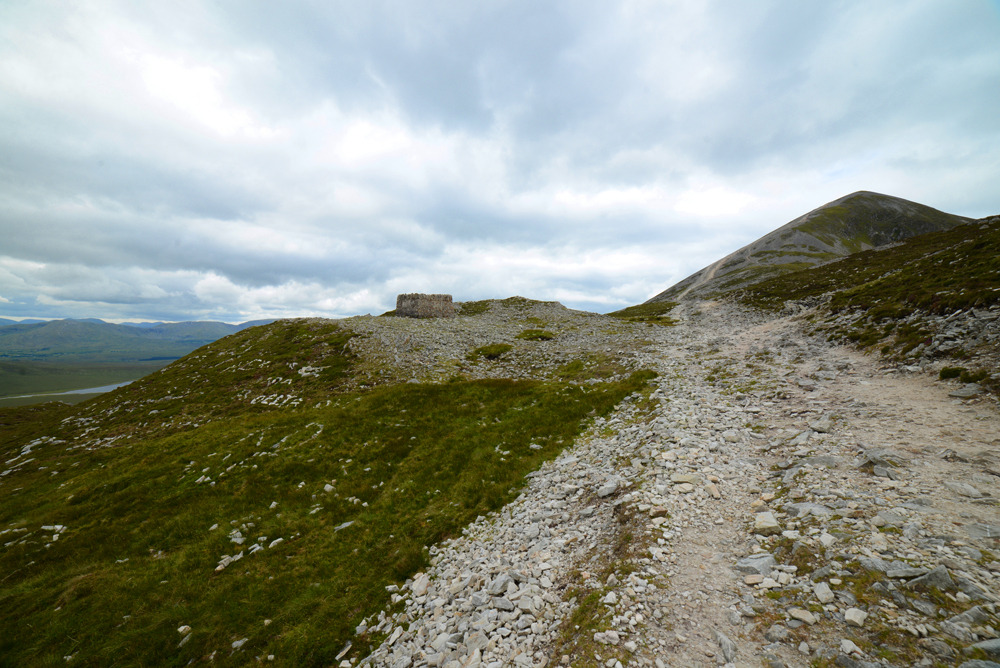
As the climb progressed, it continued to grow steeper, until it reached a plateau. Here the final stretch to the peak loomed in the distance like a mountain in its own right.

At this stage there was only a third of the way left (the climb being 3 miles in each direction), and this fostered a sense of being "almost there." However, the last stretch to the peak was the most difficult. Here again the trail as such disappeared, with climbers struggling to pick the least treacherous line up the now near-vertical rockface. The surface here consisted not of loose rocks in the standard sense of that word, but of loose thin flat slabs of what must have been quartz. These slabs combined the sleek properties of the large sturdy stones in the first part of the climb, with the unstable, crumply properties of the loose gravel in the second part of the climb. This, in addition to the steeper-than-ever pitch, made the final section stunningly difficult and time consuming. As I climbed, gaining height proportionally to distance, not only did the flat jagged slabs of stone give out under my feet, but my boots also slipped on the rock surface itself. Now and again I would lose my footing and fall forward onto my knees, bracing with my hands so as not to slide backwards and down. It was then it occurred to me how difficult it would be to get down this slope on the return trip, with my sense of balance. But for the time being, I suppressed this thought, aiming for the top.

The top came into view with excruciating slowness, but eventually come into view it did. Though I did not know it at the time, I was exceptionally lucky for the day on which I climbed Croagh Patrick to have been crystal-clear, as more commonly the top of the mountain is obscured by cloud. But on this day, the humidity had disappeared by the time we neared the peak and there was a crispness to the atmosphere that made even the most distant feature of the landscape sharply visible.

To one side stretched the mountains of inland Mayo and the neighbouring County Galway. To the other, acres of peat fields spread across the mossy hillside, dotted by sprinklings of young heather.

But the most prized view was that of Clew Bay, showing the mad messy scattering of tiny islands it is famous for, of which there are said to be 365. Here, several sheep - their coats and improbably clean shade of white - patrolled the viewing point, charging pilgrims admission for approach - the currency being banana peals and sandwich crusts.

Since not long after St. Patrick’s time, there has stood on this mountain a chapel of some sort or another. The current one is a white, tidy little structure that is kept functional by a caretaker who climbs to it 4 times a week (albeit along a less steep alternative route to the Pilgrimage trail). On special occasions, Mass is held here, with thousands of people attending - which also means climbing to reach it.

Considering how many people had been climbing the mountain alongside me, there were not a great many at the top - perhaps a dozen, which makes me think that many turn back at some point. Here I also finally saw a barefooted woman. Looking to be at least in her mid-70s, she was sinewy and tanned, dressed in high-tech hiking gear and a bandanna around her forehead, her bare feet sturdy on the slippery rocks. Just as I reached the top, she began to descend, singing songs radiantly.

Alas, my own descent was neither celebratory nor composed. To put it bluntly, I could not get down the steep top part of the mountain. I tried it this way and that, but I only slid and tumbled, losing my footing with nearly every step down the vertical rockface.

Above me and below, the pilgrims who had made it this far and now needed to get down did so the best way they could. Their methods varied wildly, from running with jaw-dropping confidence, to a weepy slip-sliding down on their behinds. The latter was a method I had seriously considered. The tops of my thighs began to burn with the effort of bracing myself against gravity's pull and the rocky downslide. My legs trembled and gave out form underneath me, weakened by effort and anxiety.

At one point, I found myself unable to pick a line through the dangerous slippery rock and, exhausted, I collapsed on my behind and began to sob involuntarily. A woman on her way up seized the opportunity to remind me triumphantly that Jesus was with me. "Be brave my girl, and Christ will save you!" I stopped myself just in time before replying with the first thing that popped into my head. "Does he have a helicopter?"

Anyway. Whether it was due to Christ saving me or not, I got off the mountain intact, and proceeded promptly to the pub with a few of the other pilgrims, where we had a "feed" of local lamb. I could not walk down stairs or properly pedal a bike for the next 3 days, coasting around Westport feebly for the remainder of my holiday while the coastal bicycle trails mocked me with their crisp white markings.

At the pub hung vintage photos of Mass held at Croagh Patrick Chapel at the turn of the 20th century. Men in suits and brimmed hats. Women in long skirts and high heeled boots with elaborate Edwardian hair. Feeling my own still-drenched top, I imagined doing the climb in a long tweed skirt and heels, then pedaling home on a high-geared fixed wheel roadster. People must have been hardier in the day, as well as more religious, to subject themselves to such an adventure. A pilgrim I am not. But there's nothing like ruining your legs for days that makes you pine for cycling, singing a song of thanksgiving once you're fit to pedal again.
Jumat, 18 Juli 2014

Making Faces When Pedaling Places

Brompton Blur
Last week some bicycle bloggers and forumites were passing around a link to a funny post on Vox.com. Entitled The 19th-century health scare that told women to worry about "bicycle face," it brings to light an article circa 1897 written by a medical doctor that warns ladies who pedal against producing a "wearied and exhausted" facial expression. So unattractive! 

Of course the title and content of the article immediately made me think of the popular online comic Bikeyface, whose author sees the matter differently. To her, a "bikeyface" is an expression of unbridled joy, rather than a pained grimace.

But despite their polarised definitions, both parties do agree on the underlying notion: that there is such a thing as a facial expression specific to bicycling. As someone whose former career included research in nonverbal behaviour, I find the idea irresistible. Could there really be a set of facial expressions specific to bicycling? 

It's a cool idea, though anecdotal evidence gleaned from my own experience gives me pause. 

Thinking back to the days before I began to ride a bike myself, my impressions of transportation cyclists fluctuated depending on what country I was in. I remember observing cyclists in English cities and finding their demeanor alarmingly aggressive. And I remember thinking that people on bikes on the East Coast of the US looked huffy-puffy and stern - as if what they were doing was both very difficult and very important. On the other hand, watching cyclists in Austria, Holland, Belgium and France, I  do not recall finding their facial expressions remarkable in any way. Some people looked happy, some looked sad, some annoyed, bored or lost in their thoughts - but none of these states seemed to have anything to do with them being on a bicycle. Cycling in its own right was matter of fact, causing neither bliss nor wearied exertion. 

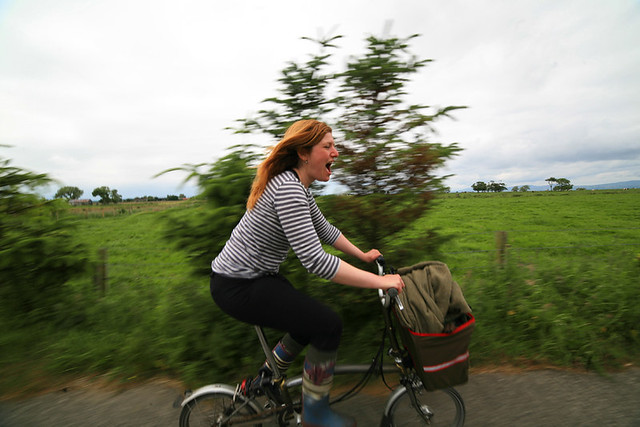
Interestingly, I first noticed the "bikeyface" - in the joy/bliss sense of the word - in myself, catching my grinning reflection in a storefront as I cycled shakily past. And with the rise of the city/transport/ cute bike movement, I did begin to spot other cyclists in the Boston area with this stamp of bliss on their physiognomies. Increasingly, that, as well as the continental European indifference, are if not replacing then at least generously supplementing the super-serious look that first dominated in those parts. 

What this extremely unscientific sampler of impressions tells me, is that the faces we make while pedaling may depend less on cycling in itself than on our attitudes toward it - which can vary tremendously. Today, cycling can be perceived as a risky athletic activity, a fashion statement, a political act, a way to relax and have fun, an independent means of travel, or as any combination thereof. Unsurprisingly, the facial expressions these attitudes yield will differ. And in cultures where transportation cycling is so normalised and easy as to be unremarkable, we are as unlikely to see the bicycle face against which Victorian doctors admonished as we are to see the bikeyface which pedaling enthusiasts promise.

By now, cycling really should be normalised for me. After all, I do it in some form or other nearly every single day. But even when riding my bike in entirely mundane circumstances, on occasion I still catch myself grinning. What can I say? I love it.

Stranger though is the habit I apparently have of smiling even when I am not having fun on the bike. Several friends have now pointed this out to me, but it seems that when I am having a particularly difficult time on a roadbike I tend to smile in leu of displaying the "pain face." This gives the impression that I am far hardier than I actually am and that I am enjoying myself, creating genuine puzzlement among my companions when I later tell them I was struggling or suffering. "But you seemed so happy! - see?" And sure enough, a snapshot will be produced showing my red face distorted by a mad grin. As I never remember doing this, all I can say for myself is that smiling must be a coping mechanism - à la the facial feedback theory: Research has shown that if our muscles contort in a way consistent with a specific emotion, we can genuinely feel some dose of that emotion regardless of whether it is situationally appropriate. So the smile must be my way of saying "I will not surrender to the pain face! If I smile, then I won't be miserable…" 

Thankfully most of my time on a bike gives me no cause to employ this technique and my grins on two wheels are, for the most part, quite genuine. Is there such a thing as a bikeyface? Perhaps not once we control for other factors. Nonetheless in me it is alive and well. When I catch myself doing it, it feels silly and embarrassing - though I am hardly complaining that cycling makes me happy!

Minggu, 13 Juli 2014

Love Bicycle Art? Share Your Favourites!

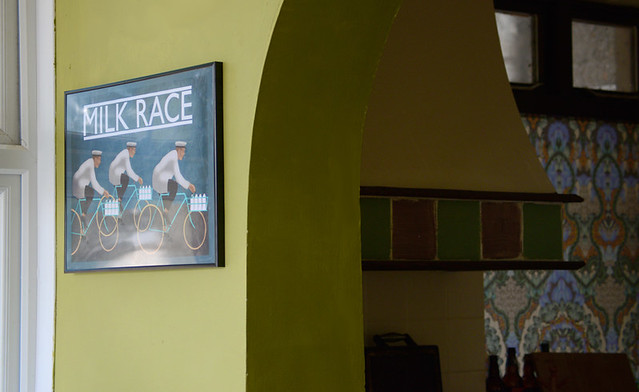
"Milk Race" Poster, by Mark Fairhurst
In honour of renovating a good chunk of my house, I have put up some paintings, photos and posters, including a couple of pieces of bicycle art. This is actually the first time I've surrounded myself with any sort of cycling-themed decor. For some reason I'd never felt like doing that before. But when I saw Mark Fairhurst's "Milk Race" poster, I could not resist. Living next door to a milk farm (with access to unprocessed milk as one of the perks!) a scene like this has been a fantasy of mine for some time. And while I'm not sure the local farmers would go for it, this poster makes me smile whenever I look at it - which is often, as it hangs right over the kettle. 

Mark Fairhurst is a photographer and graphic designer active on twitter whose cycling posters have gained popularity over the past couple of years. A good deal of his work is racing-oriented. But the poster that caught my attention initially was "Mercian Dream" - depicting two boys standing in front of a Mercian Cycles shop window and staring in awe at a purple track bike. Almost every Mercian owner I've met in the UK and Ireland has described to me a childhood memory similar to what this picture depicts. I thought it was interesting how the poster managed to express that sense of longing for the glorious unattainable bike. Its rather austere style simplifies and sharpens the sentiment of the scene. If you're into cycling-themed art deco posters, Mark's work is a treat - even just to browse online. 

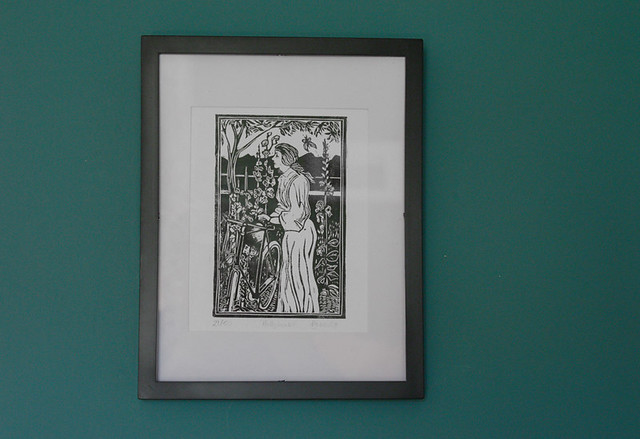
"Hollyhocks" Print, by Dave Flitcroft
My other acquisition is a lovely linocut print by Dave Flitcroft. Entitled "Hollyhocks," it is a small, intricate thing, based on an old Victor Bicycles advertisement, depicting a woman standing with her bicycle in a garden. Being a printmaker myself who works mostly with linocuts and wood blocks, this piece immediately appealed to me. It is not an image I'd be inspired to make myself, but I am glad that another artist was, because I enjoy looking at it on my wall. Combining my love of the printmaking medium with my love of old cycling adverts, it draws me in every time I walk past.

Dave Flitcroft - or Velo Dave - began making bicycle themed art as a hobby, but has recently opened up his own etsy shop called Art from the Bike Shed, selling mostly limited edition linocut prints. Have a look!

And if you like printmaking, another artist worth checking out is Mike Rubbo. On his website Sit Up Bike Art, Mike sells moody linocuts and rubbings, as well as paintings and drawings, with themes centered on utility and leisure cycling. 

"Hollyhocks" Print, by Dave Flitcroft
At one point or another, we all buy things to decorate our homes with. And if you're looking for cycling themed decor, it may surprise you to learn that handmade items and limited prints bought directly from the artist might set you back not much more than mass-produced trinkets. So why not support an artist and fellow cyclist?

Andy Arthur - aka the Magnificent Octopus - has become quite well known for his lovely and often hilarious posters (he even made one of me in his early days!). Christine Evans - aka Artist on a Bike - is one to go to for cycling themed cards. Bekka Wright - aka Bikeyface - sells t-shirts, bags, and other lovely things through her online shop. And of course there is the famous Taliah Lempert, who will create your very own unique bespoke painting of your bicycle.  

Have you any bicycle art in your home? Share your favourite pieces and artists!

Selasa, 08 Juli 2014

A Drafty Morning

Today something amazing happened to me on the way into town. I was cycling though the countryside,  half way through my usual 7 mile commute, when behind me I heard the put-put-put of a tractor. I scooted over toward the hedges and slowed down, to make it easier for the cumbersome heap of metal to pass me. And it did, huffing and creaking as it maneuvered around me on the narrow winding road. It was one of those smallish things with a flat-bed at the rear, piled high with freshly cut grass. These types of machines are not meant for the road and they move slowly - faster than a typical bicyclist, but closer to bicycle speed than car speed. In the cabin, the driver gave me a friendly wave as he passed. He then made some other gesture I could not make out and slowed down. I did not understand what he wanted at first. Why did he pass me only to slow down to a speed slower than mine? Soon I was a foot behind him and applying brakes. Now what? If I pass him, we will only play leapfrog.

Confusing me further, at this point the driver turned around, made eye contact and gave me a thumbs up. Then he began to speed up again. I followed suit, and as I did, it finally hit me what was happening: He was offering me to draft him!

Quickly I scanned the back of the tractor.  A metal ledge and a pile of cut grass; no sharp edges to impale myself upon. This was crazy, but what the heck!

As he increased his speed, I followed suit and increased mine, so that the distance between us remained the same. I did not have my computer, but by feel alone I could tell I was traveling faster than I would on my own power. It was just like riding in a paceline, sort of.

Occasionally, the driver would turn around and give me a questioning nod, like "speed still okay?" And I would reply with a thumbs up.

Cruising along at what was probably 25mph on my folding bike, I spun madly in my high gear feeling little resistance. It was just like that scene in Breaking Away, sort of. I kept expecting him to stick his fingers out the window to challenge me to daredevil speeds - three fingers, four, five! Alas, the rickety farm vehicle was no more capable of such feats than I.

At the next roundabout, the tractor turned off and I rolled into town, beside myself with giddiness in the flickering sunshine. There are plenty of drafty mornings. But not quite like this one.

Jumat, 04 Juli 2014

Room at the Inn? Accommodation Strategies for Bicycle Touring

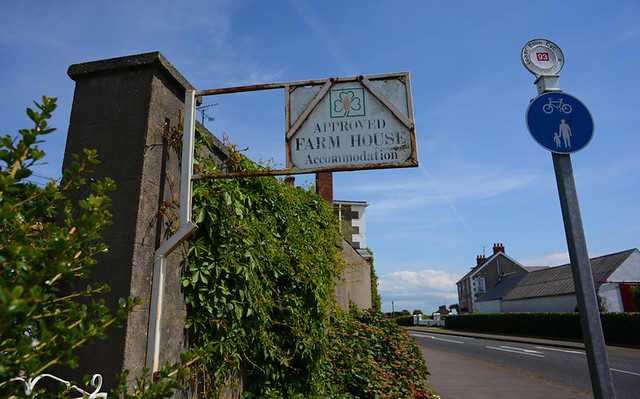
Approved Farm House Accommodation
Some years ago, an Austrian friend of mine planned a lovely bicycle tour around the west of Ireland. She put together a scenic route, booked rooms in B&Bs and hostels, took a week off work, flew overseas with her bike, and… had a miserable time! It rained every day, with visibility so poor she could hardly make out any of the scenery, and winds so strong she struggled to complete her daily milage. After a few days of this and with the forecast promising more of the same, she decided it might be better to stop and hang out locally instead of continuing to tour. So she tried to extend her stay at the B&B she'd last spent the night and cancel her other reservations. Unfortunately the B&B had no room for her to remain there for extra nights, and some of the places she'd booked ahead would not allow last-minute cancellations. She was essentially locked into continuing her tour. And she did, returning home with a pannier full of soggy clothing and pictures of blurry rainscapes. Now whenever someone mentions touring in Ireland, she grimaces and tells this cautionary tale. It was in fact what influenced me to pick a place and use it as base-camp for day trips, instead of touring from point to point, when I first visited in 2012. 

The thing about bicycle touring in Ireland, is that you have to be kind of flexible. There are stretches of beautiful, sunny weather here. And there are stretches of stormy, miserable weather. If you plan too far in advance or too rigidly, you might be committing yourself to a trip consisting entirely of the latter. And while normally I don't mind cycling in the rain one bit, with touring it's more than about being cold and wet. It's about wanting to experience the local scenery by bike. If all you are seeing is mist and sheets of rain, that rather defeats the purpose! 

Luckily for me, I do have some flexibility. What working freelance lacks in income, it makes up for in allowing for a degree of scheduling freedom. And so this summer I'd love to take advantage of this and try a little mini-tour. Nowhere far or exotic, but maybe to this little spot I like in County Sligo, just over 100 miles away. One day last month, when the forecast for the next few days looked good, I thought "Great, this is it!" and began to phone up B&Bs and hostels. But my spirits were quickly deflated when it turned out that most of them were booked, with the ones that weren't either costing a fortune or inconveniently located. Planning has its perils, but apparently so does spontaneity. 

There are other options of course, such as camping and asking around for contacts of people to stay with. One friend has even told me that he's toured all of Ireland, making no plans in advance what so ever but simply knocking on farmers' doors every evening. They would usually have a spare room where they'd let him crash - sometimes for a modest fee, and sometimes free of charge. I don't think I'd be quite comfortable with that, but it's nice to know that people can be so hospitable. 

For those experienced in touring, what are your strategies for securing accommodations? Do you book in advance, or take off and hope for the best? Do share your stories!

Rabu, 02 Juli 2014

Running and Cycling

Over the winter I wrote about my dislike of running, and moreover my inability to understand how someone could stick with something initially so painful and unpleasant. While cycling lured me in with its gentle, romantic demeanor, running had all the charm of a back alley beating - each encounter leaving me clutching my side, tasting blood and seeing stars. I have tried running at various stages of my life, usually as part of attempts at "fitness," and each time with the same result: hating every moment of it so much, that to continue after several efforts just felt like masochism. The same thing happened this winter. After 5 years of cycling and a general increase in fitness, I had hoped things might be different and, inspired by several local friends who are runners, gave it another try. Through sheer force of will I'd manage a mile up and down my lane, but again hated every agonising second of it so much that I soon gave up.

This makes what happened this summer all the more bizarre. One time I accompanied my boyfriend on his evening run - not to run myself, but to keep him company on the way there and back. I took my camera and wandered around photographing while he did his 10K. A short while later he returned, eyes glazed over and in a state of thorough depletion, yet so elated that he seemed to be levitating. Seeing him this way, something shifted in my perception of what running was, or could be. And I felt jealous - in an "I want what he's having!" sort of way. Next time I would try running too.

Cautiously excited that I actually wanted to do this, he offered some suggestions when I described the problems I've had in the past. Ankles hurt? Try hard sand or dirt instead of pavement. Lungs hurt? Start ridiculously slow. I replaced my 10 year old sneakers with a new pair of running shoes. And then off we went to the beach.

My first time I ran 3 miles on sand, slow and steady. I expected this to feel like some tremendous feat, but when I finished the loop I realised that I could have kept going. I had none of the symptoms of misery I recalled from previous attempts. My lungs were not coming out of my throat; I had no aches or pains. I felt a tightness in my legs, and I would have been bored out of my mind if it wasn't for the music in my earphones, but that is it.

The next time I ran 4 miles and felt much the same. This time I started slow and then sped up when I felt my energy increase on the return leg. Two days later I ran 5 miles in the same manner. And two days after that, I increased the distance to 7 miles. All of this was on sand - trying to pick a line close to the water, where the stuff is hard packed.

My boyfriend was greatly entertained by my sudden success with this activity I used to hate. He had not expected me to increase distances so quickly. At the same time, he felt I was not getting much fitness training out of the running if I was able to do it this way, my breathing close to normal at the end. He suggested next time I try a shorter distance but make it more intense. So we decided to cut back to 3 miles, but incorporate sprints - bursts of very fast running.

On the day of the evening we had planned to do this, I forgot about it and went on a 35 mile bicycle ride. Then on my way home I remembered, but figured I could still do the run since my bike ride was not all that long or intense and there would be a break of about an hour.

The result was interesting. Starting the run so soon after a bike ride, I felt a distinct shallowness in my reserve-pool of energy. At the same time, stretching out to run felt good as a contrast to my scrunched up position on the bike; it was as if my limbs and torso were unfurling.

While normally we run each at our own pace after the first few minutes, this time my boyfriend accompanied me most of the way to demonstrate sprints. We ran slow to start with, then increased the pace, then ran fast, then back to slow. On the return leg this was repeated more intensely, the fast part replaced with "as fast as you can." After doing this last bit, I had trouble catching my breath even after the final stretch of very slow running. My legs were killing me, my lungs were on fire, my entire body was overheated, and my heart was pounding so fast and so loud it blocked all other sensory input. But I wasn't miserable and I didn't hate it.

What changed this summer to make me not only able to run but actually enjoy it, I don't fully understand. But I do know that cycling the next day felt delightful …if a bit unnervingly easy!

Senin, 30 Juni 2014

Meditations on Early Ruin

Doing errands in the city today, I spotted a woman rolling what I took to be a pre-1960s loop frame roadster. From my vantage point across the street, the bike had a look about it, suggesting it had known better days: a wobble to the front wheel, a crimp to the rear fender, a lumpiness to the saddle, an orangey aura around the black silhouette suggesting a generous coating of rust, and a general ramshackleness that marked it as a tired, creaky, longsuffering thing. The rod brakes and generator bottle corroborated my impression of its age. By the time I reached the bike, the woman had locked it up to a pole and disappeared into a building. Carefully I approached to examine the decals - or what remained visible of them, as most of the frame's surface was caked in dirt and blighted with all manner of exotic fungal growths. When I finally could make it out, the writing surprised me: Gazelle Toer Populair. At first I thought the owner might have plastered new decals onto an old frame. But identifying features in its construction confirmed that I was looking at a retro, not a vintage bicycle, made, at the earliest, in 2009.

What could account for such exuberant decay in a machine only 5 years of age? I imagined the bike being tossed, as a prank, off the Peace Bridge into the Lough Foyle, where it served as a playground for aquatic life before being fished out by local boys and sold at a car boot sale. I imagined other scenarios, too. But even as I played them out in my mind, I knew the bicycle's real history was nowhere near that exotic. Though this specimen was one of the worst so far, I have met others here with prematurely aged bikes, with bikes in horrendous condition for which they have no particular explanation.

Ireland is a strange, damp place. Vegetation flourishes. Man-made things fall apart. Both can happen with breathtaking speed.

I am slowly renovating the house I live in, which, judging by its condition when I moved in, I had at first thought lay empty for decades. It was in fact last occupied just 3 years ago. In this time span, rot and mold had crept in with methodical determination, while on the outside weeds and stinging nettles the size of trees smothered the once-manicured garden, their roots cracking brick walkways and stone walls. The plastic on the decade-old kitchen counters had softened and browned in the manner of pre-war cellulose nitrate. In the upstairs bedrooms I peeled off decomposing wallpaper I was certain had been put up in the 1950s, to discover children's scribbles behind it with the date 2007. Even the overall age of the house is not what I had first assumed from its look and feel. It was built not in the century before last, but in the 1940s. I wonder now how many other lovely old houses I spot in the area are really fairly new constructions.

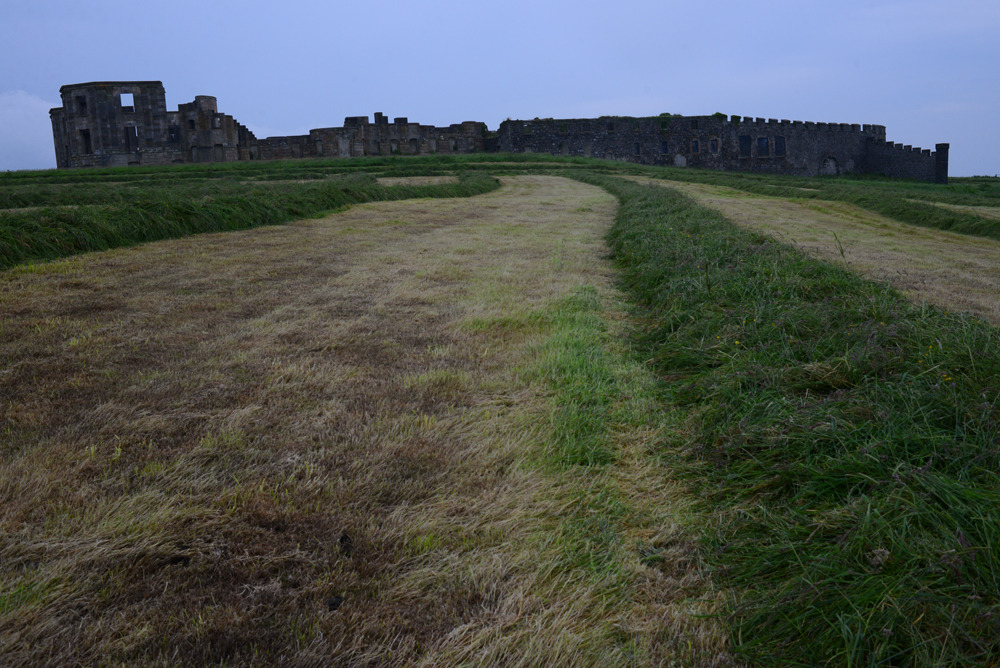
On a cliffside 4 miles down the road stands a North Coast landmark, the enormous skeletal remain of Downhill House. When new to the area and not yet familiar with this structure, I heard locals refer to it as "ancient" as if it were some excavated archaeological site or an early medieval castle. Considering that even from a distance I could spot obvious neoclassical elements, this struck me as unlikely. Still, when I looked it up I did not expect the dates to be as recent as they were: The latest version of the house was built in the 1870s and remained inhabited until after World War II, its trajectory toward disrepair beginning mid-20th century. To think that within that time, the sturdy-looking giant, built no doubt with the finest materials available in its day, became this roofless maze of crumbling stonework - so thoroughly dilapidated that locals (some of whom must surely still remember it intact!), prefer to playfully re-imagine it as an ancient ruin.

There is a trend in some circles of cyclists to celebrate - and even try to hasten - signs of aging on their modern machines. From tattered grips to chipped paint, even spots of rust and tiny dents, such things are cherished as evidence that the bike is authentic and "well loved." This trend can be observed all over contemporary culture, from distressed jeans to the "shabby chic" style of decorating. To a critical theorist, this hunger for decay is symptom of a desire for history in an ahistorical era. But I wonder also whether it is specific to areas where things tend to preserve well - decay requiring either many years or special effort. Here in Ireland, if I want "history" to happen to a modern bike all I need to do is leave it in the garden for a week, then watch it succumb to stunningly early ruin.
Rabu, 25 Juni 2014

Black and White

Two Very Different Takes on Step-Throughs!
42 centimeters, or nearly 17 inches! Any guesses what that figure refers to? Go on, think about it before I tell you. Anyone? 
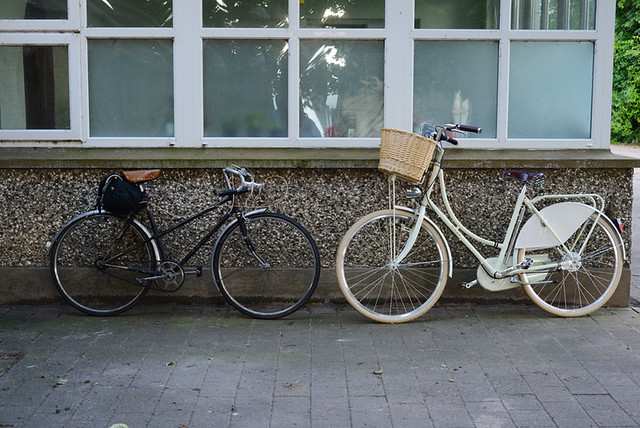
Over the past few weeks I've had under my guardianship two step-through bicycles that could not be more different from one another: a vintage Claud Butler Lady Lightweight that belongs to a friend, and a modern Mosi Carolina that was sent to me for review by the manufacturer. The former was essentially designed as a time trial bike (according to 1930s notions of what that entails) with all-arounder capability; the latter as a Dutch-style urban commuter. Switching back and forth between these machines has been an interesting experience - especially considering that 42cm is the difference in their handlebar heights! In fact I don't think I've ever ridden a bicycle that's quite as upright as the Mosi or quite as low-leaning as the Claud Butler. And to think that both of them can be described as step-throughs or "lady's bikes" - evoking a similar image while in reality being so different.

And yet, despite these differences what I found most striking about the two bikes was an attribute they had in common, aside from the low step-over: Both felt absolutely amazing to ride. Amazing in an entirely different way form one another, but amazing nonetheless, with each machine's handling feeling "just right" in the context of what that bike was meant to be. This is something not many people think about unless they are involved with product design or product reviews. But it is a core criterion based on which a product can be judged as successful. 

Recently, I was talking to a Belgian acquaintance who owns a shop selling European utility bikes, and who is also a former amateur road and track racer. In his opinion, if a Dutch-style bike feels "too upright" (and size/weight/fit are eliminated as the culprit), it is because there is a flaw in that model's design. A well-designed bicycle of its kind should feel as if it's supposed to be that upright, evoking an "Ooh, this is very different but very nice" type of reaction from even the roadiest of roadies, as opposed to a request to slam the stem. Similarly, a well designed utility bike of this type should not feel slow-rolling in action; subjectively it should feel as if its speed is just right for how fast you want to go while riding in that position. And he applies the same principle to what they refer to in continental Europe as "sports bikes" - that is, road-racing or touring bikes with drop bars. In theory, even to a rider new to the sporty side of cycling, a well designed roadbike should feel intuitive and safe after a minimal initiation period. If it doesn't, something is off. 

For the most part, I think I agree with this way of putting things. Though my own cycling experience so far is limited to just over 5 years, I've crammed a lot of pedaling time and a great number of bikes into those years. I have ridden bikes that did not feel "just right" to start with and so I'd try to wrangle them into being just right with mixed (usually not entirely successful!) results. I have also been lucky enough to ride bikes that have felt exactly right from the get-go. And the thing is, once you've had that experience you know it's possible. You know that not all bikes of the same category, even if they look similar and are similarly priced, are in fact the same in how well they perform the function they were designed to perform. Whether it is a city bike or a racing bike, or something in another category entirely, when a bike feels just right we tend to know it. Sometimes it really is black and white.

Selasa, 24 Juni 2014

Made with Pedal Power! The Velo Bagworks Tool Roll and Give-Away

Velo Bagworks Tool Roll
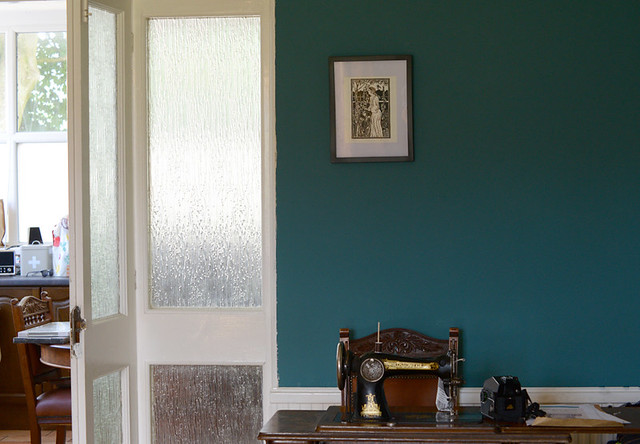
Aside from its miniature striped adorableness, what drew me to this Velo Bagworks tool roll was its maker Robert Anderson's claim to produce it "on a 1922 Singer sewing machine that doesn't even have a plug." Oh hello! Just minutes earlier I'd been sitting in front of my Singer Model 115 Sphynx of 1919 vintage, rocking the iron pedal in pursuit of finishing some curtains. Who needs electricity when you've got pedal power, eh? And how deliciously appropriate to make bicycle tool rolls for pedaling, by pedaling!

Velo Bagworks Tool Roll
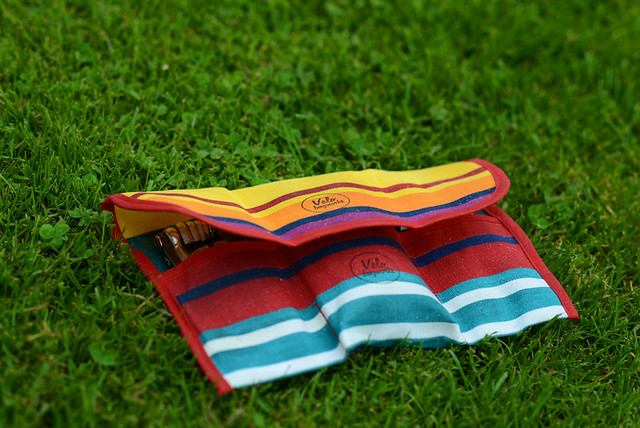
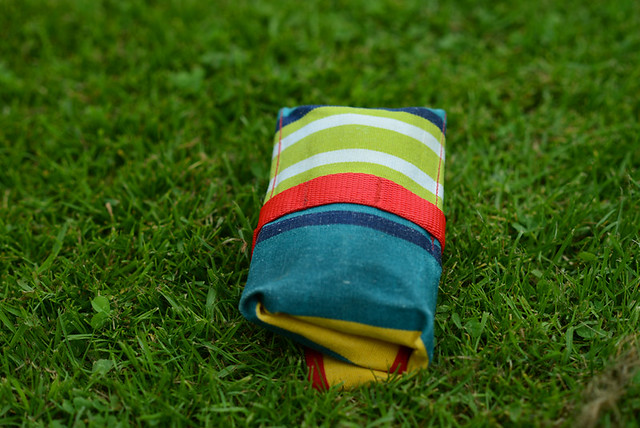
The minimalist, under-the-saddle tool-roll has become a popular offering from cottage industries and DIY enthusiasts. It is an item that is useful, fun and relatively easy to produce - allowing makers to offer a handcrafted product at a reasonable price. New to the market, Velo Bagworks tool rolls are made in Devon, England and sold via Robert's Etsy shop at around £15-20 apiece depending on fabric and pattern. Some are made from a PU-backed cordura and some out of waxed cotton canvas (pictured here), both reasonably waterproof. 

Velo Bagworks Tool Roll
There are several features of the Velo Bagworks tool roll that make it stand out from similar products of its kind. Firstly, it is among the smallest, most compact tool rolls I've ever seen. 

Velo Bagworks Tool Roll
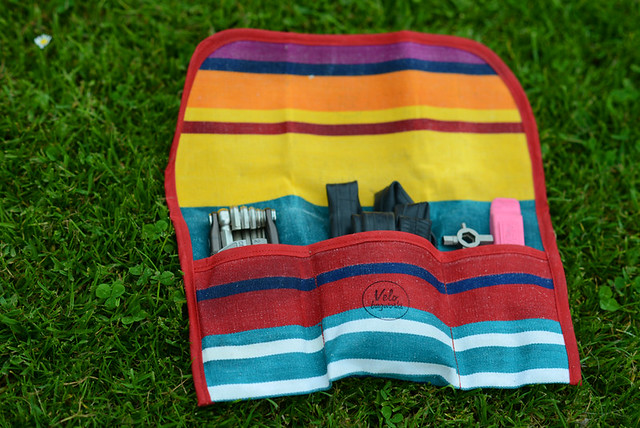
While large enough to fit the basics - including a good sized multi-tool, spare tube, tire levers, even a small pump or CO2 cartridge - it makes use of space with impressive efficiency and folds up neatly into a wallet the size of a large adult fist. For those who prefer their tool bags as small as practicable, this one is a good candidate.  

Velo Bagworks Tool Roll
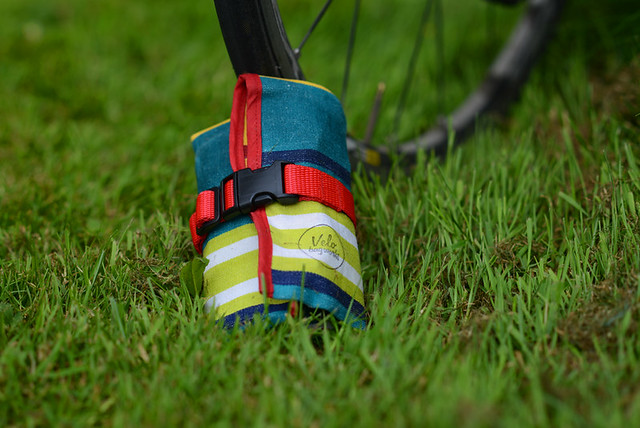
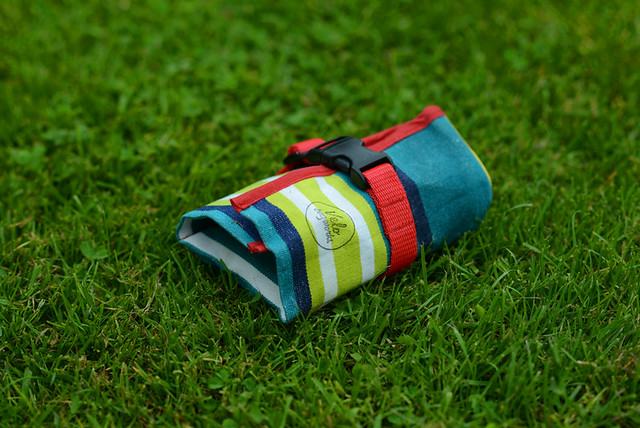
Additionally - and this is perhaps the more important feature to mention - the Velo Bagworks tool roll is designed to close and attach securely. The traditional "bike burrito" style tool roll is typically held together with a leather toe strap, which tightens around the roll but is not attached to it. As several cyclists I know who've used such bags have learned, this design carries a risk of losing the tool roll in action: It can simply slip out of the strap and you'll never know it! No such danger with the Velo Bagworks, as its lighweight nylon strap is sewn into the fabric of the roll itself.

Velo Bagworks Tool Roll
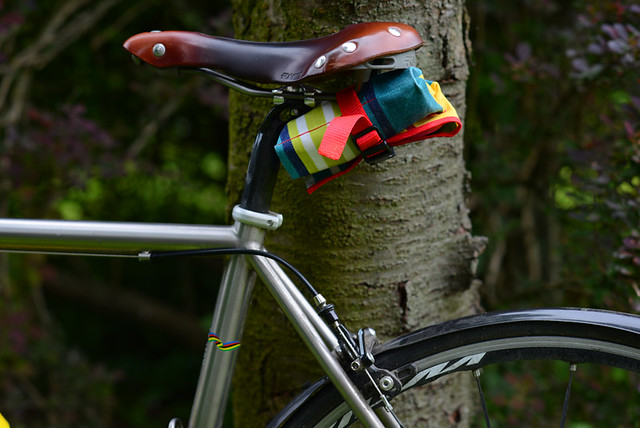
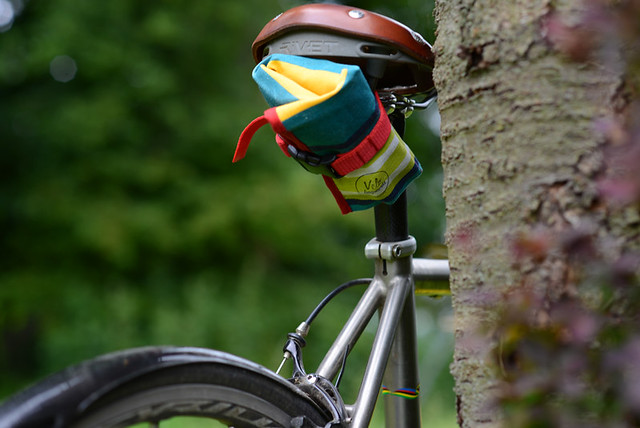
Threading easily through the rails of any standard bicycle saddle, the Velo Bagworks tool roll uses a snap-closure buckle, making it simple and quick to fit and remove, as well as to tighten as necessary. The roll is narrow enough to sit snugly under the saddle and does not interfere with pedaling. Because of the small size of the bag, those who like to clip a tail light to their seat post still might be able to fit it in if enough seatpost is showing.

Velo Bagworks Tool Roll
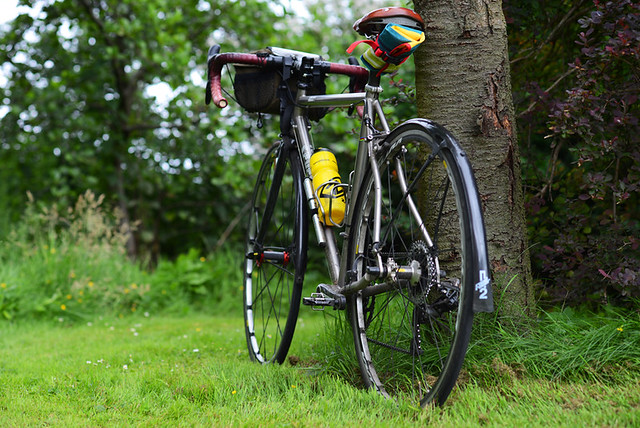
The Velo Bagworks tool rolls come in a variety of traditional colours, as well as these crazy "deck chair stripes" patterns. I love how the bright stripes look on my bare-metal bike, though they pretty much go with any bicycle colour. 

Velo Bagworks Tool Roll
If you like the look and sound of the Velo Bagworks tool roll, one of them could be yours at no cost. We would like to give away a similar roll to the one pictured here (the exact pattern of the stripes is a little different on each bag) to a Lovely Bicycle reader located in the UK or Ireland. 

If you'd like to take part in the give-away, simply leave a comment to that effect, and don't forget to include your contact email. And if you're in the mood to entertain, tell us: What is the strangest thing you've ever carried in your tool roll or saddle bag? Any bag-related adventures or misadventures? I'll get things started by admitting I've put an uncapped 1L bottle of water into a saddlebag...

Entries accepted till Thursday, 26 June, 11:59pm GMT. Many thanks to Velo Bagworks for the give-away, and, as always, thank you for reading Lovely Bicycle!